2.1Ac: Through experimentation, practice, and persistence, demonstrate acquisition of skills and knowledge in a chosen art form.
How do you feel that working with WATERCOLORS might take you to the next medium of Acrylic? Based on PAST EXPERIENCES… what similarities do you see being part of the process?
Reflection / Evaluation: Biggest accomplishment with the watercolor today? how have you seen GROWTH as an artist so far?
2.1P: Engage in making a work of art or design without having a preconceived plan.
Two weeks into sketchbooks – what are you accomplishing with the TOOLS drawing that you failed on in the CITYSCAPE – or what are you doing better in this week’s work?
Reflection / Evaluation: How have you SEEN your sculpture DIFFERENTLY now that you are DRAWING it versus BUILDING it? Do you have to continue working on it so that it is FINISHED for NEXT TUESDAY?
10.1Ad: Synthesize knowledge of social, cultural, historical, and personal life with art-making approaches to create meaningful works of art or design.
Not knowing what your thoughts are about plants / flowers, know that they have been and will be a large and important image in art. Working to make sure you have a REAL connection with the images you make, what are your personal connections to the art or the making of the art?
Reflection / Evaluation: What materials have you used today? What were the focal points of the drawings for the day.
3.1Ac: Engage in constructive critique with peers, then reflect on, re-engage, revise, and refine works of art and design in response to personal artistic vision.
Think about yesterday’s critique… How can you CONTINUE to consider the ELEMENTS and PRINCIPLES to be a successful and productive member of the oral critique?
Reflection / Evaluation: How are you falling short of being able to REALLY add to the critique? THIS IS A PART OF YOUR GRADE!
2.1P: Engage in making a work of art or design without having a preconceived plan.
What art materials are you REALLY interested in working with this year? Pencils? Paints? Camera? Clay? Collage? Something else? Explain your answer.
Reflection / Evaluation: What is ONE question that you still have about the course, department, or me?
AP Studio Art: English Computer Lab
Wayne Thiebauld: Doughnuts yum!
Goals:
1.2Ad: Choose from a range of materials and methods of traditional and contemporary artistic practices, following or breaking established conventions, to plan the making of multiple works of art and design based on a theme, idea, or concept.
What are topics / images that you frequently go to in YOUR collection of images as you draw / paint for yourself and NOT for class?
Reflection / Evaluation: What new materials are you exploring or looking to explore? What techniques are you attempting that are new to you?
Assignment ONLINE – Google Document – SHARE WITH ME at fkorb@waterforduhs.k12.wi.us! DUE ON MONDAY. CLICK HERE FOR A GOOD EXAMPLE. READ THE BRIEF BLOG POST! Where do you see yourself artistically now, where in 5 Years?
2.1P: Engage in making a work of art or design without having a preconceived plan.
What was the biggest challenge you found as you began coming up with ideas and drawing your cube, cylinder, or pyramid yesterday?
Reflection / Evaluation: What are 2 skills you have already that are going to make your experiences in Studio Art 360 easier?
AP Studio Art: Bag of Ideas?
Goals:
1.2Ad: Choose from a range of materials and methods of traditional and contemporary artistic practices, following or breaking established conventions, to plan the making of multiple works of art and design based on a theme, idea, or concept.
Where / when in your past have you used the ideas of the repetition of single object in a SERIES of drawings, paintings, artworks… something else?
Reflection / Evaluation: g been successful in TODAY’s beginnings of a CONCENTRATION?
Assignment ONLINE – Google Document – SHARE WITH ME at fkorb@waterforduhs.k12.wi.us! DUE ON MONDAY. CLICK HERE FOR A GOOD EXAMPLE. READ THE BRIEF BLOG POST! Where do you see yourself artistically now, where in 5 Years?
Drawing: Observation and Pencils?
Boxes, Objects, COMPOSITION!
Goals:
2.1Ac: Through experimentation, practice, and persistence, demonstrate acquisition of skills and knowledge in a chosen art form.
Most young artists work with their FIRST idea and that’s it. What might the benefit be to begin with MORE ideas? When you sketch in your sketchbooks / artworks… where do you mostly get your ideas from? How do you define OBSERVATION?
Reflection / Evaluation: What skills do you hope to develop this year in Drawing? What do you feel you will be able to improve on regarding the skills you have currently?
NVAS: 7.1P: Hypothesize ways in which art influences perception and understanding of human experiences.
Question to begin with: What three things do you see about the beginning of you LAST painting as successful? WHY? What are two things you need to REALLY focus on today? WHY? What is ONE thing you hope to accomplish today while you are out and about painting? WHY? How will ANY of this drive you forward in the creation of your work?
End of the Day Reflection (use the back of this page for more reflection space): Analyze the ELEMENTS That you are setting up as being the emphasis of your painting. How would you use sentences to DESCRIBE how you are using those elements to create a successful composition? WHY does that work for you? SECONDLY – REFLECT on your thoughts from yesterday about WHY you took / WHAT you were hoping to learn from this course. Now… at this point in the course, what HAVE you learned / taken away / appreciated / other thoughts about the course and YOUR WORK – your learning. WEDNESDAY NIGHT’S HOMEWORK – Write up a ONE PAGE (double spaced, Times New Roman, 12 point). You can create it in GOOGLE DRIVE and SHARE it with me… or bring it printed. Google Drive is BEST though. I can make changes, edit, proof, format it… Let me know if you have questions.
NVAS: 2.1Ac: Through experimentation, practice, and persistence, demonstrate acquisition of skills and knowledge in a chosen art form.
Question to begin with: What is it you KNOW about watercolors at this point in your art making career? Stop and think about this for a moment. Don’t RUSH your answer. Take a few minutes…
Looking at your paintings from the day (really look at them) what are three things that you are happy with? Be specific and elaborate on your comments. What are two things you discovered about the idea of painting out of doors (Plein Air)? What is one thing you look forward to tomorrow? Remember to elaborate.
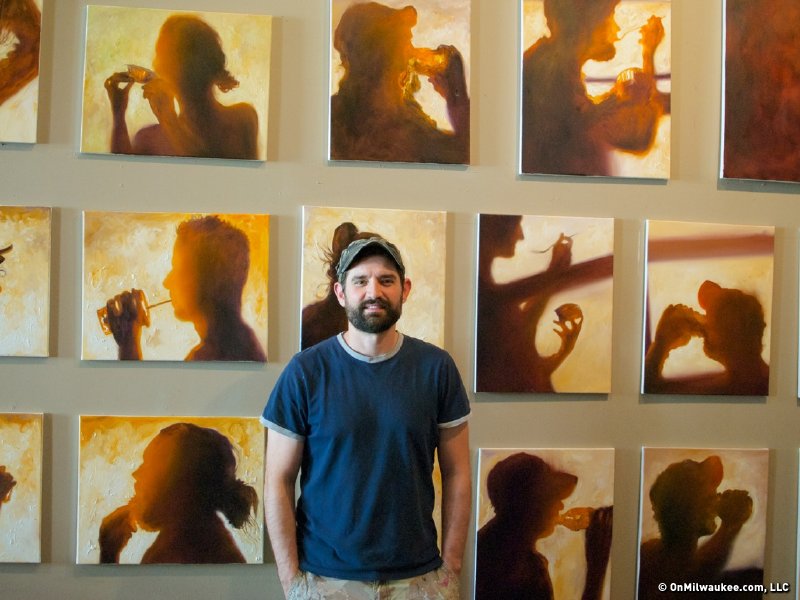
Thursday evening I had a wonderful opportunity to meet and speak with Todd Mrozinski about his artwork. In addition to the work in his “Shadow Series,” which consisted of 20+ (must be hundreds of paintings), Todd shared the Pop-Up Gallery installation in a former boutique at the Pfister. His work as well as the works of Timothy Westbrook’s are on display and the opening reception is this evening (Friday, June 12). Thank you to Todd and his wife Renee Bebeau as well as Pamela Anderson (from Milwaukee’s Plaid Tuba Gallery) and her husband Steven Kaishian for the wonderful conversation.
Also below is a great review of student created art inspired by the works of Midwest Artists from Frank Juarez’s (Sheboygan Artist / Educator) book Midwest Artist Studios (MAS). The link to the original site it here, but you can read my excerpt below. Please explore at all the student’s working and works HERE.
A Midwest Artist StudiosReflection, by Frank Juarez (and Frank Korb) – Here
Reflection on Todd Mrozinski and Silhouette Drawings
Written by Frank Korb, art teacher
2015 Drawing Class – Waterford Union High School
I introduced my students to Todd Mrozinski through theMidwestern Artist Studios Project workbook designed by Frank Juarez. In order to help my students better understand who Todd Mrozinski is, I used Frank Juarez’s writing and interview with Todd from the M.A.S. Workbook as well as looking at Todd’s website and video prepared as his application for the Pfister Artist in Residence. From there, we discussed the ideas and history behind diptychs and triptychs. The ideas behind the works were planned around the idea of working with a partner, learning about them as individuals and then working together to create works about one another through the same ideas of Todd – working with the Silhouette of one another and also working with the ideas of shadows cast from plants or trees. Originally, we were going to be creating a triptych and including the shadow of a person made object, one chosen by the partner in the pair, but because of time limitations we only had one artist get that far with the drawing.
In the very beginning, we introduced one another through learning the ideas behind the elevator pitch. Using an elevator pitch approach to introduce themselves gave them a good understanding about who they are, what they believe in, how they make art, what their ideas about life and art. From there we all went outside and looked at shadows and the partners worked together to choose which types of plant shadows to trace. The artist traced the shadow their partner liked or felt symbolized them. They then traced the sitters silhouette. From there we all worked in studio and created these wonderful images through the use of oil pastels. Over these quick 2 weeks or so, a large assortment of strong and conversation starting compositions were created. Works were focused on the positive and negative space the silhouettes created while also being built up upon the idea of color scheme. Working together gave the artwork a collaborative element that previous works did not have. Students were a bit apprehensive about the use of oil pastels, but this was a good choice as time was of a concern. Oils have a quality that really show the mark of the artist and this showed through in many of the works. A few thoughts about the next time that this lesson is taught are to allow more time to work, a mid-critique, as well as a field trip to Todd’s studio in Milwaukee.
Each class period began with a virtual trip to Todd’s gallery and discussion about a few works. Personal written reflection happened at the end of each day with students thinking about and responding to the successes and failures that they were experiencing in the work. When we had about a week left, I provided an online written critique (google forms) for them to use as their final exam. All said and done – kids came into the final exam period with their finished artwork, Skype TV turned on, and Todd, my students, and myself I met up online to talk about the ideas and works that were created.
Over the course of two days and two separate classes, 20 kids each, a 1 1/2 hour time period we had GREAT critiques, conversation, and reinforcement of many words I spoke of earlier. Todd added a lot of new ideas about intention and symbolism, compositional ideas that were new ideas for the students. The young artists were very interested in Todd’s comments, critique, and support about the work. Discussion of the works was very strong and the students took to the conversation with elements and principles in mind with interpretation becoming even more a highlight. I sincerely hope that the ideas spoken about are carried forward into the individual student work.
During the first week of summer vacation, I put out a brief survey to the kids that asked four questions. 1) What are THREE (3) highlights that you found, experienced, or achieved in the working on your shadow / color scheme drawings? 2) What are TWO (2) suggestions you suggest for the next time this artwork / experience gets taught? 3) What is the ONE (1) thing that you feel you will remember / use in the future that you learned from this work of art? 4) Do you have ANYTHING ELSE that you would like to add? Please let me hear more of your thoughts. Survey resultsHERE. While I am not expecting a lot of responses, summer vacation having started, I do hope to get a few comments in about the project. My students works as well as images of the kids in the process of working and critiquing can be seen through this link: https://goo.gl/UgFmbo.
TheMidwest Artist Studios™ Project is supported by a grant from the Kohler Foundation, Inc and the Wisconsin Art Education Association.
1.2Ad: Choose from a range of materials and methods of traditional and contemporary artistic practices, following or breaking established conventions, to plan the making of multiple works of art and design based on a theme, idea, or concept.
Look at yesterday, this past week, the past three days. What is ONE THING that got accomplished? What are two things that have interfered and need to be resolved and worked on today? As a group have the conversation and GET TO IT!
How much time are we going to be working on this project? The year is coming to a close. This is quite possibly going to be the last major work – beyond the art show… What do you all need to do to continue the success of the work?
Advanced Drawing: Self Portrait Time – You are on your own!
NATIONAL PORTRAIT GALLERY – Visit it via Google HERE and the .org site HERE.
Elaine DeKooning Self Portrait: Washington Post Article: http://www.washingtonpost.com/entert https://img.washingtonpost.com/wp-apps/imrs.php?src=https://img.washingtonpost.com/express/wp-content/uploads/2015/03/Elaine-de-Kooning-Self-Portrait-NPG_94_81.jpg&w=1484
1.2Ad: Choose from a range of materials and methods of traditional and contemporary artistic practices, following or breaking established conventions, to plan the making of multiple works of art and design based on a theme, idea, or concept.
How does the freedom of this work 1) put you at ease and 2) scare the heck out of you?
What NEW ideas have you come up with today? What advances are you making? This is a FASTER work than you might be used to – WORK in and out of class to continue to resolve this image(s).
2.1Ac: Through experimentation, practice, and persistence, demonstrate acquisition of skills and knowledge in a chosen art form.
Looking at yesterday – Wednesday – What’s happening in the drawings that draw you in? Seriously – what’s interesting and strong about the ideas in your work?
What are you taking home this week this weekend? Why is it important to make strides and visual accomplishments in this drawing for you? TWO REASONS!
2.1P: Engage in making a work of art or design without having a preconceived plan.
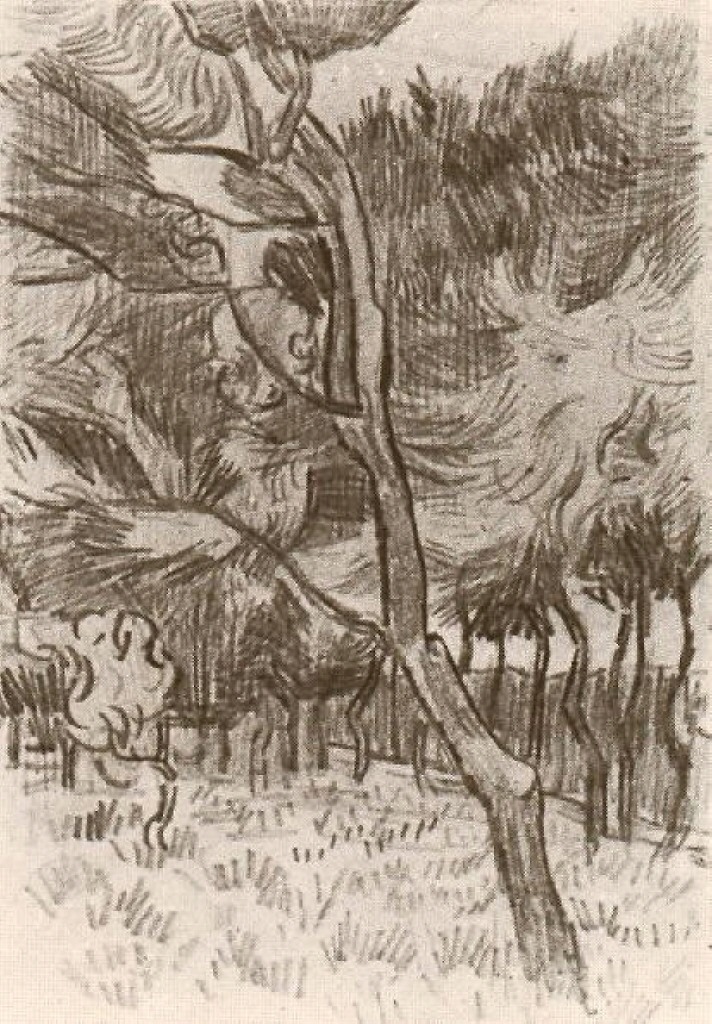
What are THREE THINGS you are SKILLED with as it comes to DRAWING? Today we are GOING OUTSIDE to DRAW from the ideas of TREES. Positive and Negative Space – Observation.
What was your biggest challenge in the drawing from observation? What are 2 things that were a challenge as you were looking at a REAL object? Vincent van Gogh Trees Outside of the Asylum:
HERE is the GROUP SLIDESHOW that we will ALL put our BEST image from the rubric into and share! All DUE on Monday at Midnight!
1.2Ad: Choose from a range of materials and methods of traditional and contemporary artistic practices, following or breaking established conventions, to plan the making of multiple works of art and design based on a theme, idea, or concept.
Before you leave for the day – thank our model for the time and posing – it is a lot of work! What is the ONE THING you are most satisfied with in your drawing today? WHY?
What did it for you to WRAP THIS DRAWING UP? Share a small thought with your classmates about this process – product?
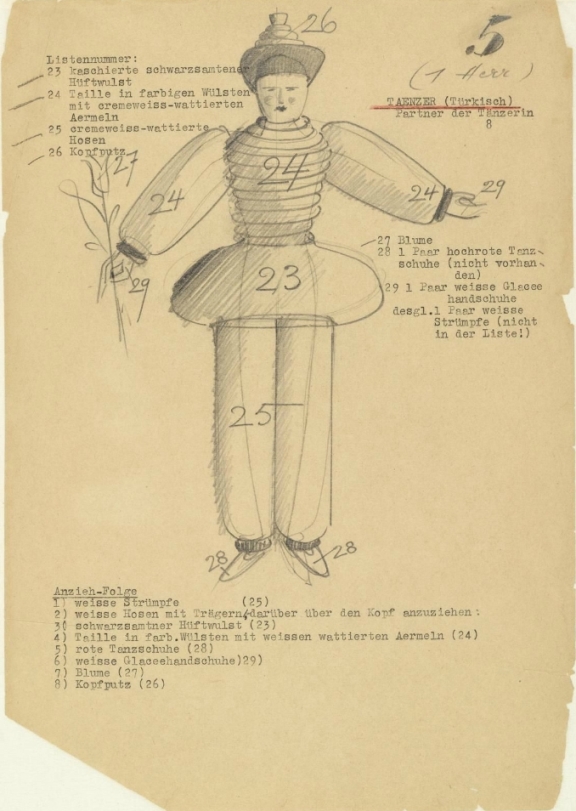
Advanced Drawing: Bauhaus Drawing – Oskar Schlemmer
7.1Ac: Recognize and describe personal aesthetic and empathetic responses to the natural world and constructed environments.
Of ALL the aspects of the face – what are you having the most success with and what is the most challenging? What is hardest about the most challenging part?
What was it about the FACIAL FEATURES of your chosen face that made for a SUCCESSFUL and at times CHALLENGING drawing?
“There is an immeasurable distance between late and too late.” —Og Mandino
Please Play for ALL Classes.
AP and Advanced Drawing Intro Video:
AP Studio Art: REGISTRATION in due TOMORROW!!!
Ideas? What’s going on in your head?
Goals:
2.1Ad: Experiment, plan, and make multiple works of art and design that explore a personally meaningful theme, idea, or concept.
What have your previous sketches been over the past months? How have you been planning the NEW and Important ideas out for your work? HOW DOES THIS HELP YOU?
What have you come up with? What materials are you using that help you to challenge yourself? How does it fit into your current body of work? How does it REACH OUT into NEW IDEAS?
Advanced Drawing: Stairway Drawing.
Your Paper Bag Drawings are HERE. Copy YOUR image into YOUR document! Questions – ask me on Wednesday.
DO NOT GO UPSTAIRS TODAY! ACT Testing… Thanks. Goals:
2.3Ad: Demonstrate in works of art or design how visual and material culture defines, shapes, enhances, inhibits, and/or empowers people’s lives.
What type of images have you created in the past REGARDING PERSPECTIVE? What was visually successful in the composition? What was technically successful in your execution? Same with the unsuccessful aspects? Share with your neighbor. Use of (Element) to create a unified artwork.
What was the success in today’s drawing? What was the challenge? Back out Thursday for preliminary drawings.
RUBRIC LINK, but it should ALREADY be in your Google Drive. SHARE it with me...
Drawing: Oil Pastels!
Goals:
7.1Ac: Recognize and describe personal aesthetic and empathetic responses to the natural world and constructed environments.
Reflect on YESTERDAY before you begin today! What worked? What didn’t?
Biggest struggle / success for today? Write it out and the WHY!
By The Way… Share your STILL LIFE DRAWINGS by visiting them HERE.
1.1P: Use multiple approaches to begin creative endeavors.
Looking at the ROMARE BEARDEN collage on the screen, what do you think this work is about? WHY? Please work with your neighbor on answering this question.
What is the most challenging aspect to creating a collaborative work of art? What did you feel will be helpful in working with a classmate? What did you feel will be a challenge?






 Art With Korb