3.5 evaluate and defend how (3.5.2) symbols (your choice in pattern) are used in art
Use SKILL and AWARENESS in the process to create SUCCESSFUL works of ART.
After you have worked on this pattern, do you thinking that it describes you? What about it does the best job in describing you? What might you change?
(2.1.4) form criticism about Still Life that works to demonstrate one’s understanding of value, composition, observation.
What do you feel was the MAJOR aspect of the crit. that YOU NEED TO WORK ON? What do you see as the benefit of the Crit. What do you see as a downfall / challenge? What NEW did you add to your understanding of your work? What about what you have added to your classmates ideas?
5.4 reflect on interpretations as a means for understanding and evaluating art
5.5 evaluate responses to works of art for communicating 5.5.1 rationale 5.5.2 ideas
What bit of advice did you get from your classmates that you will be able to put to use? What bit of advice did you give that might be used elsewhere? What are your goals for the next work(s) that will show your development?
(1.2) Create art that demonstrates an understanding of how your ideas about yourself relate to the principle of pattern.
(3.2) Apply ideas in art to solve visual challenges and communicate ideas (Who are you? How do you represent that?).
How did talking with your neighbor make your drawing look different to you? What made it difficult to speak about your work and / or your classmates work with the critical eye? What is successful in the watercolor beginnings? What is unsuccessful?
Drawing: Written Critique – DUE SUNDAY at MIDNIGHT
(2.1.4) form criticism about Still Life that works to demonstrate one’s understanding of value, composition, observation.
Digital Citizenship – Students understand human, cultural, and societal issues related to technology and practice legal and ethical behavior.
Self –evaluation: What have you taken from the crit. written by yourself? What do you need to finish up for Sunday’s final online critique? (2, 5). We will be making photographs and inserting them into the paper also.
AP Studio Art: Outdoor inspired and CONCENTRATION 9 and 10… Ideas
4.1 recognize differences in historical and cultural contexts of art (how is your Earth inspired art different than the works we have been looking at? Why is it important in 2014? How does it relate to you?)
4.2 describe the purpose and meaning of art objects within different cultures, times, and places… You – 2014?
With this OUT OF THE BOX (out of the doors) assignment… What struggles are you facing> Where are you falling in the snow? What are your challenges?
(5.3) Describe meaning of artwork by analyzing technique of watercolors.
(3.2) Apply ideas / understanding of watercolors and PATTERN to define who YOU ARE.
What variations of lines are you using? Where do you find it easiest to use the idea of line / contour to represent the face / form? What is the most challenging portion of the face to successfully create? What pattern did you use to design your background for this work? Share with your classmates
(2.1.4) form criticism about Still Life that works to demonstrate one’s understanding of value, composition, observation.
NETS: Students demonstrate a sound understanding of technology concepts, systems, and operations.
SNACKS on THURSDAY! CRITIQUE SITE HERE! Self –evaluation – What have you taken from the crit. written by your classmate? What do you need to finish up for Wednesday’s critique?
3.2 apply subjects, symbols, and ideas in art and use skill to solve visual challenges
2.6 create multiple solutions to visual challenges that show understanding in relationships between composition and meaning of artwork
What were the biggest impressions you had from going outside for ideas? What were the most difficult things you felt as you presented your work? Conversation between classmates about the 2 questions for your exam. How does this work relate to your concentration? AP Art: Earth Art / Concentration Work
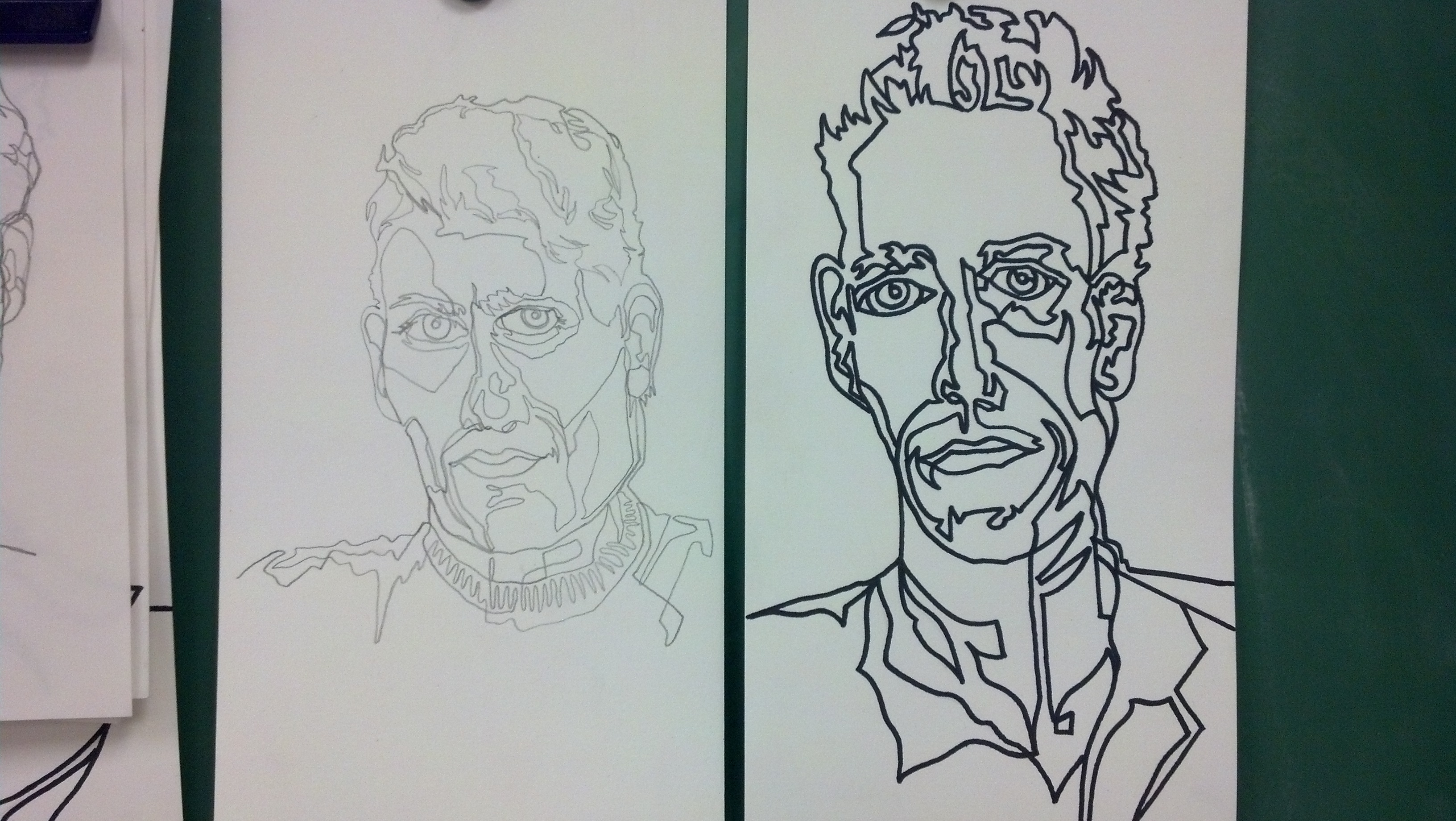
(5.3) Describe meaning of contour self-portraits by considering your line and attitude.
(3.2) apply watercolor techniques to solve visual challenges (and define ideas for your portrait background).
What types of lines are you in favor of using? Where do you find it easiest to use the idea of contour line to represent the face / form? What sorts of pattern do you think you would like to recreate with the use of WATERCOLOR to represent YOU? Share with your classmates.
“Great works are performed not by strength but by perseverance.” – Samuel Johnson – Let’s Check out P60 in Binder – Remember that you can switch next week’s sketchbook assignment with one of these Artists Habits of the Mind…
Art Foundations: Contour Line Portraits – Pattern –Watercolor and VIDEOS for Watercolor Techniques!
(1.2) Create art that demonstrates an understanding of how your ideas relate to materials, techniques and process. G: Work on contour / chiaroscuro drawings – still life.
Understand the contours and value that you are working on in your composition.
Pair / Share – self – evaluation of the day – best and worst. What do WRAP UP over the weekend?
1.4.3 evaluation [critique] (formative and summative reflections about your artwork) of your artwork through digital media. (Technology Operations and Concepts and Communication and Collaboration)
What are the upcoming challenges that you see coming for next week?
“Great works are performed not by strength but by perseverance.” – Samuel Johnson – Let’s Check out P60 in Binder – Remember that you can switch next week’s sketchbook assignment with one of these Artists Habits of the Mind…
HOMEROOM:
Art Foundations: Contour Line Portraits – Pattern –Watercolor
(1.2) Create art that demonstrates an understanding of how your ideas relate to the principle of pattern.
(3.2) Apply ideas in art to solve visual challenges and communicate ideas (Who are you? How do you represent that?).
How did talking with your neighbor make your drawing look different to you? What made it difficult to speak about your work and / or your classmates work with the critical eye?
5.4 reflect on interpretations as a means for understanding and evaluating art
5.5 evaluate responses to works of art for communicating 5.5.1 rationale 5.5.2 ideas
What bit of advice did you get from your classmates that you will be able to put to use? What bit of advice did you give that might be used elsewhere? What are your goals for the next work(s) that will show your development?
“Great works are performed not by strength but by perseverance.”– Samuel Johnson – Let’s Check outP60 in Binder– Remember that you can switch next week’s sketchbook assignment with one of these Artists Habits of the Mind…
Art Foundations: Contour Line Portraits – Pattern – Watercolor
(5.3) Describe meaning of artwork by analyzing technique and use of pattern.
What variations of lines are you using? Where do you find it easiest to use the idea of line / contour to represent the face / form? What is the most challenging portion of the face to successfully create? What pattern did you use to design your background for this work? Share with your classmates.
Drawing: Self-Evaluate, Value, Still Life – Who was Morandi?
3.4 evaluate and defend the validity of this still life for ideas toward current / future works.
(1.2) Create art that demonstrates an understanding of how your ideas relate to drawing pencils and observation.
What are your thoughts about the idea of the composition / white objects as subject matter? WRITE THAT IN YOUR GOAL SHEETS. Why do you feel this is worthy / unworthy / simple / complicated? What is working? What can you take forward to the next assignment?
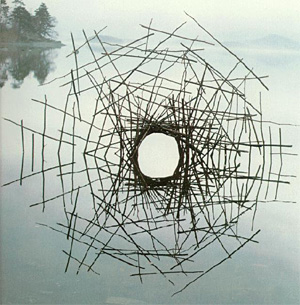
AP Studio Art:Thanks Carmel – here we go! Andy Goldsworthy onTumbler.
(1.4) Solve visual challenge of CONTOUR LINE DRAWINGS and OBSERVATION using analysis (element of Line and breaking the face into parts… lines).
What is the most challenging aspect of the portrait / line? What emotions have you chosen to represent yourself? Why? What variety of lines do you hope to use in the process of creating your self-portrait?
Drawing: Self Evaluation (ALWAYS) and DRAW DRAW DRAW!
3.2 apply subjects, symbols, and ideas in art and use skill to solve visual challenges
3.4 evaluate and defend the validity of sources for ideas – GOING OUTSIDE – Get Your Coats…
What were the biggest impressions you had from going outside for ideas? What were the most difficult things you felt as you presented your work? Conversation between classmates about the 2 questions for your exam. How does this work relate to your concentration
Welcome to KorbArtWuhs.WordPress.com… take a walk around, stretch your legs, get a feel for the landscape. Here is where I begin and end all of my classes, while also providing a resource for my students, their parents, as well as teachers and students around the world.
Know about how one teacher uses daily goal setting and interaction in the classroom.
Know about the use of a website as a communication tool both inside and outside of the classroom.
Know about how using a students prior knowledge can help set the stage for better understanding of the topic at hand.
(Originally Posted: June 26, 2013) Technology in the classroom was my big presentation at this years InterActiv Learning Conference 2013 in Whitewater, WI. My largest concern with the use of today’s technology is the misuse of it. Having had an opportunity to listen to a new Freshman in High School (not mine… well, my kid, but not my district) discuss the use (or in some conversations that stand out – misuse) of important resources such as YouTube and Google it struck me that the conversation of how we use technology in the classroom as a learning TOOL and not as “bells and whistles” to entertain or simply to “connect” with the kids was important.
Technology and Interaction in the Classroom (link to my Google Presentation is HERE) was the presentation I had at the conference and I really wish I had heard Michael Wesch’s 201o Presentation at the University of Denver prior to my presentation. The good news (maybe for me) is that I am working in the direction he speaks about in his lecture (link to his presentation is HERE). To keep this brief (and give you a chance to watch his presentation) I feel the most important part of his lecture was to emphasize that the INFORMATION out there is NOT SCARCE and the student of today has all the access to it, in their pocket! The important thing to keep in mind, and this is a brain shift for all in education (kids, parents, teachers, administrators, school board members… everyone), is that the teachers need to help the kids learn HOW to use the technology to be self directed learners. The kids sure know how to entertain themselves with the internet… but strong learners of Web 2.0 tools they are not.
How can we, as teachers, use the tools that are out there to help the kids LEARN how to LEARN? How do we demonstrate the tricks of the trade, the skills that are essential in the process of learning so that the students we have the privileged to work with, can become more independent learners? One of the tricks of using the technology (information really) that is out there is to make sure we are teaching them how to CONNECT to it and not to simply learn it all for the test. This also ties into the thoughts of Noah Chomsky (HERE for a YouTube video Presented at the Learning Without Frontiers Conference – Jan 25th 2012- London) that the TEST is not a very good demonstration of the knowledge the kids have. Yes, maybe for the day and a few weeks later, but then – POOF – that is gone. How can we, as concerned educators and leaders, help the learners make sure that the information we provide them with connects to the world they are living in? The tools are there, and they will be using them for as long as they live. How can we connect the tools, the information that is available, and the techniques to gather, toss aside, sort, filter, and use that information is through demonstration by example, teaching and reteaching, and reviewing the importance of being aware of how the tools and information is to be used.
Kids Say the Darnedest Things
Knowing that sketchbooks and goals will ALWAYS be part of the courses, what is one suggestion that you have to offer for future classes? What are some suggestions you may have to help the class become even stronger or more fulfilling than it already is? These require explanation please.
“Make the goals so that everyone does them and doesn’t slack. It helps my brain learn from the beginning of class and I know it will help others.”
“To take the goals and understand them not just write them down.”
“The goals were kind of hard to understand when looking back at them. It’s easy to understand when you explain. but the way they are written down is tricky to look back at.”
BREAKING ART NEWS! Francis Bacon Triptych Sells for $148 Million
What does $148 Million Dollars Look Like? This! Click on the painting above to read the BBC Article on this Auction record and see the video. Munch must be SCREAMing in his grave! [This] “File photo shows a journalist looking at Francis Bacon’s paintings ‘Three Studies of Lucian Freud’ (1969) during an exhibition at the Borghese museum in Rome, on September 30, 2009 (AFP/File, Vincenzo Pinto)”
“Power will accomplish much, but perseverance more.” — William Scott Downey
It is all in how you line things up…
Art Foundations: Two Point Perspective – FINAL PROJECT!
Richard Estes – Painting of a Cityscape… What has your cityscape / neighborhood scape got in it?
CITY SCAPE / NEIGHBORHOOD EXAMPLES: HERE – Under Art Foundations: Neighborhoods / City Scape Link
Broad Museum RIGHT NEXT TO GEHRY’s in LA. Click on image for 3 minute video.
Goals
Evaluate the effectiveness of your artwork.
Review with neighbors the progress of the cityscape and the proper use of 2 point perspective. What are the big challenges you are facing with the buildings?
Advanced Drawing: Hallway Drawings – Oils? I Hope So!
While this is ONE point perspective… how have they used COLOR to RAMP THINGS UP?
Goals
1.2 create art that demonstrates an understanding of how your ideas relate to the 1.2.1 materials and 1.2.2 techniques
What do you need to do differently for tomorrow to be successful with these materials in the hallways? How did today go?
AP Studio Art: Concentration and ADVENTURES (click THERE for the story)… PHOTOGRAPH? Build your digital portfolio.
AAArghh.. Although he is NOT a very scary pirate… not in the least.
Goals
1.2 Create works of Visual Art that demonstrate an understanding of how the communication of your ideas relate to the 1.2.1 media, 1.2.2 technique 1.2.3 and process you use.
2.3 Create artworks that use organizational structures and functions to solve specific visual art problems – How are COMPOSITION and ORGANIZATION holding your work together to COMMUNICATE your message?
Working in class over the past 2 weeks – what have you accomplished – SHARE! What did you accomplish today? What do you need to do tomorrow?




 Art With Korb