#Day2, Let’s make some #ART and get through some #Philosophy

What is Art? – “Art is the concrete representation of our most subtle feelings.” Anges Martin, Art In America (p.124, 1996)

I Could do that

Folder: Everyone – Page 7. Let’s talk about 10 Lessons the Arts Teach Children (everyone).

Painting and Advanced Painting: Preliminary ideas and exercises

Turner Norham Castle at Sunrise: http://www.tate.org.uk/art/images/work/N/N01/N01981_9.jpg – TATE MODERN

Goals:

  • 1.2Ac: Choose from a range of materials and methods of traditional and contemporary artistic practices to plan works of art and design.
  • What made it challenging to put that first mark on your paper? Unless you had no problems – then what was it that gives you confidence in painting?

Reflection / Evaluation: What three things did you succeed with today in  your painting? AT THIS MOMENT?

Studio Art 360: Observation Anyone?

ROBERT INDIANA: Love: http://whitecubediaries.files.wordpress.com/2013/02/3923768734_6b16394256_z.jpg

Goals:

  • 2.1P: Engage in making a work of art or design without having a preconceived plan.
  • What was the biggest challenge you found as you began coming up with ideas and drawing your cube, cylinder, or pyramid yesterday?

Reflection / Evaluation: What are 2 skills you have already that are going to make your experiences in Studio Art 360 easier?

AP Studio Art: Bag of Ideas?

Goals:

  • 1.2Ad: Choose from a range of materials and methods of traditional and contemporary artistic practices, following or breaking established conventions, to plan the making of multiple works of art and design based on a theme, idea, or concept.
  • Where / when in your past have you used the ideas of the repetition of single object in a SERIES of drawings, paintings, artworks… something else?

Reflection / Evaluation: g been successful in TODAY’s beginnings of a CONCENTRATION?

Assignment ONLINE – Google Document – SHARE WITH ME at fkorb@waterforduhs.k12.wi.us! DUE ON MONDAY. CLICK HERE FOR A GOOD EXAMPLE. READ THE BRIEF BLOG POST! Where do you see yourself artistically now, where in 5 Years? 

Drawing: Observation and Pencils?

Boxes, Objects, COMPOSITION!

Goals:

  • 2.1Ac: Through experimentation, practice, and persistence, demonstrate acquisition of skills and knowledge in a chosen art form.
  • Most young artists work with their FIRST idea and that’s it. What might the benefit be to begin with MORE ideas? When you sketch in your sketchbooks / artworks… where do you mostly get your ideas from?  How do you define OBSERVATION?

Reflection / Evaluation: What skills do you hope to develop this year in Drawing? What do you feel you will be able to improve on regarding the skills you have currently?

A #NewSchoolYear! #Art is #AWESOME

WELCOME BACK!

Please take some time and SUBSCRIBE or FOLLOW this website (look to the right of this screen). You will get up to date information about this class and all that we are doing during the day – WAY AHEAD OF CLASS TIME! Woo Hoo! If you are NOT in my class… THANK YOU for visiting!

What is Art?

“Art is the concrete representation of our most subtle feelings.” Anges Martin, Art In America (p.124, 1996)

Agnes Martin at the Tate in London: http://www.tate.org.uk/art/images/work/T/T01/T01866_10.jpg

I Could do that

Folder: Everyone – Page 6. Let’s talk about SUCCESS in ART.

Painting and Advanced Painting: Let’s Start With Watercolors

Turner (Bio) – Norham Castle at Sunrise (http://www.tate.org.uk/art/images/work/D/D40/D40191_10.jpg)

Goals:

  • 1.2Ac: Choose from a range of materials and methods of traditional and contemporary artistic practices to plan works of art and design.
  • What techniques do  you remember from your earlier classes about WATERCOLOR PAINTS?

Reflection / Evaluation: 

  • What difficulties do you see with your painting AT THIS MOMENT?

Studio Art 360: Observation Anyone?

Robert Indiana (Bio): Numbers: (http://farm3.static.flickr.com/2277/1750965577_f7ee03962d.jpg)

Goals:

  • 2.1P: Engage in making a work of art or design without having a preconceived plan.
  • How do you draw something in 3 dimensions? What are different techniques you know? Sit with your neighbor and BEGIN with a box, a cylinder, a pyramid, and the first letter of your first or last name. NO OBSERVATION – Talk about and visually demonstrate the ideas in your GOALS PAGE!

Reflection / Evaluation: 

  • What are 3 things you hope to learn in this room? END OF CLASS – Stand up – Think about what you are hoping to learn – in ONE WORD (and you cannot repeat another person’s comment) Your name and then your word. That’s it. Speak it out loud.

AP Studio Art: Bag of Ideas?

Wayne Thiebauld : Cakes. http://thumbs.media.smithsonianmag.com//filer/thiebaud-cakes-631.jpg__800x600_q85_crop.jpg

Goals:

  • 1.2Ad: Choose from a range of materials and methods of traditional and contemporary artistic practices, following or breaking established conventions, to plan the making of multiple works of art and design based on a theme, idea, or concept.
  • What is your understanding of AP Art? How do you plan on using your skills to make the best you can? Talk to your classmates about this – write this in your GOALS folder.

Reflection / Evaluation: 

  • Art From OBSERVATION – What are / were you able to create from the materials in your bag of ideas? This is what you will use to create a small body of works this week… Drawing / Painting / Photography / Sculpture / Whatever? What is the interesting – worthwhile object(s) and how do you relate to it? 5 different artworks – all from the same focus / visual starting point.

Drawing: Observation and Pencils?

Group of Boxes: What can you do to make an interesting COMPOSITION? http://jetantonio.com/wordpress/wp-content/uploads/2010/11/box.jpg

Goals:

  • 1.1Ac: Individually or collaboratively formulate new creative problems based on student’s existing artwork.
  • What is it that you think about when you think about what IS art? (SHARE WITH FRIEND) What is it you think about when you think about making art?

Reflection / Evaluation: 

  • What are 3 challenges or successes you had with your first few thumbnail drawings about the boxes? THINK COMPOSITION.

12 Things You Were NOT Taught About Creative Thinking

Aspects of Creative Thinking are not usually Taught
  1. You are creative. The artist is not a special person, each one of us is a special kind of artist. Every one of us is born a creative, spontaneous thinker. The only difference between people who are creative and people who are not is a simple belief. Creative people believe they are creative. People who believe they are not creative, are not. Once you have a particular identity and set of beliefs about yourself, you become interested in seeking out the skills needed to express your identity and beliefs. This is why people who believe they are creative become creative. If you believe you are not creative, then there is no need to learn how to become creative and you don’t. The reality is that believing you are not creative excuses you from trying or attempting anything new. When someone tells you that they are not creative, you are talking to someone who has no interest and will make no effort to be a creative thinker.
  2. Creative thinking is work. You must have passion and the determination to immerse yourself in the process of creating new and different ideas. Then you must have patience to persevere against all adversity. All creative geniuses work passionately hard and produce incredible numbers of ideas, most of which are bad. In fact, more bad poems were written by the major poets than by minor poets. Thomas Edison created 3000 different ideas for lighting systems before he evaluated them for practicality and profitability. Wolfgang Amadeus Mozart produced more than six hundred pieces of music, including forty-one symphonies and some forty-odd operas and masses, during his short creative life. Rembrandt produced around 650 paintings and 2,000 drawings and Picasso executed more than 20,000 works. Shakespeare wrote 154 sonnets. Some were masterpieces, while others were no better than his contemporaries could have written, and some were simply bad.
  3. You must go through the motions of being creative. When you are producing ideas, you are replenishing neurotransmitters linked to genes that are being turned on and off in response to what your brain is doing, which in turn is responding to challenges. When you go through the motions of trying to come up with new ideas, you are energizing your brain by increasing the number of contacts between neurons. The more times you try to get ideas, the more active your brain becomes and the more creative you become. If you want to become an artist and all you did was paint a picture every day, you will become an artist. You may not become another Vincent Van Gogh, but you will become more of an artist than someone who has never tried.
  4. Your brain is not a computer. Your brain is a dynamic system that evolves its patterns of activity rather than computes them like a computer. It thrives on the creative energy of feedback from experiences real or fictional. You can synthesize experience; literally create it in your own imagination. The human brain cannot tell the difference between an “actual” experience and an experience imagined vividly and in detail. This discovery is what enabled Albert Einstein to create his thought experiments with imaginary scenarios that led to his revolutionary ideas about space and time. One day, for example, he imagined falling in love. Then he imagined meeting the woman he fell in love with two weeks after he fell in love. This led to his theory of acausality. The same process of synthesizing experience allowed Walt Disney to bring his fantasies to life.
  5. There is no one right answer. Reality is ambiguous. Aristotle said it is either A or not-A. It cannot be both. The sky is either blue or not blue. This is black and white thinking as the sky is a billion different shades of blue. A beam of light is either a wave or not a wave (A or not-A). Physicists discovered that light can be either a wave or particle depending on the viewpoint of the observer. The only certainty in life is uncertainty. When trying to get ideas,  do not censor or evaluate them as they occur. Nothing kills creativity faster than self-censorship of ideas while generating them. Think of all your ideas as possibilities and generate as many as you can before you decide which ones to select. The world is not black or white. It is grey.
  6. Never stop with your first good idea. Always strive to find a better one and continue until you have one that is still better. In 1862, Phillip Reis demonstrated his invention which could transmit music over the wires. He was days away from improving it into a telephone that could transmit speech. Every communication expert in Germany dissuaded him from making improvements, as  they said the telegraph is good enough. No one would buy or use a telephone. Ten years later, Alexander Graham Bell patented the telephone. Spencer Silver developed a new adhesive for 3M that stuck to objects but could easily be lifted off. It was first marketed as a bulletin board adhesive so the boards could be moved easily from place to place. There was no market for it. Silver didn’t discard it. One day Arthur Fry, another 3M employee, was singing in the church’s choir when his page marker fell out of his hymnal. Fry coated his page markers with Silver’s adhesive and discovered the markers stayed in place, yet lifted off without damaging the page. Hence the Post-it Notes were born. Thomas Edison was always trying to spring board from one idea to another in his work. He spring boarded his work from the telephone (sounds transmitted) to the phonograph (sounds recorded) and, finally, to motion pictures (images recorded).
  7. Expect the experts to be negative. The more expert and specialized a person becomes,  the more their mindset becomes narrowed and the more fixated they become on confirming what they believe to be absolute. Consequently, when confronted with new and different ideas,  their focus will be on conformity. Does it conform with what I know is right? If not, experts will spend all their time showing and explaining why it can’t be done and why it can’t work. They will not look for ways to make it work or get it done because this might demonstrate that what they regarded as absolute is not absolute at all. This is why when Fred Smith created Federal Express, every delivery expert in the U.S. predicted its certain doom. After all, they said, if this delivery concept was doable, the Post Office or UPS would have done it long ago.
  8. Trust your instincts. Don’t allow yourself to get discouraged. Albert Einstein was expelled from school because his attitude had a negative effect on serious students; he failed his university entrance exam and had to attend a trade school for one year before finally being admitted; and was the only one in his graduating class who did not get a teaching position because no professor would recommend him. One professor said Einstein was “the laziest dog” the university ever had. Beethoven’s parents were told he was too stupid to be a music composer. Charles Darwin’s colleagues called him a fool and what he was doing “fool’s experiments” when he worked on his theory of biological evolution. Walt Disney was fired from his first job on a newspaper because “he lacked imagination.” Thomas Edison had only two years of formal schooling, was totally deaf in one ear and was hard of hearing in the other, was fired from his first job as a newsboy and later fired from his job as a telegrapher; and still he became the most famous inventor in the history of the U.S.
  9. There is no such thing as failure. Whenever you try to do something and do not succeed, you do not fail. You have learned something that does not work. Always ask “What have I learned about what doesn’t work?”, “Can this explain something that I didn’t set out to explain?”, and “What have I discovered that I didn’t set out to discover?” Whenever someone tells you that they have never made a  mistake, you are talking to someone who has never tried anything new.
  10. You do not see things as they are; you see them as you are. Interpret your own experiences. All experiences are neutral. They have no meaning. You give them meaning by the way you choose to interpret them. If you are a priest, you see evidence of God everywhere. If you are an atheist, you see the absence of God everywhere. IBM observed that no one in the world had a personal computer. IBM interpreted this to mean there was no market. College dropouts, Bill Gates and Steve Jobs, looked at the same absence of personal computers and saw a massive opportunity. Once Thomas Edison was approached by an assistant while working on the filament for the light bulb. The assistant asked Edison why he didn’t give up. “After all,” he said, “you have failed 5000 times.” Edison looked at him and told him that he didn’t understand what the assistant meant by failure, because, Edison said, “I have discovered 5000 things that don’t work.” You construct your own reality by how you choose to interpret your experiences.
  11. Always approach a problem on its own terms. Do not trust your first perspective of a problem as it will be too biased toward your usual way of thinking. Always look at your problem from multiple perspectives. Always remember that genius is finding a perspective no one else has taken. Look for different ways to look at the problem. Write the problem statement several times using different words. Take another role, for example, how would someone else see it, how would Jay Leno, Pablo Picasso, George Patton see it? Draw a picture of the problem, make a model, or mold a sculpture. Take a walk and look for things that metaphorically represent the problem and force connections between those things and the problem (How is a broken store window like my communications problem with my students?) Ask your friends and strangers how they see the problem. Ask a child. How would a ten year old solve it? Ask a grandparent. Imagine you are the problem. When you change the way you look at things, the things you look at change.
  12. Learn to think unconventionally. Creative geniuses do not think analytically and logically. Conventional, logical, analytical thinkers are exclusive thinkers which means they exclude all information that is not related to the problem. They look for ways to eliminate possibilities. Creative geniuses are inclusive thinkers which mean they look for ways to include everything, including things that are dissimilar and totally unrelated. Generating associations and connections between unrelated or dissimilar subjects is how they provoke different thinking patterns in their brain.  These new patterns lead to new connections which give them a different way to focus on the information and different ways to interpret what they are focusing on. This is how original and truly novel ideas are created. Albert Einstein once famously remarked “Imagination is more important than knowledge. For knowledge is limited to all we now know and understand, while imagination embraces the entire world, and all there ever will be to know and understand.”

And, finally, Creativity is paradoxical. To create, a person must have knowledge but forget the knowledge, must see unexpected connections in things but not have a mental disorder, must work hard but spend time doing nothing as information incubates, must create many ideas yet most of them are useless, must look at the same thing as everyone else, yet see something different, must desire success but embrace failure, must be persistent but not stubborn, and must listen to experts but know how to disregard them.- See more at: http://www.creativitypost.com/create/twelve_things_you_were_not_taught_in_school_about_creative_thinking#sthash.ldO1JQvB.dpuf

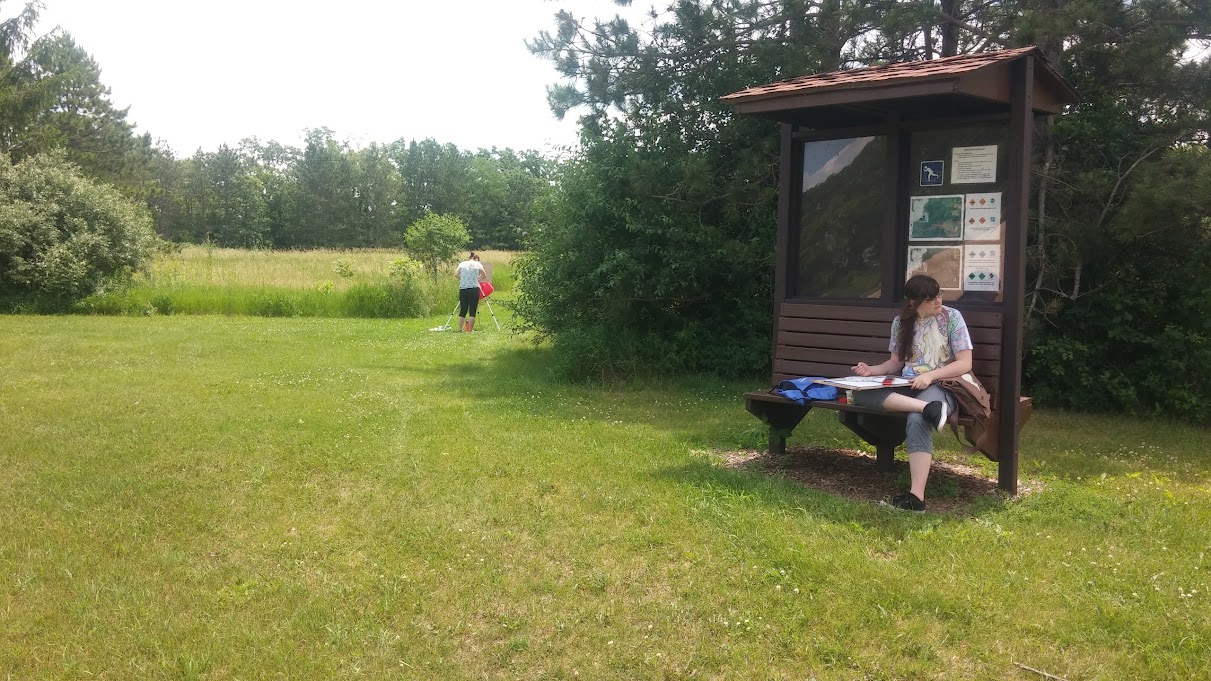
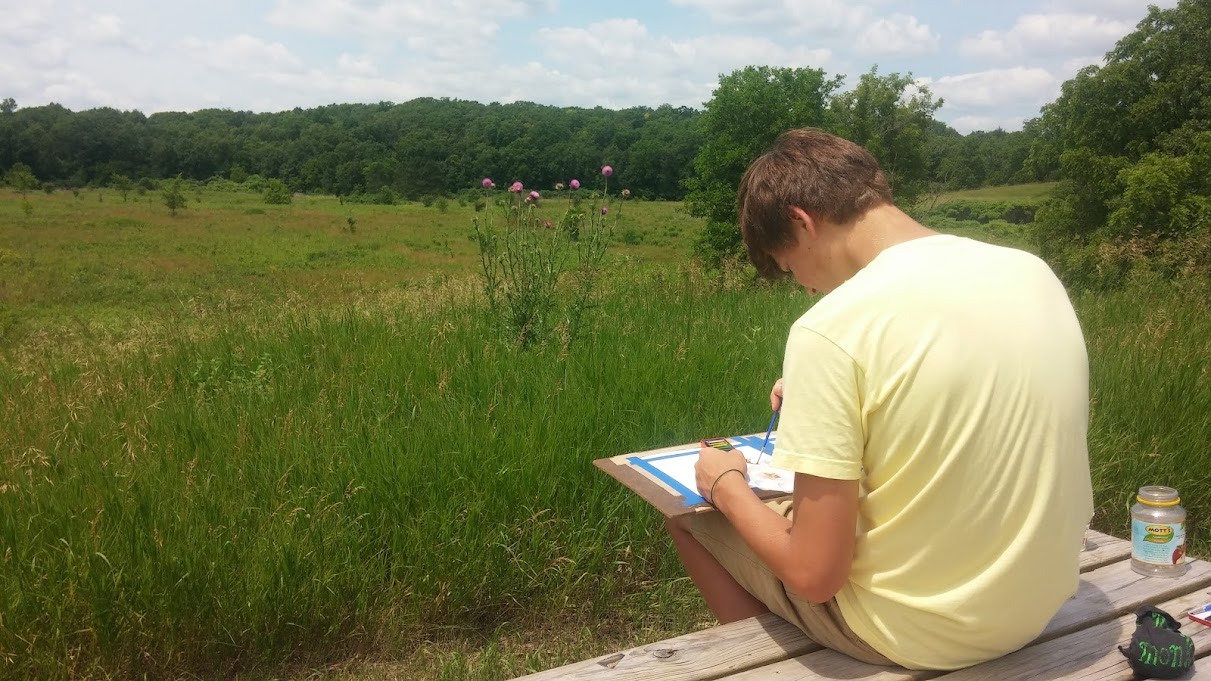
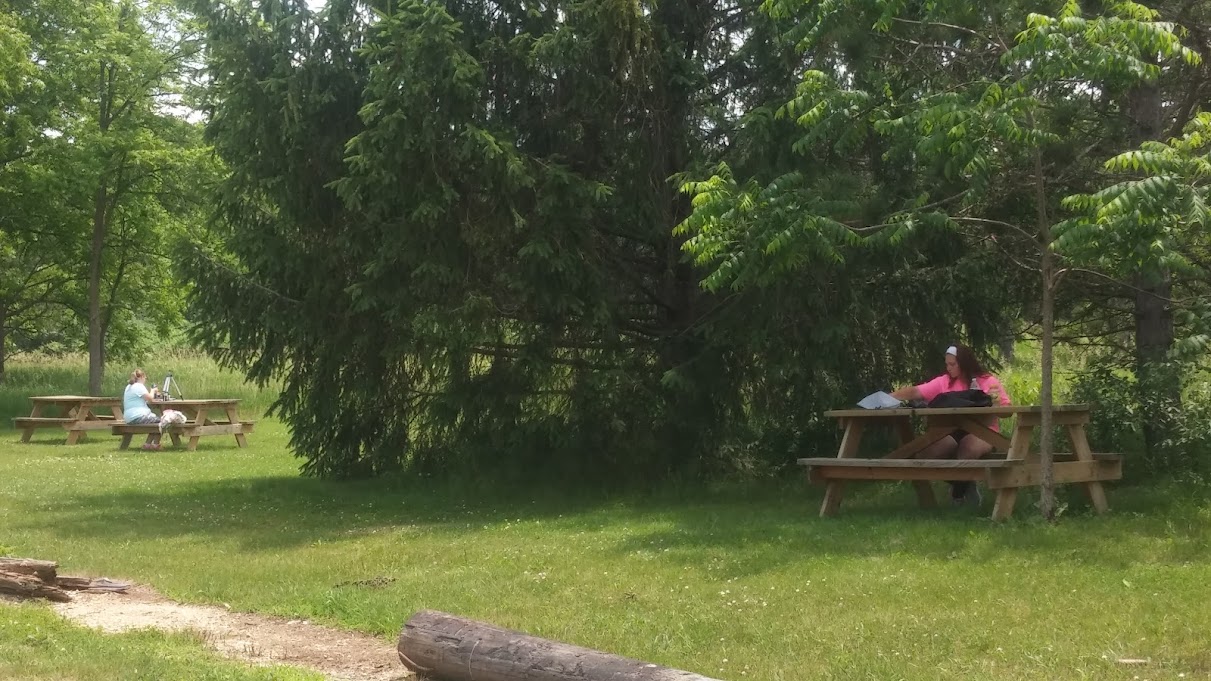
Final Day of the #PleinAirPainting Week – #WhereDidTheTimeGo?

Look at the GREAT PAINTERS! Keep at it!
  • NVAS: 1.2P: Shape an artistic investigation of an aspect of present-day life using a contemporary practice of art or design.
  • Question to begin with: What did you get lost in yesterday as you made your art? Where did you FLY? Take a REAL MOMENT before you begin finishing or setting up a NEW composition and consider the progress of the works you are making. PLEASE GIVE SOME EXAMPLES and EXPLAIN!
Go MATT!

End of the Day Reflection (use the back of this page for more reflection space): As you look back on the past two weeks of painting, what are the highlights of the experience (remember that the word EXPERIENCE is emphasized here)? How do you see some of the ideas as being those that MAY carry you forward into your future paintings? Techniques? Compositions? New Skills? What else and WHY – ELABORATE!

You are creating WONDERFUL works!

Remember that you have HOMEWORK this weekend. Take the artist you most enjoy from your list of 3 and CREATE your best version (copy) of one of their works of your choice. ALSO – make sure you create one or two paintings of your choice based on the style of your artist of choice.

#Friday #Friday #Friday… I can’t believe this week has flown by.

Yeah! https://i0.wp.com/www.inspirationalconnections.com/wp-content/uploads/2014/09/the-earth-without-art-is-just-eh.jpg
‘Nough Said! https://d22d7v2y1t140g.cloudfront.net/m_4020048_YGmNllW5GFUV.jpg

AP Studio Art: Update to AP Sites / Preparing work for Presentation

The DATE is almost upon us… May 5th to earn your 5. http://www.theprospect.net/wp-content/uploads/2014/09/Rise-of-the-AP-exam.jpg

Goals:

  • 4.2Ad: Critique, justify, and present choices in the process of analyzing, selecting, curating, and presenting artwork for a specific exhibit or event.
  • Choose one MORE of the BEST works that you have in your collection… This is going to be the SECOND of your QUALITY works that we are MOUNTING for the portfolio. What is it about the work that makes it STAND OUT FROM the others as one of the BEST works?

We have 2 weeks to pull the 5 total QUALITY works to mount and 24 total other works to photograph, edit, and UPLOAD to the AP Site AND OUR AP Site… How many DIGITAL WORKS do you need to work on?

Advanced Drawing: Mat and Frame your work – Hallways and Hanging!

Combination of gesture drawings… http://www.studentartguide.com/wp-content/uploads/2015/02/line-drawings-wang-tzu-ting.jpg

 Goals:

  • 2.1Ad: Experiment, plan, and make multiple works of art and design that explore a personally meaningful theme, idea, or concept.
  • Look at the series of works from a few days ago… how have you begun to see the figure differently? Are you thinking about the the FORM in a different fashion than you had earlier?

Next week – LONGER FIGURE DRAWINGS – Be aware of the challenges you faced today? What was the BIGGEST CHALLENGE you faced today in the drawing? 

Drawing: Graffiti and Fauvism

Max Pechstein Girl on a Green sofa with a cat.

Goals:

  • 1.1Ac: Individually or collaboratively formulate new creative problems based on student’s existing artwork.
  • After ONE WEEK of pastels, what is your STRONGEST aspect of the composition? Describe WHY you feel it is working so well.

How do you feel about the work you accomplished today? What has changed in how you are looking at using Soft Pastels?  

Studio Art 360: POP Art

Goals:

  • 1.2P: Shape an artistic investigation of an aspect of present-day life using a contemporary practice of art or design.
  • What are the 4 color schemes that you are going to be using in your painting?

What do I have to do in order to get painting on Monday?

#HappyBirthday #KanoTanyu #Japanese Artist b.1602 d.1674

HAPPY BIRTHDAY: Kano Tanyu b.1602 d.1674

Kano Tanyu b.1602 d. 1674 http://www.metmuseum.org/toah/hi/hi_kanotan.htm

“There is an immeasurable distance between late and too late.”  —Og Mandino

Please Play for ALL Classes.

AP and Advanced Drawing Intro Video:

AP Studio Art: REGISTRATION in due TOMORROW!!!

Ideas? What’s going on in your head?

Goals:

  • 2.1Ad: Experiment, plan, and make multiple works of art and design that explore a personally meaningful theme, idea, or concept.
  • What have your previous sketches been over the past months? How have you been planning the NEW and Important ideas out for your work? HOW DOES THIS HELP YOU?

What have you come up with? What materials are you using that help you to challenge yourself? How does it fit into your current body of work?  How does it REACH OUT into NEW IDEAS?

Advanced Drawing: Stairway Drawing.

Your  Paper Bag Drawings are HERE. Copy YOUR image into YOUR document! Questions – ask me on Wednesday.

Walter Gropius’ Bauhaus Staircase – Germany. https://c2.staticflickr.com/4/3080/2774825669_eb82e7df20_b.jpg

DO NOT GO UPSTAIRS TODAY! ACT Testing… Thanks.
Goals:

  • 2.3Ad: Demonstrate in works of art or design how visual and material culture defines, shapes, enhances, inhibits, and/or empowers people’s lives.
  • What type of images have you created in the past REGARDING PERSPECTIVE? What was visually successful in the composition? What was technically successful in your execution? Same with the unsuccessful aspects? Share with your neighbor. Use of (Element) to create a unified artwork.

What was the success in today’s drawing? What was the challenge? Back out Thursday for preliminary drawings.

RUBRIC LINK, but it should ALREADY be in your Google Drive. SHARE it with me...

Drawing: Oil Pastels!

Goals:

  • 7.1Ac: Recognize and describe personal aesthetic and empathetic responses to the natural world and constructed environments.
  • Reflect on YESTERDAY before you begin today! What worked? What didn’t?

Biggest struggle / success for today? Write it out and the WHY!  

By The Way… Share your STILL LIFE DRAWINGS by visiting them HERE.

Kandinsky at MAM – HERE

Studio Art 360: Romare Bearden and Social Commentary

What is the Romare Bearden collage About? Why? http://lindberghschoolartspace.wikispaces.com/file/view/Romare%20Bearden%20collage.jpg

Goals:

  • 1.1P: Use multiple approaches to begin creative endeavors.
  • Looking at the ROMARE BEARDEN collage on the screen, what do you think this work is about? WHY? Please work with your neighbor on answering this question.

What is the most challenging aspect to creating a collaborative work of art? What did you feel will be helpful in working with a classmate? What did you feel will be a challenge?

#Drawing and #Critiquing – ACROSS THE BOARD!

4. You can’t think your way through an art problem. As John Cage said, “Work comes from work.” – Jerry Saltz – Art Critic and personality.

Personality JERRY SALTZ!

AP Studio Art: Outside of the box thinking?

Using nature to make art – how are are you doing? Nils-Udo.

Goals:

  • 1.2Ad: Choose from a range of materials and methods of traditional and contemporary artistic practices, following or breaking established conventions, to plan the making of multiple works of art and design based on a theme, idea, or concept.
  • What has been successful for your outdoor work? What has FAILED you? Where do you need to go from here?

With this OUT OF THE BOX (out of the doors) assignment… What struggles are you facing> Where are  you falling in the snow? What are your challenges?  Nils-Udo

Advanced Drawing: Time to CRIT!

Critique – TODAY! Let’s REALLY get to it!

Goals:

  • 3.1Ad: Reflect on, re-engage, revise, and refine works of art or design considering relevant traditional and contemporary criteria as well as personal artistic vision.
  • What was the successful part of the drawing for you? What will you carry forward as you make more art?

How did doing the critique open your ears to what was said? How did it open your eyes to what you saw?

Drawing: DRAWING – What is the criteria you think about when judging art!

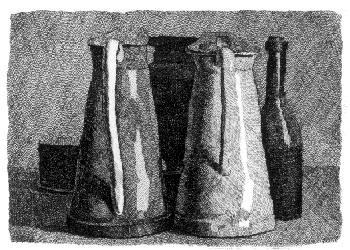
Morandi did it well – How well are you doing? How well did you do?

Goals:

  • 3.1Ac: Engage in constructive critique with peers, then reflect on, re-engage, revise, and refine works of art and design in response to personal artistic vision.
  • Looking at the still life you have drawn, what are aspects that you would talk about if you were critiquing the work as being successful or unsuccessful?

Why do you feel that using white objects is worthy or unworthy, simple or complicated as the subject matter or idea for a drawing? What can you take forward from this experience into the next artwork?

Studio Art 360: How to draw? Thumbnails and IDEAS! – VALUE TOO!

Morandi’s studio – how would you like to have a studio space like this?

Goals:

  •  10.1P: Document the process of developing ideas from early stages to fully elaborated ideas.
  • Look back at yesterday’s drawings – Which one is the BEST and SHARE WHY YOU FEEL THIS with your neighbor. SERIOUSLY – SHARE.

What went well today? Where did you struggle? Explain your thoughts here…  Morandi’s studio…

How about COMPOSITIONS? Looking for ideas? Let’s Look HERE!

How To Do Everything

How to do Everything Image
How To Do Everything with your chef – Mr. Korb… Listen to the second half of the show to hear Mr. Korb’s Contributuion to the BIG GAME snack dip recipe. Start at 5:55.

#Friday and let’s stay #Warm in the #Arts

“An average person with average talent, ambition and education, can outstrip the most brilliant genius in our society, if that person has clear, focused goals.” – Brian Tracy

”Even talent is rarely indistinguishable, over the long run, from perseverance and lots of hard work.” Ted Orland and David Bayles – Art and Fear.

Studio Art 360: Continuous Line PORTRAITS and then…

Mono Print TOMORROW!

Goals:

  • 9.1P: Establish relevant criteria in order to evaluate a work of art or collection of works.
  • Using CRITERIA to EVALUATE a work of art can be a personal thing. Generally we use a four steps process to a well thought out critique. What are three things you would choose to use when critiquing your non-objective print? What are two things you will focus on today when working on it?

What is ONE thing you found that worked out really well for you today in class?

Painting: Continue to Paint and RESOLVE the image

Our critique will be a lot like this… but WAY BETTER! Use this link to access the ONLINE critique sheet and make sure you SHARE it with me.

Goals:

  • 3.1Ac: Engage in constructive critique with peers, then reflect on, re-engage, revise, and refine works of art and design in response to personal artistic vision.
  • You were asked to begin thinking about the work in front of you… What DO YOU SEE IN YOUR PAINTING? That’s it.. WHAT DO YOU SEE? Take your time… look at everything you see in the work and write down all that you see.

Time to work today began with DESCRIPTION – was there anything NEW that you saw when you began writing and working today? We do not have a lot of time to work this week but… lots of time use that knowledge in your life. 

AP Studio Art – PAINT and CONCENTRATE!

One More by Frank Juarez…

Goals:

  • 4.2Ad: Critique, justify, and present choices in the process of analyzing, selecting, curating, and presenting artwork for a specific exhibit or event.
  • How is the online presentation coming along? What do you STILL NEED TO DO in order to get the website finished and polished?

Presentation of your current body of work is on Monday. What do you have to do in order to get the 3 works finished?

LAST NIGHT at MIDNIGHT CHAPTER 8 was due in Art and Fear Blog

#MerryChristmas, #HappyHolidays, #HappyNewYear and enjoy the #BREAK!

image

I wish you ALL the Merriest of Christmases and the Happiest of New Year’s.

Thank you to my students for making this an incredible, productive year of art and learning. Thanks to my fellow staff members for collaborative learning opportunities for our students and one another. Thanks to my administrators for continued support of our students and the visual and other arts. Thank you to the art club members and leaders for makingthe extra time so worthwhile asks teaching out to kids not immediately involved in an art class. Thanks to all my followers and friends in the digital platforms for the sharing of ideas and support.Thanks to all the artists of the past and present for inspiring our artists of the present and future. Most importantly, thank you to my family for all your love and support. I hope all your days are filled with JOY, HAPPINESS and AWE INSPIRING ART!

image
"Merry Christmas"

#Mid #Week is #PAST – What #ART are you doing for the #REST of it?

“Never tell a young person that anything cannot be done. God may have been waiting centuries for someone ignorant enough of the impossible to do that very thing.” — John Andrew Holmes

LET’S TALK MISSING WORK…

All work that you have missing as of RIGHT NOW… will be DUE… DUE… DUE FRIDAY! That’s it – no more days. The end of the semester is coming up fast(?) 4 more weeks… but I cannot wait on ANYMORE late work. (BTW… progress reports go out tomorrow! SURPRISE!)

Studio Art 360 – Collage, Frottage, Grattage, and Decalcomania

LARGE GROUP Slide Show Project – Let’s SEE it HERE!

How has he created a sense of SPACE? How did YOU? http://michaeldcommunications.com/wp-content/uploads/2011/05/75-collage-FAther.jpg

Goals:

  • 7.1P: Hypothesize ways in which art influences perception and understanding of human experiences.
  • What are you NERVOUS about as we venture into the work of clay?

Working with the clay for ONE DAY now… what do you feel you are going to have to do to REALLY make this sculpture work? How are you going to have to balance and budget your time? 

Painting – Drawing and Painting on your canvas! Let’s hang a show too!

NEW PAINTINGS by the WUHS Painting Class – HERE!

GREAT TEXTURE! How is this different than acrylic? http://dudleyquintard100.blox.pl/resource/oil_painting_texture03.jpg

Goals:

  • 2.1Ac: Through experimentation, practice, and persistence, demonstrate acquisition of skills and knowledge in a chosen art form.
  • What challenges do you see in the use of OIL paint versus Acrylic paint? What advantages do you see in the use of oil over acrylic?

What ideas do you see coming out from others works as you took the 4 minutes to walk around today and see what others are doing? How can you see working with OTHERS in a COMMUNITY as being beneficial to the development of your art?

AP Studio Art – ONLINE and IN CLASS / Out of the Studio Too!

YESTERDAY at MIDNIGHT CHAPTER 5 was due in Art and Fear Blog.

SAM FRANCIS! Great BIG artwork! What’s the practice you are taking to COMPLETE your works? New Ideas – same techniques? MONDAY!

Goals:

  • Research and Information Fluency – Students apply digital tools to gather, evaluate, and use information.
  • What problems are you having with the BLOG / WordPress program – uploading? Writing? Maneuvering around the site?

What do you need to do in order to have ALL your work (made so far this year) photographed, edited, and uploaded to the website? Sam Francis Working: 

***ASSIGNMENT in ONE WEEK (NEXT Monday) Adventure Image and Still Life FOCUSING ON and being able to SPEAK ABOUT an ELEMENT and PRINCIPLE Specifically… and MONDAY (Change of HEART) – Website is DUE – Statements on your NAME PAGE, 6 Concentration Works Uploaded, How many BREADTH works do you have done? ***

ADVENTURE – This American Life: http://www.thisamericanlife.org/radio-archives/episode/448/adventure

Thanks for the nod towards my thoughts on communicating with Parents, Students and the WORLD on Teach.Com. I appreciate the recognition.