Well oh well… the risk was taken and the edits have been made. Switching the look of something that I have been working on for 3 years was a difficult thing to do, but I felt it needed some updates.
Please let me know your thoughts about the new look of the page. I have cleaned up the PAGES portion (now at the top of the window) and grouped a few together. I am still thinking about more changes to the sidebar… remove my beautiful face, switch places with this badge and that image among other things.
Always looking for FEEDBACK – it is the hinge that holds all learning and change together (thanks Janie – stole that one).
For your viewing pleasure – a new artwork… it is “Untitled” as of yet and is also not quite finished… Enjoy!
I apologize for missing the Thursday morning post. It is funny how the days are different when the daily planning for classes has been set a side and the larger picture of learning comes back into focus for me. I am not sure if anyone else in any other industry (if one can think of education as an industry) has experienced that… anyway.
~~~
As a BEFORE – I share today’s work in my studio with you. I THINK I have a show coming up in July… I’ll keep you posted, and it was good to get back to work.
“Untitled” as of yet. I have been neglecting my work for some time… good to be back at it.
~~~
Technology in the classroom was my big presentation at last weeks InterActiv Learning Conference 2013 in Whitewater, WI. My largest concern with the use of today’s technology is the misuse of it. Having had an opportunity to listen to a new Freshman in High School (not mine… well, my kid, but not my district) discuss the use (or in some conversations that stand out – misuse) of important resources such as YouTube and Google it struck me that the conversation of how we use technology in the classroom as a learning TOOL and not as “bells and whistles” to entertain or simply to “connect” with the kids was important.
Technology and Interaction in the Classroom (link to my Google Presentation is HERE) was the presentation I had at the conference and I really wish I had heard Michael Wesch’s 201o Presentation at the University of Denver prior to my presentation. The good news (maybe for me) is that I am working in the direction he speaks about in his lecture (link to his presentation is HERE). To keep this brief (and give you a chance to watch his presentation) I feel the most important part of his lecture was to emphasize that the INFORMATION out there is NOT SCARCE and the student of today has all the access to it, in their pocket! The important thing to keep in mind, and this is a brain shift for all in education (kids, parents, teachers, administrators, school board members… everyone), is that the teachers need to help the kids learn HOW to use the technology to be self directed learners. The kids sure know how to entertain themselves with the internet… but strong learners of Web 2.0 tools they are not.
How can we, as teachers, use the tools that are out there to help the kids LEARN how to LEARN? How do we demonstrate the tricks of the trace, the skills that are essential in the process of learning so that the students we have the privileged to work with, can become more independent learners? One of the tricks of using the technology (information really) that is out there is to make sure we are teaching them how to CONNECT to it and not to simply learn it all for the test. This also ties into the thoughts of Noah Chomsky (HERE for a YouTube video Presented at the Learning Without Frontiers Conference – Jan 25th 2012- London) that the TEST is not a very good demonstration of the knowledge the kids have. Yes, maybe for the day and a few weeks later, but then – POOF – that is gone. How can we, as concerned educators and leaders, help the learners make sure that the information we provide them with connects to the world they are living in? The tools are there, and they will be using them for as long as they live. How can we connect the tools, the information that is available, and the techniques to gather, toss aside, sort, filter, and use that information is through demonstration by example, teaching and reteaching, and reviewing the importance of being aware of how the tools and information is to be used.
From the Daily Inspirational Blog Goal Achievement Quote – June 24, 2013
by Paul Mark Sutherland “I do not think that there is any other quality so essential to success of any kind as the quality of perseverance. It overcomes almost everything, even nature.” —John D. Rockefeller
~~~
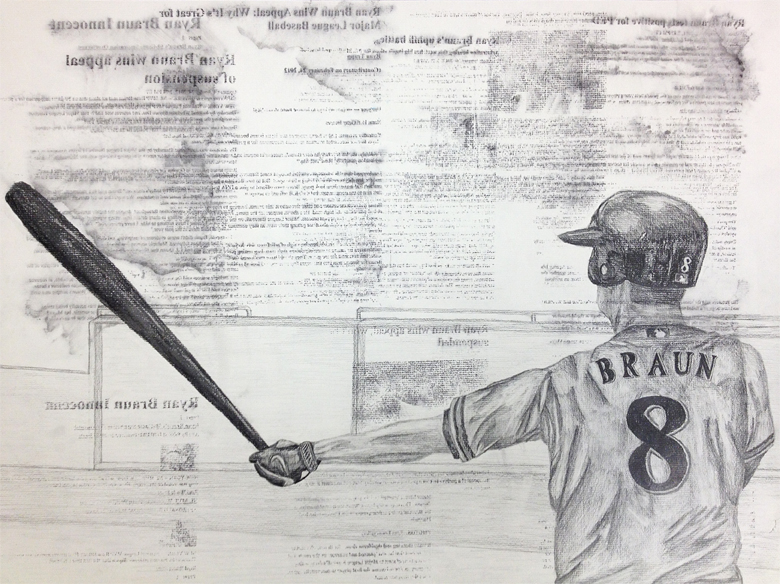
What inspires you? Ryan Braun has done a number on countless baseball fans… even with the challenges of alleged doping. Braun, Austin Schroeder, pencil and ink, 17.5″ by 23.25″, 2013.
~~~
One of my colleagues, a great leader in the building and inspiration to our 1100ish students, asked about the lengthy notes I had taken during the 2012 – 13 school year about the 2nd Edition of Classroom Instruction That Works – (An ASCD Publication [Link HERE for the ASCD Website]) by Dean, Hebbell, Pitler, and Stone. I now have the notes available to you… but I suggest getting a hold of the book as well. The Google Document is set up so that ANYONE who can access it (you bu clicking on the book) can read it and MAKE COMMENTS – GO FOR IT! (Thanks Russel.)
Click on the Book Cover to go to my not quite complete (still haven’t finished writing about Chapter 10) notes.
While this book was a great read – and is an essential reminder for all of those who already feel like I do things such as, but in no order of importance: Feedback, Recognition, Co-operative Learning, Non-Linguistic Representations… among other technique and strategies. It is one thing to DO them, daily, but it is an altogether different thing when you are AWARE of the strategies you are using and doing them with the purpose of moving Student Centered Learning FORWARD.
~~~
Another GREAT Video bit of Inspiration I recently got was the YouTube clip (26 minutes, so get a cup of coffee and a set of headphones) was by Anthony Salcito on The New Classroom Experience(my notes HERE – please add your comments).
There are a lot of GREAT thoughts in this lecture and I have been moved to look at the Look of MY Classroom. I feel that the activities ARE the most important aspect of the classroom, not the look of the classroom, and that is why I am REALLY emphasizing the use of technology to create environments for COLLABORATION and also how the ARTWORK the kids are learnign about and producing is essential to how they solve problems as well as the necessity of them failing (not necessarily with an F, but rather just not producing exactly what they thought it was “suppose” to look like), reflect on their failures, move forward from their failures, and continue to fail until they succeed – in WHATEVER WAY THEY SUCCEED!
~~~
LASTLY – Some thoughts and comments from the kids from 2012 – 13 as the school year wrapped up. The question that was posed was: What was the single greatest accomplishment for you over the past semester?
I learned to focus on visual unity and the elements of art to create pieces of art with ideas and processes being executed well.
I learned to take time while drawing and give effort towards art. I’m proud that I can now be a better drawer.
I expanded my mind. I really didn’t like art at all. When I had to take it in 7th grade I said I was never going to take it again. But this semester I took it and some parts were pretty fun with this class.
Learning how to use dimension, proportion, shading, and drawing in general.
My webpage has been ranked on Teach 100… Thanks for the badge! Let’s work to move the rating up the list!
~~~
A HUGE word of thanks to all those who attended my sessions over the past two days at InterActive Learning Conference at UW-Whitewater. The sessions I had were well attended and had a lot of great feedback. Links to ALL of my sessions are available to the RIGHT of this post under PAGES: IntertActiv 2013.
Thanks to Scott Christensen and the entire InterActive Learning Team, all the vendors, the presenters, and UW-Whitewater’s Tech crew for a fantastic couple of days.
This slideshow requires JavaScript.
Comments from Survey: Thanks All!
Enjoyed your energy. All your communication with parents. I need to get my staff to do that more. I will share all your tools.
Putting goals out there for my students. Right now, they just have to guess… and most of them don’t try, oddly 🙂
I’ve enjoyed it a lot. Learned a lot. It’s been great to have some time to work and experiment with WordPress.
I liked that it setting up a blog is easy and free.
And Even…
I think you over-explained and I grew bored.
It seemed sort of self-promotional.
I appreciate ALL the comments. I enjoyed working with each group and learning form other experts in their own fields. Criticism in essential in the learning process and I appreciate all the work and reflections from everyone. Your thoughts about my sessions… HERE.
Technology and Communication in the 21st Century Classroom: SURVEY – HELP me (and your contemporaries) with your thoughts! Survey is HERE.
~~~
~~~
Please FOLLOW my GOALS PAGE by entering your e-mail address (see the right of the screen) to get daily updates, ideas, and inspirations. Share, Retweet, Facebook me… however you can share me…
~~~
Self-Portraits and Reflection on oneself… charcoal on paper. What do you think about when you reflect on the lessons you teach? The ideas the kids walk away with? Reflection is essential to the process of learning – them and us.
~~~
Goals:
Walk away with a new set of tools, skills, and connections to help your students (and yourself) become stronger and more self-aware / driven learners (and teachers).
Share the ideas and skills about technology that you are great at and help others become more knowledgeable in technology.
~~~
My 3 sessions at the InterActiv 2013 Technology Conference are listed below. The links to the Google Presentations are below also. I am ALWAYSlooking for your feedback.
What are your thoughts about my sessions? What are things you enjoyed or learned from? What would you have liked to have learned more about? While this survey is “mostly” about my sessions… I am happy to share your responses about anything that you feel needs addressing. Thanks. Survey is HERE.
~~~
Kids will say the Darndest Things…
Knowing that sketchbooks and goals will ALWAYS be part of the courses, what is one suggestion that you have to offer for future classes? What are some suggestions you may have to help the class become even stronger or more fulfilling than it already is? These require explanation please.
“Make the goals so that everyone does them and doesn’t slack. It helps my brain learn from the beginning of class and I know it will help others.”
“To take the goals and understand them not just write them down.”
“The goals were kind of hard to understand when looking back at them. It’s easy to understand when you explain. but the way they are written down is tricky to look back at.”
Welcome to InterActiv 2013 Technology Conference! Over the next 2 (or 4) days you will have MANY opportunities to learn new techniques, tools, technologies that can help you make your classroom even more effective towards the goal if IMPROVING STUDENT LEARNING!
Technology and Communication in the 21st Century Classroom: SURVEY – HELP me (and your contemporaries) with your thoughts! Survey is HERE.
Please follow my GOALS PAGE by entering your e-mail address (see the right of the screen) to get daily updates, ideas, and inspirations. Share, Retweet, Facebook… however you can share me…
MY NOTES FROM THE CONFERENCE – If you are interested – Comments are welcome – HERE.
“Dream,” Matthew Jacob, oil on canvas, 15″ by 19.75″, 2013 – How far from your box can the new ideas you will be exposed to this week take you?
Goals:
Walk away with a new set of tools, skills, and connections to help your students (and yourself) become stronger and more self-aware / driven learners (and teachers).
Share the ideas and skills about technology that you are great at and help others become more knowledgeable in technology.
~~~
My 3 sessions at the InterActiv 2013 Technology Conference are listed below. The links to the Google Presentations are below also. I am ALWAYSlooking for your feedback.
After having had an opportunity to visit the conference… what are your thoughts about the session? What are things you enjoyed or learned from? What would you have liked to have learned more about? While this survey is “mostly” about my sessions… I am happy to share your responses about anything that you feel needs addressing. Thanks. Survey is HERE.
Tech In Class: Google Form – HELP me with your thoughts! http://goo.gl/kZSWQ
Please follow me by entering your e-mail address (see the right of the screen) to get daily updates, ideas, and inspirations. Share, Retweet – however you can share me…
~~~
Micah Reflects Melanie Modic, Pencil, 12″ x 20.55″ 2012-2013
Art Students say the Darndest Things…
What was the one thing that you feel you will be able to take into your next course or carry on into the next stage of your artistic development.
“When we got to work on projects. Being able to do our own things” – Art Foundations 2013
“paying more attention to realizing importance of art rather than what I just see.” – Art Foundations 2013
“I will know how to better place things out on paper. Social Skills.”– Art Foundations 2013
“Work Ethic” – Art Foundations 2013
“Do the thing even if you do not enjoy the beginning. Probably, when you are done, you’ll discover the reason of what you did it and tool for opportunities.” – Art Foundations 2013
These kids FLOORED me with their insights and thoughts about all that they learned in an Art Class… I knew it was happening… I am PROUD that they saw it in the end too.
Please follow me by entering your e-mail address (see the right of the screen) to get daily updates, ideas, and inspirations. Share, Retweet – however you can share me…
Welcome to Thursday! As the summer has entered the second half of its first week, I have set my summer goal to post on Monday’s and Thursday’s. Next week I will be presenting at the Interactiv Learning Conference in Whitewater, Wisconsin so… I may be posting a few more times than twice next week. Enjoy! ~~~ What was your favorite aspect of this class? Please go into some explanation to allow for a fully developed thought and answer.
“Trying hard on my work and Mr. Korb recognizing the quality of my work even when I can’t.”– Art Foundations Artist 2013 – NVAS Goal 2.3, 2.4, and 4.5
“Your humor, your environment. The general fun in the class” – Art Foundations Artist 2013 – NVAS Goal 3.3
“Being able to choose things that relate to me.” – Art Foundations Artist 2013 – NVAS Goal 2.6 and 3.1
~~~
AP Studio Artists Works – Kyle S.’s Mixed Media installation… I am curious as to where this work has ended up… Click on the image to visit the AP Google Presentation of their entire body of work from 2012 – 2013.
“Success means doing the best we can with what we have. Success is the doing, not the getting—in the trying, not the triumph.” —Zig Ziglar
~~~
“Not all of our best students are our “A” students. I have had “C” students who I consider excellent students because they were so engaged into the educational process. I really don’t think it has to do with a letter grade, it has to do with enthusiasm.” – Charles Rineheimer – NPR – Talk of the Nation Interview LINK HERE: The Students That Keep Teachers Inspired
~~~
What has inspired me? Hard Work – New Thinking, Hallways…
“Not all of our best students are our “A” students. I have had “C” students who I consider excellent students because they were so engaged into the educational process. I really don’t think it has to do with a letter grade, it has to do with enthusiasm.” – Charles Rineheimer – NPR – Talk of the Nation Interview LINK HERE: The Students That Keep Teachers Inspired
~~~
What was the most difficult or challenging aspect of this course for you personally? Were you able to learn from this experience or gain something from it that has helped you to develop as an artist?
Abstract Art and I just really had to think about it.
Thinking through things before beginning the piece of artwork.
The hardest thing for me would have to be taking time to slow down when making art.




 Art With Korb