May 22, 2013 – Wednesday

“A dream only becomes overrated when not pursued by the dreamer.” ― Courtney Hickman 

~~~

Art Foundations: Continue to develop the ABSTRACT IDEAS of your Social / Personal ideas and topics of importance.

Abstract art at its best… Vasilly Kandinsky…Localization of Graphic Motifs II. 1912–13

Abstraction – -Color Schemes – What can you do? What did Max Ernst do?

GOALS:

  1. 3.2 apply subjects, symbols, and ideas in art and use skill to solve visual challenges.
  2. 1.1 apply paint, crayon, and charcoal, through various texture making processes, using collage with 1.1.3 an awareness so that your ideas are executed well

What have you been able to do to help you SYMBOLIZE the larger concrete idea into an ABSTRACT visual representation? Which if the three categories does it fit under – Cosmology, Architecture, or Landscape? HOW?

~~~

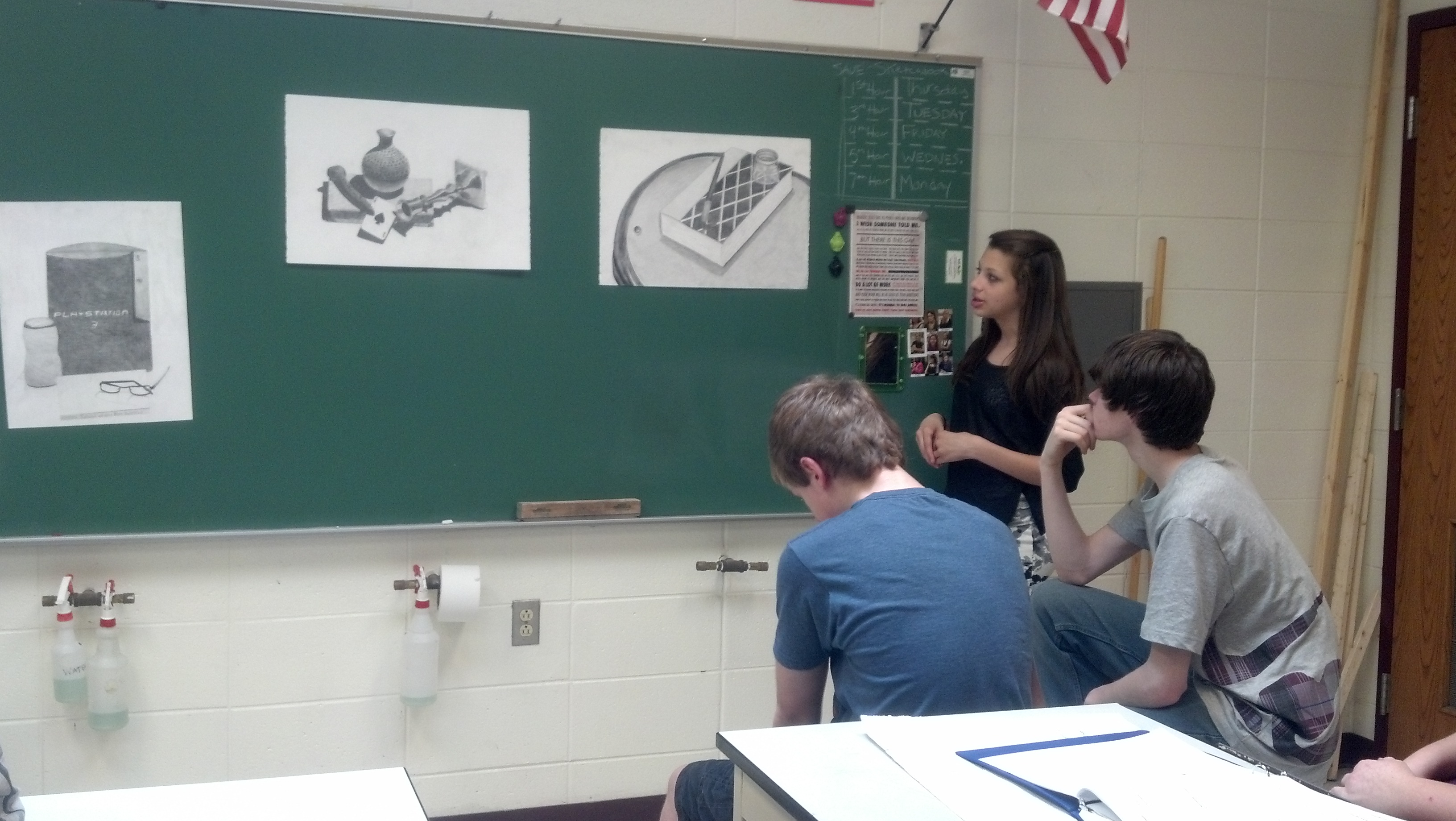
Drawing: Critique your artwork and your classmates artwork?

I am so glad that I am back… thank you all.

GOALS:

  1. 2.1 form criticism about artworks that work to accomplish personal meanings (what are you trying to communicate?)
  2. 5.5 Evaluate responses to works of art for communicating rationale and ideas.

What did you accomplish with the critique today? How does this process help you with your artwork? What are you still struggling with regarding the process of the critique?

~~~

AP Studio Art: Installing your art exhibition and getting the space ready for your debut to the school.

  • YOU ARE ON YOUR OWN – Ms. Hanson and Mr. Roberts are watching you today. Please use the time and space wisely. We are walking the display boards to the CAFETERIA TOMORROW. 
  • Write Down your Goals for the day… end of the hour – look at the accomplishments you have done and respond to the questions below.
  • Bryan – you are in charge of time.
  • Mel – you are in charge of the Computer and the Technology.
  • Matt – you are in charge of music.
  • Make sure the room is CLEAN and ORGANIZED at the end of the hour and the walls are back in the corner.
Last day to adjust the lights and straighten the pictures, fix the artist statements and make sure your names are on the wall correctly.

GOALS:

  1. 2.5 defend personal evaluations
  2. 3.3 describe the creation of images and ideas and explain why they are of value

How does your artwork look? How have you put your best foot forward and represented yourself in the best light? What are the struggles you can see in your work? What are the successes that you see in your work?

May 21, 2013 – Tuesday

“A dream only becomes overrated when not pursued by the dreamer.” ― Courtney Hickman 

~~~

Art Foundations: We are going to be working in ABSTRACTION and reading about UNITY and that sort of stuff. If you are away… Check out the text online – Look to the right of the screen and click on the Foundations Page… REMEMBER that the exam is coming up shortly – begin to review! What are social topics that are important to you in life? We are going to create works over the next week that speak to the social topic that you feel is important enough in your life that you can make work to respond and comment on it.

ARTnews: The Golden Age of Abstraction: Right Now

Abstraction Worksheet / brainstorming sheet – HERE

Max Ernst (1891‑1976) Title The Entire City La Ville entière Date 1934 Medium Oil paint on paper on canvas Dimensions support: 502 x 613 mm frame: 696 x 798 x 47 mm Collection Tate Acquisition Purchased with assistance from the Knapping Fund 1941 Reference N05289

GOALS:

  1. 2.6 Work on creating multiple solutions to solve visual challenges.
  2. 3.2 apply subjects, symbols, and ideas in art and use skill to solve visual challenges.
How to ABSTRACT the idea of COSMOLOGY? Stars, planets, orbs, or orbits? What might you be able to do with this image?
What about the idea of a landscape? How could you abstract this idea with shape, line, texture, or / and color?
What about the idea of athletics as being important and how can you abstract this idea? The use of abstraction is hard, but when you think about simplifying the forms into shape and focus on the arrangement of the shapes, colors, textures, or other elements of art… it can become easier and more meaningful.

What is the social topic that you feel is important enough to make an artwork about? Why does it touch your life? How?

~~~

DRAWING:

Perspective… Remember this???

GOALS:

  1. Create multiple solutions to visual problems.

What were the biggest challenges you had today with perspective? What came back to you relatively easily?

~~~

AP Studio Art: Hang a show! Get the work up and out!

Make it even… make it straight… make it balanced!

GOALS:

  1. 2.5 defend personal evaluations
  2. 3.3 describe the creation of images and ideas and explain why they are of value

How many works have you chosen for your exhibition? Feedback from your neighbor about your display / wall.

May 20, 2013 – Monday

“A dream only becomes overrated when not pursued by the dreamer.” ― Courtney Hickman 

~~~

Art Foundations: We are going to be working in ABSTRACTION and reading about UNITY and that sort of stuff. If you are away… Check out the text online – Look to the right of the screen and click on the Foundations Page…

ARTnews: The Golden Age of Abstraction: Right Now

Abstraction – -Color Schemes – What can you do? What did Max Ernst do?

GOALS:

  1. 4.3 compare relationships of texture and meaning in visual art in terms of 4.3.2 aesthetics (how things look and how you respond to them)
  2. 2.6 Work on creating multiple solutions to solve visual challenges.

What is the topic that that you focused on today? How do you think that you are going to be able to create an abstract work of art based on the idea? Why does abstract art look so easy? Why do you feel it is going to be hard?

~~~

Drawing: Critique Day! What have you got? What are you going to be talking about? What are you going to be LISTENING FOR?

Romare Bearden gave critiques too, and his students listened and participated in the critiques as well. DO NOT LET one or two of your classmates dominate the room.

GOALS:

  1. 2.1 form criticism about artworks that work to accomplish personal meanings (what are you trying to communicate?)
  2. 5.5 Evaluate responses to works of art for communicating rationale and ideas.

What have you taken away from today’s critique? What came from this past week’s worth of work? What did you learn about the ideas of your own work / ideas / work from the instructor with specific goals and intentions in mind? Easy? Hard? What made it worthwhile?

~~~

AP Studio Art: Are you ready to go with your show? What have you done with your statement? What have you got for your name tags? Do you have your Art and Fear ready to go? PIZZA TIME!

GOALS:

  1. Evaluate the effectiveness of artwork. (P).
  2. Know about the use of symbolism, self-reflection, personal experiences, and feelings

What did you take away from today’s critique? What did you offer to your classmates? (2) Statement / Paper or Presentation DUE (last week – be ready to hang art today!)

May 18, 2013 – Saturday – NVAS: Standard 5

*Note: This is a day early because I am curious as to the comparison of a late Friday post versus a Saturday post. Any feedback? Let  me know!

~~~

Visual Art GOALS and OBJECTIVES

National Visual Arts Standards – Standard 5
Reflecting upon and assessing the characteristics and merits of the visual arts

Frank Korb

Click HERE for a look at the RUBRIC for EVALUATING WORK I have implemented in MOST of my art courses. This document follows the process of making art through a Formative and Summative, Self – Evaluation and COLLABORATIVE Critique.

~~~

Welcome to another weekend of thinking about the 6 OVERARCHING GOALS that all students ought to work toward and focus on EVERY DAY during the year in all of their art classes. These Goals are unpacked from the National Standards for the Visual Arts so that they make more sense to the students and parents who are working with them through their art making and other art experiences. As I use goals in my classroom it OPENS THE FOLDER to learning.

The National Standards for the Visual Arts are now GOALS that are clear, measurable, observable, and understandable to the students, parents, and community. The use of goals is to keep the mind open to the idea of learning and focused on the act of learning, By combining both declarative (mind) and procedural (application) knowledge the intentional actions are focused on the combination of art theory and art making and art critiquing as well as the reflection on the close relationships.

~~~

Standard #5: Reflecting upon and assessing the characteristics and merits of the visual arts

As an art student you will demonstrate the ability to:

  • 5.1 identify the rationale behind making art

All too often the ideas behind the art is forgotten or never fully realized and the art is made because it was an assignment. Through this focus, the artists are asked to think about why they are making the art they are. Does it matter? The use of a reason in the process has helped the artists I have worked with stay focused on the work as well as taking pride in the work they are completing. It is more than just making art for art’s sake… it is for their sake and the sake of an artist’s job of communication.

  • 5.2 stand behind your criticism of art

Critiquing is SO important in the process of the art making procedure. This objective forces the artist to think about the choices they have made as well as the responses they verbalize (both in speech and in writing) and to be able to back it up with fact and experience. The novice, the uneducated, can easily throw off a “this work is terrible” or the opposite “this work is great!” The educated, the thoughtful artist / critic will have the words, facts, and personal experience to back up their thoughts. If they are critiquing others’ work, the facts and experiences are helpful… so long as the other artist is open for critique.

  • 5.3 describe meanings of artworks by analyzing
    •      5.3.1 techniques
    •      5.3.2 how they relate to history and culture

How is one using materials and techniques to make art? The Impressionists had a certain brush stroke that the German Expressionists didn’t have. A minimalist would approach a work with a very different intent and hand than a Romanticist or der Blaue Reiter. What is happening in the young artists society and culture that they can relate to the work they are creating? What are they able to pull from the annals of history that impacts their artwork? To look at and JUSTIFY the work, once again, gives the work a strngth and rationale that simply “completing an assignment” does not do.

  • 5.4 reflect on interpretations as a means for understanding and evaluating art

When a group sits down and has a conversation about the work in front of them, there are bound to be a variety of thoughts that are far different from the original intent of the artist. Is this a bad thing? When a young group of artists is able to listen to the variety of interpretations their classmates have about their work, the knowledge that their message may or may not have been communicated well can help them in the next work… or come to a realization that they need to go back and rework something in the current work in front of them.

  • 5.5 evaluate responses to works of art for communicating
    •      5.5.1 rationale
    •      5.5.2 ideas
    •      5.5.3 opinions

What was the artist trying to say? What was the impetus behind the work? Where are they deriving their ideas and thoughts from? Society, spirituality, politics… what do they hope to impress upon the viewer? As a professional, an artist should be thoughtful regarding the ideas they are trying to put out in the world. All that said, what do they think about how others are thinking about the works they are creating? One needs to put all of this is mind as they design, draw up, plan, create, and move forward with their works.

~~~

Lastly, once you open the door to learning  you also need to close it.  During the last couple of minutes of my classes, we take time to reflect, to GENERALIZE the relationship to the goals and the day’s work / lessons onto what the students know or think they know about the world / practice of the arts.. This is the CLOSING THE FOLDER that allows the brain to settle down and pack away the learning, the experiences, until the following day.

You can find these (and more) in my Visual Arts Handbook HERE.

Thanks –

Frank
May 17, 2013 – Friday – Really? Already? : (

“Talent may get someone off the starting blocks faster, but without a sense of direction or a goal to strive for, it won’t count for much.”
– David Bayles and Ted Orland
Art and Fear: Observations On the Perils (and Rewards) of Artmaking Thank you Ted and David – You have both been inspirations for the AP kids this past month. Pizza Party for a Critique? Sounds Good!

~~~

ASCD Webinar Participants – SEE BELOW FOR MORE INFORMATION

~~~

Art Foundations: TEXTURE – Brief Textbook (175?) and Note taking. What is the texture we spoke of yesterday and how can we gather it up? Did you go and gather it up with your classmates.

Max Ernst’s TEXTURE Surrealism… What can you do that Ernst has mastered?

GOALS:

  1. 1.1 apply media (acrylic paint), techniques (Grattage and Decalcomania), and processes (creating an series of textures) with an 1.1.3 awareness so that your ideas are executed well.

What, of the three texture making techniques, did you enjoy using the most? What do you think you can do with each of these textures?

~~~

DRAWING: Finish the pastel drawing… DO NOT FORGET to COLLABORATE with your partner!

Backgrounds… Culture… What does your drawing say about you?

GOALS:

  1. 2.2 evaluate the effectiveness of artworks
  2. NETS: Communication and Collaboration – Students use digital media and environments to communicate and work collaboratively, including at a distance, to support individual learning and to the learning of others.

What has been the most difficult part of this Self-Portrait for you? What has been the most rewarding part of this Self-Portrait for you? Please take a moment to reflect on why you felt this way. How have you GROWN through this process? I am SO proud of each and every one of you. You may not have worked at an A level, but each of you who challenged yourselves have succeeded in your own way.

~~~

AP Studio Art: FINISH ALL THAT I HAVE ASKED OF YOU! Holy Cow! There is a lot to do… Art Show goes up next week.

Woah! Let’s hang a show as good at the ideas these kids have created! Show your best work and put your best foot forward!

GOALS:

  1. 3.1 reflect on how art differs and describe how it relates to your history and your culture.

What have you created this year?What have you challenged yourself with? What have you accomplished that you did not think that you might have been able to accomplish? Take a moment and give yourself some credit for all that you have finished and think about what you were unable to finish… why were you unable to finish you were able to finish?

MAY 16, 2013 – Thursday

“Talent may get someone off the starting blocks faster, but without a sense of direction or a goal to strive for, it won’t count for much.”
– David Bayles and Ted Orland
Art and Fear: Observations On the Perils (and Rewards) of Artmaking

~~~

ASCD Webinar Participants – SEE BELOW FOR MORE INFORMATION

~~~

Art Foundations: TEXTURE – Textbook and Note taking. What is texture and how can we gather it up?

Jonathan Lasker REASONABLE LOVE, 2007 Oil on linen 81 x 108 inches 205.7 x 274.3 centimeters CR# LS.13939

GOALS:

  1. 1.1 apply media (crayon and acrylic paint), techniques (frottage, grattage, and decalcomania), and processes (EXPERIMENTATION) with an 1.1.3 awareness so that your ideas are executed well.

Where do you experience TEXTURE in your day to day activities? How does TEXTURE affect the way you experience some of the day to day events and happenings in your life?

~~~

Drawing: Draw, Critique, Fix, Correct, Draw, Discuss, FAUVISM – Upload and Edit your Rubric – Collaborate with your classmates!

How are you keeping it cultural and self-focused?

GOALS:

  1. 2.2 evaluate the effectiveness of artworks through self and collaborative critiques
  2. 1.1 apply pastel, layers, and Fauvist Drawing with an 1.1.3 awareness so that your ideas are executed well

Yesterday got away from us – late start and all… what are your biggest accomplishments today? What were your classmates biggest accomplishments today? Write out your thoughts about your classmates drawing in the COmments section so that you can then take it to the computer and make the thoughts there also. COLLABORATE!

~~~

AP Studio Art: Artist Statement, Gather Work for Show, Name Tags, Art and Fear Art Work

What is your Fear about Art?

GOALS:

  1. 3.1 reflect on how art differs and describe how it relates to your history and your cultures
  2. 1.1 apply mediums , techniques, and process with an 1.1.3 awareness so that your ideas are executed well

Homework? Cards for your artwork. Statements for the exhibition? Get it done? What are you proud of having accomplished this year?

~~~

ASCD Webinar Participants – Thanks for the time at the the webinar. I hope that my thoughts were of value and raised some good points and some challenging questions. I am always looking for feedback – so please pass it along to me. Take a tour, have a look, follow me and see how I effectively  use technology as a tool for interaction, content, resources, collaboration and communications tool in my classroom. If you would like to contact me – you can leave a message below or e-mail me at fjkorb@gmail.com. Enjoy!

May 15, 2013 – Wednesday – Late Start

“Talent may get someone off the starting blocks faster, but without a sense of direction or a goal to strive for, it won’t count for much.”
– David Bayles and Ted Orland
Art and Fear: Observations On the Perils (and Rewards) of Artmaking

~~~

ASCD Webinar Participants – Thanks for the time at the the webinar. I hope that my thoughts were of value and raised some good points and some challenging questions. I am always looking for feedback – so please pass it along to me. Take a tour, have a look, follow me and see how I effectively  use technology as a tool for interaction, content, resources, collaboration and communications tool in my classroom. If you would like to contact me – you can leave a message below or e-mail me at fjkorb@gmail.com. Enjoy!

~~~

Art Foundations 2D: ABSTRACTION – Let’s go out and look at MORE abstraction and see what interests us in the worlds that it offers.

Abstraction is NOT as easy or simple as you might think… what are you thinking about as you see this work by contemporary artist Jonathan Lasker’s The Quotidian and the Question, 2007, suggests anatomical structures. COURTESY CHEIM & READ, NEW YORK. ARTnews link to magazine article in the picture – go ahead… click it!

GOALS:

  1. Research and Information Fluency – Students apply digital tools to gather, evaluate, and use information. LAPTOPS!
  2. 2.6 create multiple solutions (sketches) to visual challenges (making abstract art with a meaning) that show understanding in relationships between composition and meaning of artwork.

What was the most interesting part of the ARTnews article that you read about the Golden Age of Abstraction? How has looking at contemporary abstract art changed your mind about the work that is available and out there? Do yo understand the ideas of ABSTRACTION better than you did before? Please write your thoughts down in your COMMENTS section of your GOALS SHEET.

~~~

Drawing: Work work work – Think think think. Pastels are in your hands and your mind is focused on the drawing. How are you breaking this space up? DUE – MONDAY! Critique – Monday – Wednesday of next week.

Hip-Hop… What does YOUR art say about YOU? Did your choice in COLOR SCHEME help you communicate your ideas and thoughts?

GOALS:

  1.  3.1 reflect on how art differs and describe how it relates to your history and your cultures.
  2. 1.1 apply pastel, layers, and Fauvist Drawing with an 1.1.3 awareness so that your ideas are executed well.

How are you moving forward with this drawing? What have you chosen to do with the background? Why? How have you divided it up and made sure it was working with the portrait? Is it?

~~~

AP Studio Art: How is the choice of your artwork going? How has your artists statement gone? Friday – it is due – POINTS for PARTICIPATION! Art and FEAR artwork… There is a lot of work you are working on… how can you keep up / keep it straight?

GOALS:

  1. 3.1 reflect on how art differs and describe how it relates to your history and your cultures
  2. 1.1 apply mediums, techniques, and process with an 1.1.3 awareness so that your ideas are executed well

Art and Fear, Name Tags, Art Show… there is a lot of work to get accomplished  Art and Fear is due Monday- Your Statement is due Friday, your Name Tags are due when you put the show up  – NEXT WEEK! What are you done with? Good work yesterday Bryan! Keep up the good work EVERYONE!

May 14, 2013 – Tuesday – Hello ASCD Webinar Participants!

“Talent may get someone off the starting blocks faster, but without a sense of direction or a goal to strive for, it won’t count for much.”
– David Bayles and Ted Orland
Art and Fear: Observations On the Perils (and Rewards) of Artmaking

~~~

ASCD Webinar Participants – Welcome to my DAILY Blog! Take a tour, have a look, follow me and see how I effectively  use technology as a tool for interaction, content, resources, collaboration and communications tool in my classroom. If you would like to contact me – you can leave a message below or e-mail me at fjkorb@gmail.com. Enjoy!

~~~

Art Foundations: Self Evaluation on GRID DRAWING. Introduction to ARTnews magazine and ABSTRACTION in the 21st Century – the GOLDEN AGE of ABSTRACTION! Review of Color Schemes too.

Abstraction is NOT as easy or simple as you might think… what are you thinking about as you see this work by contemporary artist Chris Martin’s “Seven Pointed Star for Isaac Hayes”, 2009, COURTESY MITCHELL-INNES & NASH, NEW YORK, ARTnews link to magazine article in the picture – go ahead… click it!

GOALS:

  1. Research and Information Fluency – Students apply digital tools to gather, evaluate, and use information. LAPTOPS!
  2. 2.6 create multiple solutions (sketches) to visual challenges (making abstract art with a meaning) that show understanding in relationships between composition and meaning of artwork.

What was the most interesting part of the ARTnews article that you read about the Golden Age of Abstraction? Do you think that creating an abstract work of art with a meaning to support it is an easy thing to do? Why of why not? Please write your thoughts down in your COMMENTS section of your GOALS SHEET.

~~~

DRAWING: Continue to work on the FAUVIST artworks from the past week. Collaborate with a classmate ONLINE! This is DUE at the beginning of class on Thursday and you will earn completion points in your character grade.

3rd Hour MidCrit Artworks to UPLOAD by WEDNESDAY – Comments on the COLLABORATION by Thursday.

6th Hour MidCrit Artworks to UPLOAD by WEDNESDAY – Comments on the COLLABORATION by Thursday.

Contemporary Portrait – NOT FAUVIST. Hip-Hop inspired – how inspired are you?

GOALS:

  1. Communication and Collaboration – Students use digital media and environments to communicate and work collaboratively, including at a distance, to support individual learning and to the learning of others. (NETS)
  2. 1.4 create, define, and solve visual challenges using 1.4.1 analysis and 1.4.2 synthesis

Which portions of the drawing were you BEST able to analyze? How do feel that breaking it up into smaller pieces has helped you? How have you seen the work synthesize as you have continued to progress forward? Discuss the synthesis with your classmate AFTER you have written down your response to the first question.

~~~

AP Studio Art: Continue with the Artist Statement and SEE the use of the NAMETAGS (Google DRIVE – NEW – FROM TEMPLATE – KORB Art Nametags – LINK). Get out your art and let’s have a conversation…

Who is the ARTIST? What is the YEAR this was painted in? What is the MEDIUM? What is the SCALE? Who were the DONORS? The information can all be found on the tiny little card next to the painting. 10 extrat credit points if you give me ALL that information by Wednesday Morning VIA Email: fkorb@waterforduhs.k12.wi.us.

GOALS:

  1. 2.1 form criticism about artworks that work to accomplish 2.1.1 commercial or 2.1.2 personal meanings (thanks Jennifer for the correction from yesterday)

What are you struggling with regarding the use of the ARTIST STATEMENT? (Link to the HANDBOOK HERE – PAGES 28 and 29… right Bryan?). What is challenging about the ideas of putting to WORD what you were trying to express in ART? Talk about your works with your classmates… maybe the conversation will help.

May 13, 2013 – Monday

“Talent may get someone off the starting blocks faster, but without a sense of direction or a goal to strive for, it won’t count for much.” – David Bayles and Ted Orland

What do you to get off the starting blocks? What do you do to keep going?

~~~

Art Foundations: How are you using the grid to help you create your art? Is it helping you or is it making it too hard? This is something that some of you have spoken about… it being difficult… it being easy… Analysis!

Imagine using the grid as the basis for your artwork. How can you use the grid as the basis for an abstract work?

GOALS:

  1. 1.1 apply media (colored pencil), techniques (grid), and processes (one square at a time) with an 1.1.3 awareness so that your ideas are executed well.

What is the most successful aspect of your drawing? Did the slowing down and working one square at a time help you to better understand the image you were drawing? Why or why not?

~~~

Drawing: Fauvism – How much are you enjoying, hating, challenged by, made easier with the use of the WILD BEAST-like colors and REAL observation behind the image? I am THRILLED!

Mid Crit – DUE NEXT MONDAY – CRITIQUE 3 DAYS NEXT WEEK – PAPER DUE Thursday Beginning of class next week… COLLABORATIVE EFFORTS DUE WEDNESDAY OF THIS WEEK – WRITE OUT 10 sentences (one paragraph) about your partners work – good / bad / suggestions – make it worth their while.

3rd Hour MidCrit Artworks to UPLOAD by WEDNESDAY

6th Hour MidCrit Artworks to UPLOAD by WEDNESDAY

How does looking at the work at this stage help you? Help your classmates?

GOALS:

  1. 1.4.3 evaluation [critique] (formative and summative reflections about your artwork) 2.1 form criticism about artworks that work to accomplish
  2. 2.1.2 personal 2.1.3 communal (societal) 2.1.4 or other meanings

Write out what you have learned about the work you have produced. 4 minutes of SOLID writing – this will help you begin tomorrow and write your paper later this week (next week).

~~~

AP Studio Art – 

Get Ready for the Artist Statement.

 Writing an artist’s Statement: https://docs.google.com/document/d/1mgnr69bpmbrqCUk74QbNpEq8GCeFrXZTpX3I_MMs23E/edit#

GOALS:

  1. 2.1 form criticism about artworks that work to accomplish 2.1.1 commercial 2.1.2 personal

What hurdles are you facing that stop you from writing about your artwork? What gets in the way? Why are words so hard?

May 11, 2013 – Saturday – NVAS: Standard 4

Visual Art GOALS and OBJECTIVES

National Visual Arts Standards – Standard 4
Understanding the visual arts in relation to art history and cultures

Frank Korb

Welcome to another weekend of thinking about the 6 OVERARCHING GOALS that my  students work toward and focus on EVERY DAY during the year in all of my art classes. These standards (Goals) are modified from the National Standards for the Visual Arts so that they make more sense to the students and parents who are working with them through their art making and other art experiences. As I use GOALS in my classroom it OPENS THE FOLDER to learning.

This is the fourth in the series and the topic is how the visual arts relate to the history it took place in and the culture that surrounded it. Again, using the national standards in visual arts as the beginning, I “unpack” them so the standards know about (declarative knowledge) them and are able to demonstrate (procedural knowledge) their understanding of them. It is important to note that, when the goals are given to the students, they are restructured (a smidgen) so that they are meaningful and pertinent to the day’s activity AND make sense to the kids. This has been, and continues to be, something that is developed and worked on so that they are stronger and more meaningful to the kids.

The National Standards for the Visual Arts are now GOALS that are clear, measurable, observable, and understandable to the students, parents, and community. The use of goals is to keep the mind open to the idea of learning and focused on the act of learning, By combining both declarative (mind) and procedural (application) knowledge the intentionality is focused on the combination of art theory and art making as well as the investigating the close relationship between the two.

~~~

Standard #4: Understanding the visual arts in relation to art history and cultures

As an art student you will demonstrate the ability to:

  • 4.1 recognize differences in historical and cultural contexts of art

Art does not happen in a bubble. Art does not come from a vacuum. The arts are born out of the historical events and societal contexts that are around them at the time. Impressionism was a reaction to Romanticism. Dada, to be overly simplified,  art that was so because the artist deemed it to be and to test the tastes of what was and was not acceptable in the world of art. None of the movements in art history were all by themselves. All things happen because of where the artists are in the world and how they are able to respond and work with what they had. Rauschenberg studied at the Black Mountain College and would never have been able to make what he did (as he essentially discovered concrete in some of his earlier works created under the stairs between his classes) had he not been where he was in the world.

  • 4.2 describe the purpose and meaning of art objects within different cultures, times, and places

It is certainly one thing to make art in a classroom because the great and mighty art teacher told you to. Why, then, did so many artists make things that nobody told them to make? What was it that drove them to create and invent the things that they did? What was the reason, the rationale that drove Picasso, Braque, and Gris to invent Cubism? What was it that the ancient Greeks were hoping to accomplish as they defined and formed the perfect specimen of human kind in their sculptures? What did the Native Americans, the artists of Asia, Russia, New Zealand  the ancients in the Caves at Lascaux  France… what were they all hoping to accomplish in the works they made?>

  • 4.3 compare relationships in visual art in terms of
    • 4.3.1 history
    • 4.3.2 aesthetics
    • 4.3.3 and culture as it relates to your own art

There is SO much more to the art than how it matches the couch and curtains in the room it is displayed. That is, for the artist, the least of their concerns. What is the relationship of the art to the history it was born from? How was “beauty” defined in 500 B.C., 400 A.D., 1500 A.D. and today? What is happening in today’s world that affects the works of art that we are able to make and stand behind? Would we have camouflage if the Cubists hadn’t broken up the picture place and displaced the flat edge of a table? Would we have the abstract architecture of Frank Ghery if the recognizable surfaces of the canvas was not broken up and changed by Wassily Kandinsky? What about the art of today? Could we look at and appreciate the work of Bill Viola if the invention of the television and the idea of performance art had not been married? What about the kids? What does the art they make have to do with them at all? How can they begin tomake art that matters to them and not art that matters to someone that is NOT them?

  • 4.4 evaluate and interpret art for relationships in
    • 4.4.1 form
    • 4.4.2 context
    • 4.4.3 meanings showing understanding of the work of various art professionals*

The fundamentals of art – Principles and Elements – Form, Balance, Repetition, Line, Color, Shape and From… all of this matters, and matters a great deal. Why is it that I have 64 crayons in my box, but I should only use the colors that have red in them? If I am creating a work of art based on the news of poverty in inner city America… why should I not use magazine pages of starving children on Africa? How are the Clement Greenberg’s, the Frida Kahlo’s, the Kasmir Malevich’s of the 21st century talking about and making works that I can relate to and find deeper meaning in?

  • 4.5 look at the qualities of art from various times and cultures to (Critique – Prezi Presentation)
    • 4.5.1 describe
    • 4.5.2 analyze
    • 4.5.3 interpret
    • 4.5.4 and judge works of art

These four aspects behind taking a word of art apart and critiquing it are essential in the development of a young (and old) artist as they are learning the ropes and deciding for themselves what they like, understand, care about, do about in the world of the arts. If we do not SLOW ourselves down enough to smell the flowers, all the tulips in all of Holland do not matter. To really get at the ideas of what art is, why art is, and if it even matters, the audience needs to approach the work of art with an open mind and a lot of questions.

~~~

Lastly, once you open the door to learning  you also need to close it.  During the last couple of minutes of my classes, we take time to reflect, to GENERALIZE the relationship to the goals and the day’s work / lessons onto what the students know or think they know about the world / practice of the arts.. This is the CLOSING THE FOLDER that allows the brain to settle down and pack away the learning, the experiences, until the following day.

You can find these (and more) in my Visual Arts Handbook HERE.

Thanks –

Frank