What is the challenge you find in drawing… especially when you you can’t pick up your pencil?

Goals are the fuel in the furnace of achievement.” Brian Tracy, Eat that Frog

~~~

Advanced Drawing: Continue to design a paper bag drawing – subject matter and meaning

How dis this artist use the space? How did they create figure ground relationships?

Goals:

  1. 2.6 create multiple solutions to visual challenges that show understanding in relationships between composition and meaning of artwork.

What did you see in your neighbor’s drawings that were successful / needed work? Why do you feel the POP artists chose to pursue the EVERYDAY object to base their body of work on? Share your thoughts with the class.

~~~

Art Foundations: Chapter 1 – What is Art?

Jean-Michel Basquiat

Goals:

  1. Work on (1.1.1, 3) applying media and techniques with skill and awareness (HOW you are using line?)

What emotions have you chosen to represent yourself? Why? What variety of lines do you hope to use in the process of creating your self-portraits.

~~~

AP Studio Art: Jim Dine Video – Self Portrait on the Wall, Plant Drawings, PACE GALLERY SITE

Multiple papers make this drawing up. What challenges might you have from using multiple pieces of paper? What might you gain from the experience? How MIGHT it change how you feel about the making of art?

Goals:

  1. 1.1 apply media, techniques, and processes with (1.1.3) an awareness so that your ideas are executed well.
  2. 3.3 describe the creation of images and ideas and explain why they are of value

What materials have you used today? How have you decided to arrange your composition? What are the elements you are looking at using / focusing on?

Mary, Mary, quite contrary, How does your garden grow? Let’s ask Jim Dine.

Goals are the fuel in the furnace of achievement.” Brian Tracy, Eat that Frog

TODAY I EAT MY FROG WITH A SIDE OF TOAD!

~~~

Advanced Drawing: Everyday Objects – How do see them and REALLY observe.

Paper Bag Drawings – We will introduce a smidge of color – later…

GOALS:

  1. 2.6 create multiple solutions to visual challenges that show understanding in relationships between composition and meaning of artwork
  2. evaluate and interpret art for relationships in (4.4.1) form.

Looking at a VERY ORDINARY OBJECT… Where do you find it a challenge to make a successful composition from such an ordinary object? What can you do to make the drawing something someone will take to time to stop in front of and recognize? Share your thoughts with your neighbors.

~~~

Art Foundations: Chapter 4 AND Chapter 1 – Contour Line and Gesture Drawings.

Continuous Line Self – Portraits – of Mr. Korb – Many solutions to the same problem… We are going to do a lot of self-portraits so we can find the one that works best.

Goals:

  1. (1.1.1) Apply art materials (markers and pencils) being aware of your skills.
  2. (1.4) Solve visual challenges using analysis (element of Line and breaking the face apart).

What is the most challenging aspect of the portrait / line? What emotions have you chosen to represent yourself? Why? What variety of lines do you hope to use in the process of creating your self-portrait?

~~~

AP Studio Art: Welcome to the world of Jim Dine – Plants and Flowers and Observations

Jim Dine – Plants and Flowers – Click on the Image to see the PACE Gallery Exhibition of Jim Dine’s Works.

 GOALS:

  1. 2.6 create multiple solutions to visual challenges that show understanding in relationships between composition and meaning of artwork
  2. 1.2 create art that demonstrates an understanding of how your ideas relate to the (1.2.1) materials

What materials have you used today? What were the focal points of the drawings for the day. (1, 3, 5).


How’s that frog taste?

Goals are the fuel in the furnace of achievement.” Brian Tracy, Eat that Frog

Have you eaten your frog today?

Have you eaten your frog today?

~~~

Advanced Drawing – Computer Lab: Writing About Your Art

How are you feeling about this?

GOALS:

  1. (3.3) describe the creation of images and ideas and explain why they are of value in written form and participate in the self – evaluation of your drawing.
  2. (4.3) compare relationships in visual art in terms of (4.3.2) aesthetics

Hopefully we looked at Execution and Composition in the Rubric and you were able to get some good solid writing down and thoughts worked out. What have you seen or thought about that is now something you can REALLY reflect on regarding your work?

~~~

Art Foundations: Line and the Portrait – Continuous line contour drawings

How to draw with a contour line.

GOALS: 

  1. (3.3) Know about the creation of images and explain why they are important (contour line).
  2. (1.4) Solve visual challenges using analysis (element of Line).

What was difficult about the contour line drawing? Did you have any FUN drawing this image – knowing that there was no fear of doing it wrong?

~~~

AP Studio Art: In Class Oral Crit.

Morandi made a LIFE of bottles and jars… what can you do for 18 weeks? Link to the Morandi article by clicking his work from above.

GOALS:

  1. (3.3) describe the creation of images and ideas and explain why they are of value Orally participate in the discussion of your classmates drawing.
  2. (4.3) compare relationships in visual art in terms of (4.3.2) aesthetics

What did you take away from the critique today? Write down what you have taken from the crit. of your work or the work of others. We HAVE to get comfortable doing this… FEEDBACK is ESSENTIAL.

Eat that Frog! I dare you! No, not really, unless it is well seasoned and properly cooked

“Goals are the fuel in the furnace of achievement.” Brian Tracy, Eat that Frog

~~~

Advanced Drawing: Critique in the Computer Lab

What can you SAY about your work?

GOALS:

  1. (3.3) describe the creation of images and ideas and explain why they are of value in written form and participate in the self – evaluation of your drawing.
  2. (4.3) compare relationships in visual art in terms of (4.3.2) aesthetics

What did you learn about the work you have made by looking carefully at it? What are your strengths? what are your weaknesses? What is holding you up in Google Drive?

~~~

Art Foundations: Line – Contour Line Drawings – Lesson 2 Chapter 4

Contour Line… Well… not exactly – but – look at how the face is broken (analyzed) into shaped.

GOALS:

  1. 3.2 Apply subjects, and ideas in art and use skill to solve visual challenges
  2. 1.2 create portraits that demonstrates an understanding of how your ideas relate to the 1.2.2 techniques of CONTOUR Line Drawings

What is the most challenging aspect of the portrait / line? What emotions have you chosen to represent yourself? Why? What variety of lines do you hope to use in the process of creating your self-portrait?

~~~

AP Studio Art: In Class Oral Crit.

What can you SAY about your work?

GOALS:

  1. (3.3) describe the creation of images and ideas and explain why they are of value Orally participate in the discussion of your classmates drawing.
  2. (4.3) compare relationships in visual art in terms of (4.3.2) aesthetics

What did you take away from the critique today? Write down what you have taken from the crit.

Are you Concrete in your Art? Donald Judd is.

“Art is the concrete representation of our most subtle feelings.” Agnes Martin

Donald Judd LITERALLY used concrete to make his most subtle feelings known.
Logo 1
The Podcasts are UP and ready for your listening pleasures!

~~~

Advanced Drawing – Continuous Line Contour Drawings – PORTRAITS

Blind Contour Drawing – Look at the way the figure was handled! Cool Huh?

GOALS:

  1. 2.2 evaluate the effectiveness of artworks.
  2. 5.3 describe meanings of artworks by analyzing 5.3.1 techniques.

What do you feel you need to do over the weekend to make it DONE for Monday? Do you need to do anything? What was you largest accomplishment with this work? Did you learn anything, become more comfortable with anything, understand the importance of anything in the creation of making art?

~~~

Art Foundations: PBIS Poster Collection – Line Chapter 4

How did the GRANDFATHER of Abstraction use line in HIS work? What is interesting to you? Why? How can you use the same ideas or approaches?

GOALS:

  1. 5.1 identify the rationale behind making art (PBIS POSTER and the LINE DRAWING)

What did you take away from the various types and qualities of line and how can you use them in your artwork?

~~~

AP Studio Art: Wrap up your 3 works that have introduced you to the small introduction to CONCENTRATION.

Lets sit and LOOK at your works together – BRIEFLY. What FREAKS you out about TALKING about your work? Yeah – me too (no not really).

GOALS:

  1. evaluate and defend how 3.5.1 subject matter and 3.5.2 symbols are used in art

What did you take away from the MID to FINAL critique today? Write down what you have taken from the crit. in your Generalization / Comments page today. Give yourself some strong thoughts about the idea of a concentration… what is the biggest challenge you see coming up?

NOTE: Advanced Drawing and AP Artists

Want to develop MORE portfolio works and skills?

While the teacher is away, the children will WORK EVEN HARDER!

I am so sorry that I cannot be with you today. I have important meetings all day. This is your opportunity to be REALLY focused on the tasks at hand (and maybe earn cookies for FRIDAY!

REMEMBER“Art is the concrete representation of our most subtle feelings.” Agnes Martin

~~~

Advanced Drawing:

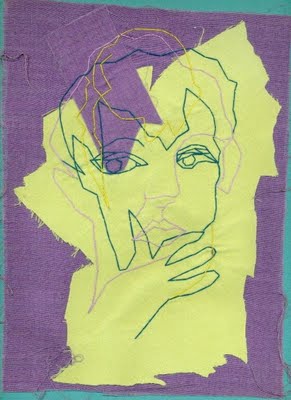
What materials dod this artist use to make this continuous line portrait?

GOALS:

  1. 2.2 evaluate the effectiveness of artworks

What did you see in your neighbor’s drawings that were successful / needed work?

~~~

Art Foundations:

What types of LINE did Pablo Picasso use in this drawing?

GOALS:

  1. 1.3 communicate ideas clearly (how are you communicating your PBIS message?)
  2. 2.3 create artworks that solve visual challenges (what techniques, style, approach are you taking with your poster design?)

What were the different types of lines drawings that you worked on today? What are different kinds of lines and what sorts of messages can they communicate to an audience? Talk about all 5 types with your neighbor and write down which type of line you think best describes you and WHY

~~~

AP Studio Art:

What is the same about these works? What is different?

GOALS:

  1. 1.1 apply media, techniques, and processes with (1.1.3) an awareness so that your ideas are executed well.

What materials have you challenged yourself with today? What are you struggling with? What are you succeeding with? Share your thoughts with a NEW neighbor… not the same person you go to usually.

Work WITH and THROUGH your materials. 10 Things the Arts Teach Children.

“Art is the concrete representation of our most subtle feelings.” Agnes Martin

Agnes Martin – Subtle work, no?

10 Things the Arts do for children – Click Here for the Binder insert – go to the table of contents and click on the page.

~~~

Advanced Drawing: MID CRIT – How is your continuous line contour drawing coming? Background, foreground? How is it?

What mediums did this artist use and are they AWARE of the materials? Are they thinking with and THROUGH the materials?

Goals:

  1. 1.1 apply media, techniques, and processes with 1.1.1 skill and 1.1.2 confidence.

What do you feel was the MAJOR aspect of the crit that YOU NEED TO WORK ON? What do you see as the benefit of the Crit. What do you see as a downfall / challenge?

~~~

Art Foundations: PBIS Poster – CHAPTER 4 in the textbook.

Lines, Limes, Everywhere there’s line…

Goals: 

  1. 1.4 create, define, and solve visual challenges using 1.4.1 analysis (breaking up the artwork / subject matter to basic elements of LINE)

What were the challenges you have had with the PBIS poster? What was fun about the process? What kinds of lines were you “Drawn” to?

~~~

AP Studio Art: Concentration works – how’s the progress on the mini-critique?What were the challenges you had with the line drawing What was fun about the process? What kinds of lines were you “Drawn” to?

Watercolors… how are you attempting to use the materials that are made available to you?

Goals:

  1. 1.1 apply media, techniques, and processes with (1.1.3) an awareness so that your ideas are executed well.
  2. 1.2 create art that demonstrates an understanding of how your ideas relate to the (1.2.1) materials.

What are the biggest challenges you are having? How many works have you FINISHED? 3 are DUE on Monday!

What the Arts teach Children… SO MUCH & MORE!

What is Art? Anges Martin “Art is the concrete representation of our most subtle feelings.” Art In America (p.124, 1996)

Look back at page 8 in the Handbook… Which of the “TEACHINGS” of art do you think is most important to you? Take a few minutes and talk with your neighbor about this and write you BRIEF thoughts in the Generalization / Reflection portion of your Goals Pages.

~~~

Advanced Drawing: QUICK CRIT – Put your work up! Portraits with Continuous Lines and NEW AND EXPERIMENTAL MATERIALS!

How are you using COLOR to deal with the NEGATIVE SPACE – ACTIVATE THE WHITE!

Goals:

  1. 1.4 Solve visual challenges using 1.4.3 evaluation (Self and Peer)

What did you take away from the critique today? Write down what you have taken from the critique?

~~~

Art Foundations 2D: PBIS Posters, Chapter 1, Sketchbook Info

Shepard Fairey and his POSTER! COMMUNICATION! And his COURT CASE.

Goals:

  1. (3.3) describe the creation of images and ideas and explain why they are of value.

Describe how you and your team came up with the PBIS idea and explain why it is important and / or successful.

~~~

AP Studio Art: Mini Concentration today. Begin to think about WHY you are in this class.

What is PASTEL doing for you? How can you use it to enhance your work? Have you ever USED pastel before?

Goals:

  1. 1.1 apply media, techniques, and processes with (1.1.3) an awareness so that your ideas are executed well.
  2. 1.2 create art that demonstrates an understanding of how your ideas relate to the (1.2.1) materials.

Sit down with a classmate and have a conversation about what materials you used today? Discuss how are the project is coming along? What do you need to be doing tomorrow to make STRONG headway?  Have a good, in depth conversation… What do you hope to get out of this class?

How can YOU create a concrete representation of your most subtle feelings?

Agnes Martin in her NY Studio 1960. Photo Alexander Liberman

“Art is the concrete representation of our most subtle feelings.” – Agnes Martin

~~~

Advanced Drawing: Take a look at the state of the work from last week.

What is the SCARY part of being critiqued?

GOALS:

  1. evaluate the effectiveness of artworks

What did you take away from the critique today? Write down what you have taken from the crit.

~~~

Art Foundations: Talk about the importance of sketch books and work on PBIS Posters.

Art Class Teaches… ART Teaches…

10 Lessons the ARTS teach Children – Page 9 in Goals Binder

GOALS:

  1. Know about the reason behind making art (and sketchbooks)

What advancements did YOU make in the poster? How does your poster communicate the ideas of PBIS?

~~~

AP Studio Art: Work with DIFFERENT materials in your small concentration?

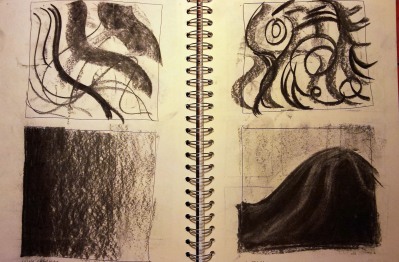
What can you do with CHARCOAL?

GOALS:

  1. 1.1 apply media, techniques, and processes with (1.1.3) an awareness so that your ideas are executed well

What materials have you used today? How are the projects coming along?

Ask Me ARTnother – A game show about what you may or may not know about art.

Welcome to the BEST ART CLASSES in the WORLD!

Put your GOALS sheets away!

Today the ONLY goal is to test your knowledge of the arts and make it to the final round.

TODAY – ALL of my art classes will be participating in a quiz show called:

Logo 1

Special Thanks to the inspiration of all the folks from NPR’s Ask Me Another. NPR’s exciting new show featuring puzzles, word games and trivia played in front of a live audience. Ask Me Another is a co-production of NPR and WNYC. Host Ophira Eisenberg invites in-studio guests and listeners alike to stretch their noggins, tickle their funny bones, and enjoy witty banter and guitar riffs from house musician Jonathan Coulton. Additional thanks to game gurus John Chaneski, Art Chung, and actor/writer Will Hines