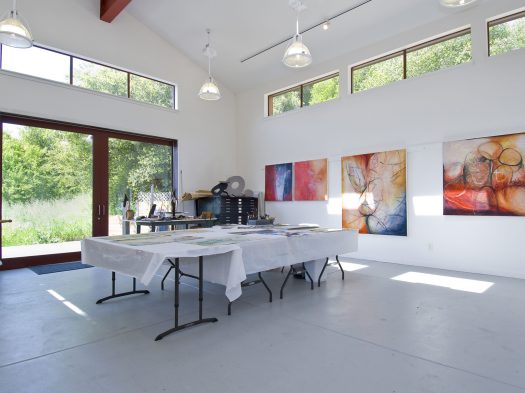
#Making #Art as the #Week #Ends – #Thursday in the #Studio

“Nobody tells this to people who are beginners, I wish someone told me. All of us who do creative work, we get into it because we have good taste. But there is this gap. For the first couple years you make stuff, it’s just not that good…” Ira Glass


Drawing: Tomorrow – MID CRIT – What do you have to show?

2.1Ac: Through experimentation, practice, and persistence, demonstrate acquisition of skills and knowledge in a chosen art form.

What skills do you want to demonstrate as we prepare for the mid-crit for tomorrow.

img_1288
Fred Bell : https://2.bp.blogspot.com/-wSxmce88u2Y/WBP1-gWb0zI/AAAAAAAAEVk/KarrZZchi-InsTs3WASwutM7pEEs91KBgCPcB/s1600/IMG_1288.JPG

Take a look at the FIRST portion of the back of the rubric and fill out the EXECUTION portion of it.


Studio Art 360: The GRID and your CANVAS

3.1P: Apply relevant criteria from traditional and contemporary cultural contexts to examine, reflect on, and plan revisions for works of art and design in progress.

What challenges did you have in the finding of SHAPE in the portrait? Talk for 2.67 minutes to your table about the process.

1452526259-alex-katz-ted-berrigan
Alex Katz’s Ted Barrigan. Portrait: https://assets.paddle8.com/media/editorial/entry/1452526259-alex-katz-ted-berrigan.jpeg

How have you begun to transfer the images to the canvas? Success? Not as much? Why? Explain.


AP Studio Art: Concentration – Mid Crit on Monday? Sketchbook Looks on Friday.

Research and Information Fluency – Students apply digital tools to gather, evaluate, and use information.

What problems are you having with the BLOG / WordPress program – uploading? Writing? Maneuvering around the site?

sam_francis_untitled_1992cf
Sam Francis in the studio – Look at ALL THE WORKS! http://www.samfrancis.com/images/samfrancis/Portraits/Zoom/sam_francis_untitled_1992cf.jpg

What do you need to do in order to have ALL your work (made so far this year) photographed, edited, and uploaded to the website?
 

#Wednesday and we’ve got a lot of #ART to make. #Grids #StillLife #Concentration

“Nobody tells this to people who are beginners, I wish someone told me. All of us who do creative work, we get into it because we have good taste. But there is this gap. For the first couple years you make stuff, it’s just not that good…” Ira Glass


Drawing: Fred Bell and YOU

2.1Ac: Through experimentation, practice, and persistence, demonstrate acquisition of skills and knowledge in a chosen art form.

How is the work developing? REMEMBER – Friday of THIS WEEK as a MID-CRIT! N: Mark making and process over product. Emphasize the ideas of the mark making and observation.

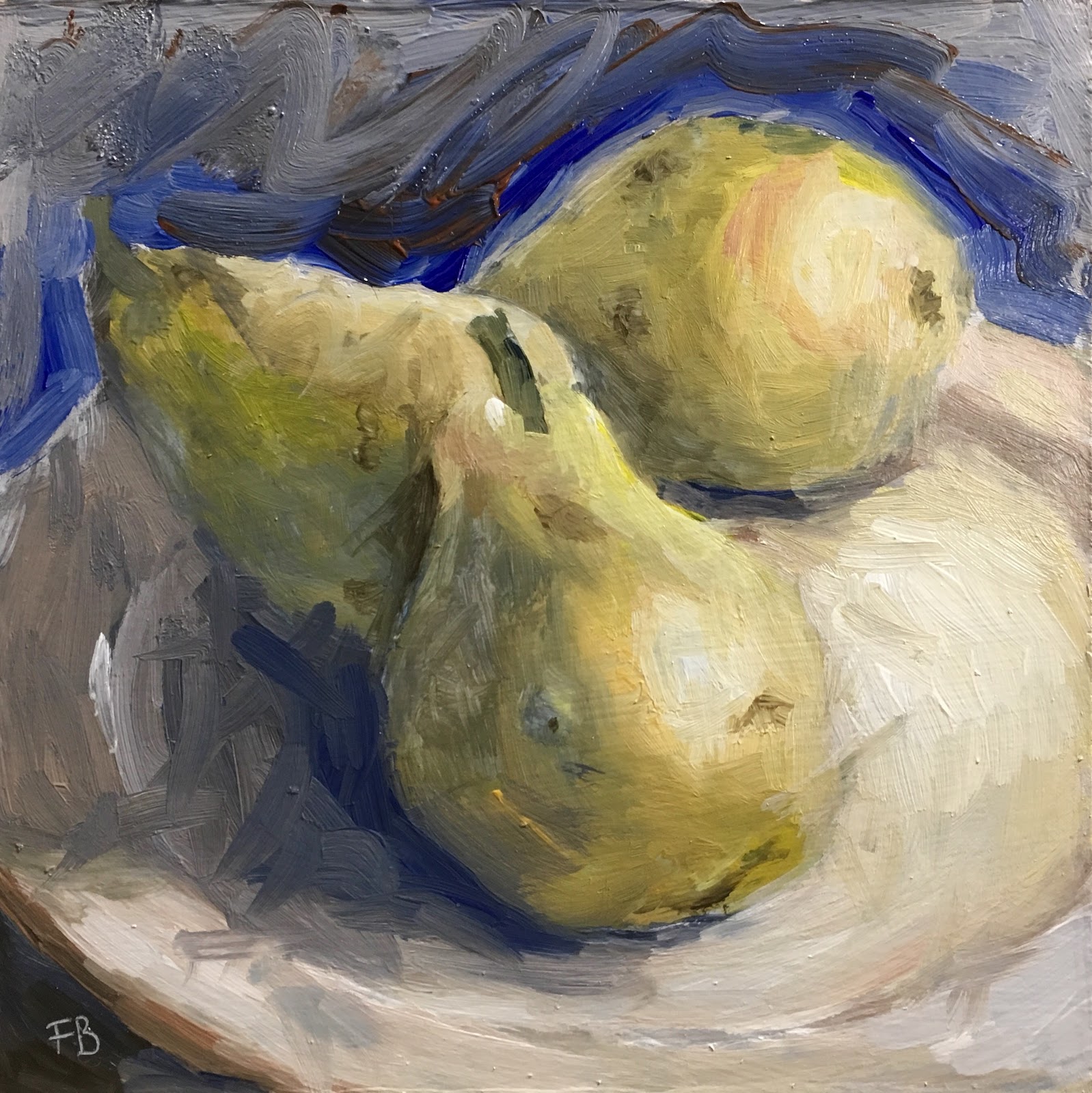
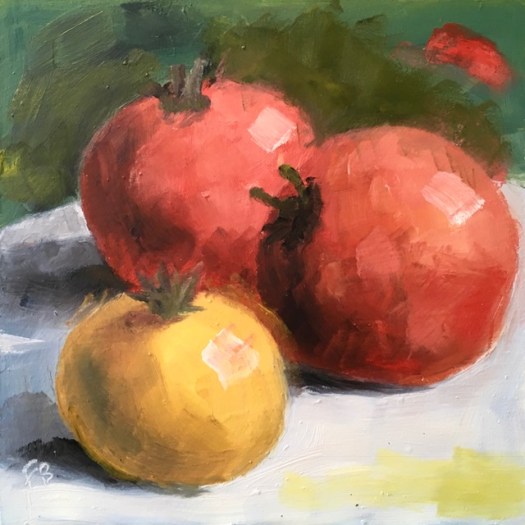
3152b22bred252c2bone2byellow
Fred Bell Still Life – Small group of fruit: https://3.bp.blogspot.com/-yo1W3evh5u0/WV_3KI2LOiI/AAAAAAAAF0w/Wj8M58Q98jED4eodd4wev_7y_2utn9ACACLcBGAs/s1600/315%2B2%2BRed%252C%2BOne%2BYellow.jpg

Progress? 3 points of progress please.


Studio Art 360: CHUCK CLOSE and the GRID

1.2P: Shape an artistic investigation of an aspect of present-day life using a contemporary practice of art or design.

How is BREAKING the image down to basic shapes going to make the process of creating a memorable and successful work of art easier?


What challenges did you have today with the transferring of the portrait up to the canvas? Two struggles?


AP Studio Art: CONCENTRATE – Really concentrate on the work.

1.2Ad: Choose from a range of materials and methods of traditional and contemporary artistic practices, following or breaking established conventions, to plan the making of multiple works of art and design based on a theme, idea, or concept.

Scholastic Assignment

How have you been able to use the NEW skills you’ve developed this year and create a STRONG BODY of CONCENTRATION works? How are you being interested in the CONCENTRATION work that you are creating?

0a9f141ebe665bf14ad9cd47fcae4723-anne-washington-dc
Anne Truit Working in her Studio: https://i.pinimg.com/736x/0a/9f/14/0a9f141ebe665bf14ad9cd47fcae4723–anne-washington-dc.jpg


Knowing that you are working on your concentration works and STRONG IDEAS with SKILL Building ideas, how are you advancing the ideas of the ARTIST’S JOB? (Or would you like to draw / make JUST TO MAKE ART TO CHALLENGE YOURSELF)?

Korb’s #Absence is Your Gain – Lots of #Art #WorkTime in the #Studio

52 Every color has an opposite, called a complement. Complementary colors sit opposite one another in the color wheel. Additionally, all colors are affected by the presence of other colors. Even the smallest presence of a complement will enhance the intensity of a color when it is present in the same visual field. The presence of red, for instance, will cause the retina to “seek” green in the other colors present, hereby enhancing all parts of the green spectrum. If you wish to intensify a color in a composition, place some of its complement nearby. This applies to all media. The effective use of color is one of the greatest tools at an artist’s disposal. Kit White 101 Things to Learn in Art School


Drawing: Colored Pencils and the Still Life – Time to START with this.

2.1Ac: Through experimentation, practice, and persistence, demonstrate acquisition of skills and knowledge in a chosen art form.

How is the work developing? REMEMBER – Wednesday of NEXT WEEK as a MID-CRIT! N: Mark making and process over product. Emphasize the ideas of the mark making and observation.

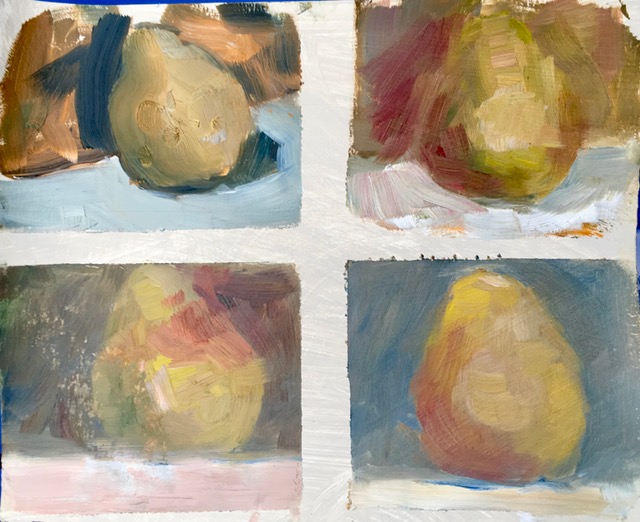
CLICK ON THE IMAGES BELOW to show the 2 different stages of the process. DRAW LIGHTLY when you begin and SKETCH IT OUT!

Progress? 3 points of progress please. 3 pieces of fruit


Studio Art 360: Paints – CLEAN UP AFTER YOURSELF!

1.2P: Shape an artistic investigation of an aspect of present-day life using a contemporary practice of art or design.

Review with your neighbor the relationships of color on the color wheel.

20171130_114235.jpg

Review with neighbors the relationships of the colors on the color wheel? QUIZ one another on the names, types and relationships of the colors.


AP Studio Art: Concentrate – Website – 3 images and 2 Questions, 1 Sketchbook and 1 Scholastic Art Magazine Article – DUE MONDAY

3.1P: Apply relevant criteria from traditional and contemporary cultural contexts to examine, reflect on, and plan revisions for works of art and design in progress.

What are you planning on doing TODAY to set yourself up for a productive WEEKEND? What is your body of work centered on? Drawing? 2D Design? How do you see this in your first three artworks?

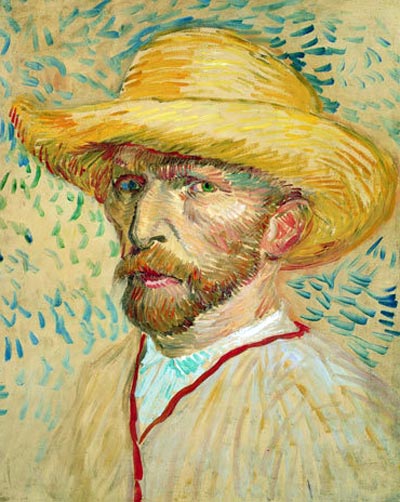
van-gogh-painting
Portrait of Vincent Van Gogh: Self Portrait: http://www.clevelandseniors.com/images/funny/art-thief/van-gogh-painting.jpg https://en.wikipedia.org/wiki/List_of_works_by_Vincent_van_Gogh

What did you accomplish today? What do you need to do tomorrow? How can you develop your OWN voice? What does the BREADTH work do to help you find that VOICE in your concentration? EXIT TICKET – Sticky Note – What is the Central Idea behind your concentration of work. 5 hours of AP Studio Art this week in class – are you putting in 5 hours outside of class? REALLY WORKING? No? You need to be.

Thursday in #Studio – Let’s get down to business… #COLOR is the Topic. GO

52 Every color has an opposite, called a complement. Complementary colors sit opposite one another in the color wheel. Additionally, all colors are affected by the presence of other colors. Even the smallest presence of a complement will enhance the intensity of a color when it is present in the same visual field. The presence of red, for instance, will cause the retina to “seek” green in the other colors present, hereby enhancing all parts of the green spectrum. If you wish to intensify a color in a composition, place some of its complement nearby. This applies to all media. The effective use of color is one of the greatest tools at an artist’s disposal. Kit White 101 Things to Learn in Art School


Drawing: Colored Pencil Worksheets and PRACTICE

2.1Ac: Through experimentation, practice, and persistence, demonstrate acquisition of skills and knowledge in a chosen art form.

20171130_064652.jpg
Gary Larson’s “The Far Side”… Still Life is moving.

How is the colored pencil work developing? What struggles are you having with the ideas of making marks with this medium?

dk1
Fred Bell – Regular – ordinary objects: https://2.bp.blogspot.com/-po7P8yJjkCo/WXgGxsl9M3I/AAAAAAAAF2k/KvycvIW8qcgYNAq4uJ8DllC0072zK9XMACK4BGAYYCw/s1600/DK1.jpg

Progress? 3 points of progress please.


Studio Art 360: Color and the Wheel – RELATIONSHIPS

7.1P: Hypothesize ways in which art influences perception and understanding of human experiences.

Where do you see color? How does the color on TV get blended together? How does color in a magazine get blended together? Optical color?

1
This is the close up of an old school TV: RGB: https://ak9.picdn.net/shutterstock/videos/18871319/thumb/1.jpg

What are the three types of colors on the color wheel? What can you NOT mix? How do you mix Orange, etc…


AP Studio Art: What are YOU doing today?

1.2Ad: Choose from a range of materials and methods of traditional and contemporary artistic practices, following or breaking established conventions, to plan the making of multiple works of art and design based on a theme, idea, or concept.

MONDAY we look at the sketchbooks as I will be gone tomorrow. What NEW ideas are you having about the concentration? Do you have a transition piece in mind that demonstrates GROWTH? 

http://seanscullystudio.com/

How is the WEBSITE developing? Will your questions be answered for MONDAY?

Wednesday is HUMP day and ART MAKING day too

52 Every color has an opposite, called a complement. Complementary colors sit opposite one another in the color wheel. Additionally, all colors are affected by the presence of other colors. Even the smallest presence of a complement will enhance the intensity of a color when it is present in the same visual field. The presence of red, for instance, will cause the retina to “seek” green in the other colors present, hereby enhancing all parts of the green spectrum. If you wish to intensify a color in a composition, place some of its complement nearby. This applies to all media. The effective use of color is one of the greatest tools at an artist’s disposal.

Kit White 101 Things to Learn in Art School


Drawing: Begin the DRAWING and with COLORED PENCILS

2.1Ac: Through experimentation, practice, and persistence, demonstrate acquisition of skills and knowledge in a chosen art form.

3rd day with the ideas of developing compositions – What skills are you looking to develop? We start by prepping a board with watercolor. Let it DRY. Begin to practice on the illustration board.

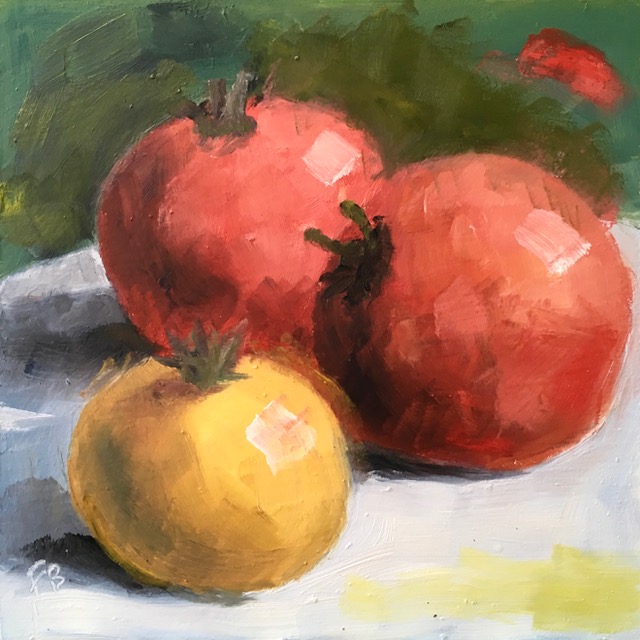
3382bquiet2btomatoes
Fred Bell Bowl of Fruit: https://2.bp.blogspot.com/-8VwIQejhtF0/WZTXbWMeejI/AAAAAAAAF5I/9dqXDGFnpkwX3R8R9U-6EyBzCY7Mg6oKwCK4BGAYYCw/s1600/338%2BQUIET%2BTOMATOES.jpg

What feedback would you offer and like to get about your work?


Studio Art 360: Sketchbooks and FUN!

What STRUGGLES do you have with OBSERVATION? How about VALUE?

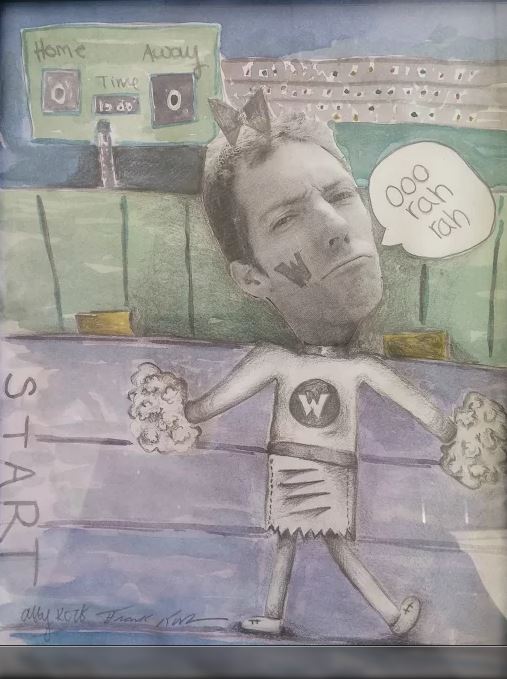
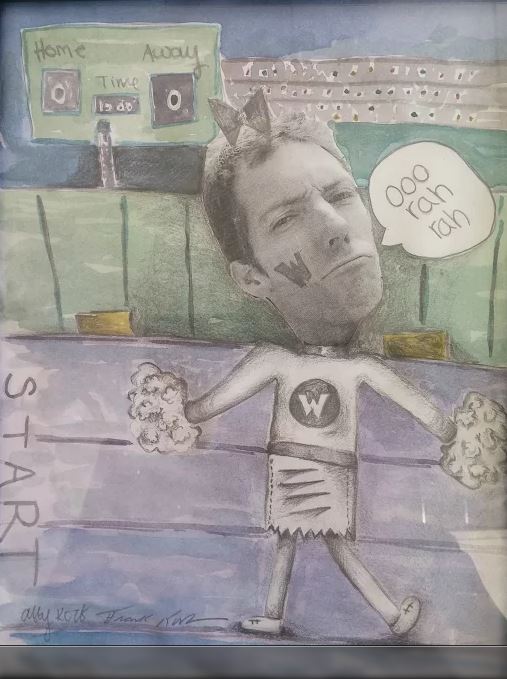
Cut out the head, glue it to the sketchbook page, and then give it to a friend. Using the photograph that has been glued down – resolve the rest of the picture with a friend. Let them begin the background and encourage them to DISREGARD to what was in the original background. HAVE FUN with this.

Check out Mica Angela Hendrick’s website – see what her and her daughter can come up with. http://goo.gl/Xiihh1

oooo-rah-rah-korb


Studio Art 360: Concentration and Conversations – How’s the Sketchbook working FOR you?

1.2Ad: Choose from a range of materials and methods of traditional and contemporary artistic practices, following or breaking established conventions, to plan the making of multiple works of art and design based on a theme, idea, or concept.

What are 3 things you have learned, researched, inquired about your ideas for your concentration so far this week?. I’ve had MANY great conversations with each almost each of you… what do you take away from them?

Alexander Clader's Circus: http://whitney.org/image_columns/0002/4353/alexandercalderinstallview1_600_1200.jpg?1369062947
Alexander Clader’s Circus: http://whitney.org/image_columns/0002/4353/alexandercalderinstallview1_600_1200.jpg?1369062947

What are your questions about making your statement ONLINE? Do you have an idea how to access your ONLINE portion of the website? :

Tuesday and the Color of Art is moving us Forward!

52 Every color has an opposite, called a complement. Complementary colors sit opposite one another in the color wheel. Additionally, all colors are affected by the presence of other colors. Even the smallest presence of a complement will enhance the intensity of a color when it is present in the same visual field. The presence of red, for instance, will cause the retina to “seek” green in the other colors present, hereby enhancing all parts of the green spectrum. If you wish to intensify a color in a composition, place some of its complement nearby. This applies to all media. The effective use of color is one of the greatest tools at an artist’s disposal. – Kit White 101 Things to Learn in Art School


Drawing: Color and the Colored Pencil

1Ac: Through experimentation, practice, and persistence, demonstrate acquisition of skills and knowledge in a chosen art form.

How are your compositions beginnings? What are you thinking about as you work the positive and negative space? N: Mark making and process over product. Emphasize the ideas of the mark making and observation.

23659506_10213355019024300_2430715751463750231_n
Fred Bell – Cherries – No Horizon Composition – How do you play with the negative space? https://scontent-ort2-1.xx.fbcdn.net/v/t1.0-9/23659506_10213355019024300_2430715751463750231_n.jpg?oh=4d88642397b3a03d8670a27d511b141f&oe=5AA4622C

As you look at your beginning drawings what are the strengths of the drawings are moving forward? Light Bulb Fred Bell:


Studio Art 360: Color Schemes and the Sketchbook

What STRUGGLES do you have with OBSERVATION? How about VALUE?

Cut out the head, glue it to the sketchbook page, and then give it to a friend. Using the photograph that has been glued down – resolve the rest of the picture with a friend. Let them begin the background and encourage them to DISREGARD to what was in the original background. HAVE FUN with this.

Check out Mica Angela Hendrick’s website – see what her and her daughter can come up with. http://goo.gl/Xiihh1

Oooo Rah Rah Korb

What was the FUN part of this assignment? What was the CHALLENGE you had with it?


AP Studio Art: Concentration #s4, 6, and 6

G: NETS: Use digital media and environments to communicate and work collaboratively

What are your FEARS as you begin to come to the end of the first three works? What are your FEARS about the AP Process? N:Concentration and SELF DIRECTED WORKS!

Website about Robert Arneson’s Work.

Robert Arneson: http://www.artnet.com/artwork_images_484_822284_robert-arneson.jpg

Ask 2 probing questions about the work of one of your classmates.

#WelcomeBack – Next time it is #WinterBreak

Placeholder

52 Every color has an opposite, called a complement. Complementary colors sit opposite one another in the color wheel. Additionally, all colors are affected by the presence of other colors. Even the smallest presence of a complement will enhance the intensity of a color when it is present in the same visual field. The presence of red, for instance, will cause the retina to “seek” green in the other colors present, hereby enhancing all parts of the green spectrum. If you wish to intensify a color in a composition, place some of its complement nearby. This applies to all media. The effective use of color is one of the greatest tools at an artist’s disposal. Kit White 101 Things to Learn in Art School.

Computer Screen Shot Photoshop


Drawing: Still Life and HOMEWORK – Do you have your objects? Thumbnails and Color study with colored pencils

2.1Ac: Through experimentation, practice, and persistence, demonstrate acquisition of skills and knowledge in a chosen art form.

What do you see creating a series of drawings can do for a artist that a single drawing would not allow the artist to do?

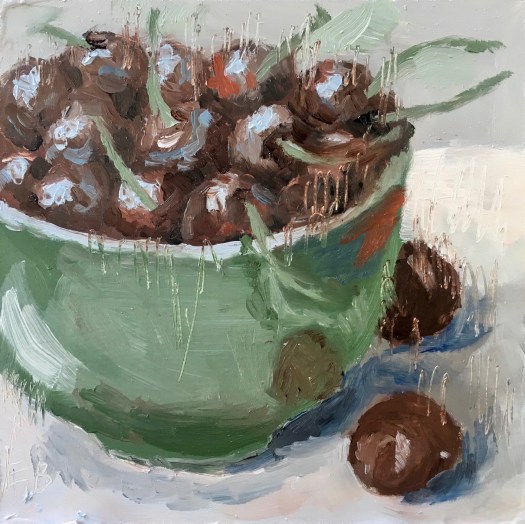
2352bbowl2bof2bcherries
Fred Bell – Bowl of Cherries: https://1.bp.blogspot.com/-gwurEG7CCEY/WYs5022iiMI/AAAAAAAAF4o/2G57iBkc81QOTGCTJKiA8-MPZ6SiHJJVQCLcBGAs/s1600/235%2BBowl%2Bof%2Bcherries.jpg

As you look at your THUMBNAILS and the numerous drawings you have begun, what are the strengths that you are seeing as you move forward? Contrast? Value? Observation?


Studio Art 360: Color and POP Art – coming up!

7.1P: Hypothesize ways in which art influences perception and understanding of human experiences.

Where do you see color? How does the color on TV get blended together? How does color in a magazine get blended together? Optical color?

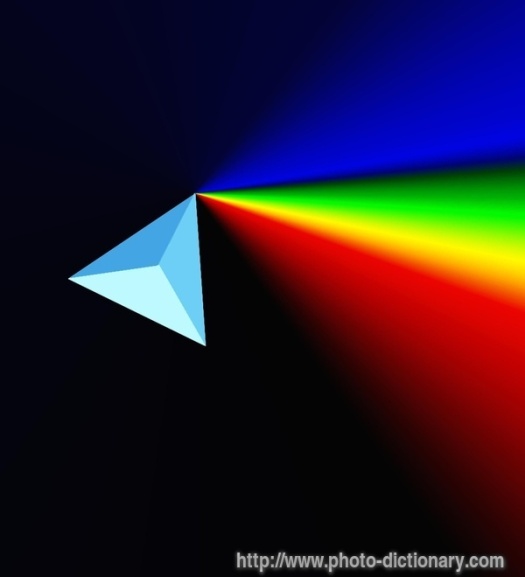
PRISM and Color Mixing http://www.photo-dictionary.com/photofiles/list/699/1110prism.jpg

What are the three types of colors on the color wheel? What can you NOT mix? How do you mix Orange, etc…


AP Studio Art: The WEBSITE and your first 3 concentration works

NETS: Use digital media and environments to communicate and work collaboratively

What is the central idea behind your concentration?  NOTE: We are 1 week off in the concentration / syllabus – we will try to make up for it over the next few weeks / Christmas Break.

draft-37f379f1-8e24-426d-bd51-410c8d3e5823
Alice Need: the DeVegh Twins: https://dg19s6hp6ufoh.cloudfront.net/pictures/612993934/large/draft-37f379f1-8e24-426d-bd51-410c8d3e5823.jpeg?1462237640

Share with your AP Classmates the work you have accomplished up to this point. One on One

Last Day of #CRIT and the #TURKEYDay Break!

51: Learn the basic principles of color. There are three primary colors: red, blue, and yellow. They are the building blocks of all other colors. The secondary colors are violet (blue and red), green (blue and yellow), and orange (red and yellow). They are composed by the equal mixture of two primaries. All other colors are referred to as tertiary, because they are mixtures of a primary and a secondary color. Kit White 101 Things to Learn in Art School


Drawing: CRIT

ASSIGNMEMT OVER BREAK – 3 OBJECTS AND ONE PATTERNED FABRIC. Check out your Google Classroom for more information.

3.1Ac: Engage in constructive critique with peers, then reflect on, re-engage, revise, and refine works of art and design in response to personal artistic vision.

What do you feel about talking aloud when it comes to other’s works? What are your thoughts about why you may be apprehensive or confident when discussing other individual’s work?

What were 3 things that you took away from today’s critique?


Studio art 360: Sketchbook Tuesday

2.1P: Engage in making a work of art or design without having a preconceived plan. A: What do you feel is the value of practicing in a sketchbook? How can you see this as being a place that others (engineers, designers, architects, artists) might need as a valuable tool?

Please grab hold of a piece of candy from the pile in the classroom. Open the candy and eat it. Keep the wrapper and STAPLE it into your sketchbook – folds and all. Look at how the 2 contemporary artists Stephen Shanabrook and Veronika Georgieva worked together. Fold, crease, wrinkle it a few times and overlap a bit of it. Use a VIEWFINDER (provided) trace out the empty space on a page in your sketchbook (you’ll be drawing in that space later). Choose a PORTION of the folded candy bar image and, using the VIEWFINDERS (look at the new compositions and simplify it), and draw it out to the best of your ability (HB – Hard Pencil to start, colored pencil to finish). The ideas are all up to you.

Stephen Shanabrook: https://hypebeast.imgix.net/http%3A%2F%2Fhypebeast.com%2Fimage%2F2016%2F09%2F10-facts-artist-stephen-j-shanabrook-1.jpg?fit=max&ixlib=php-1.1.0&q=90&w=1755&s=9ab731681698819730b13651c2718777

What are your thoughts about how you can draw this object? Stephen Shanabrook:


AP Studio Art: Concentration and Protest Art – Judy Chicago

2.1Ad: Experiment, plan, and make multiple works of art and design that explore a personally meaningful theme, idea, or concept.

What are you thinking about carrying forward as you begin your next three works? Write your ideas out in your sketchbook as you work.

1363
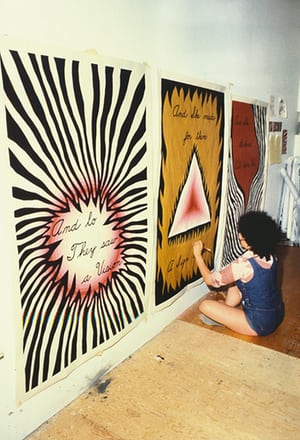
Judy Chicago preparing banners for the Dinner Party” https://i.guim.co.uk/img/media/625d49b6f96ba6806c02129e968066d645401e71/0_0_1363_2000/master/1363.jpg?w=300&q=55&auto=format&usm=12&fit=max&s=8a8eb9dd543f82304729ec05d6636725

What are two things that you would judge as successful as you look at the 3 works together? Consider these FIRST three works as beginnings. Judy Chicago: Banners for the Dinner Party:

#Thanksgiving is coming up! Gobble Gobble Gobble!

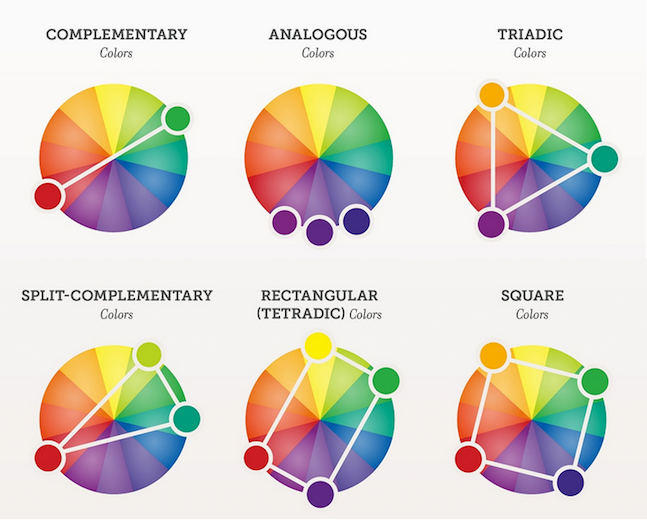
51: Learn the basic principles of color. There are three primary colors: red, blue, and yellow. They are the building blocks of all other colors. The secondary colors are violet (blue and red), green (blue and yellow), and orange (red and yellow). They are composed by the equal mixture of two primaries. All other colors are referred to as tertiary, because they are mixtures of a primary and a secondary color. Kit White 101 Things to Learn in Art School

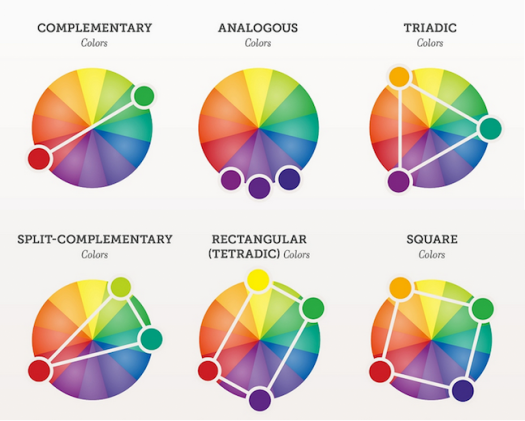
Color Schemes: https://oss.adm.ntu.edu.sg/lzhang041/wp-content/uploads/sites/423/2015/10/color_schemes.png

Drawing: CRITIQUE DAY! Clip and Pin your work to the boards in the front of the room!

3.1Ac: Engage in constructive critique with peers, then reflect on, re-engage, revise, and refine works of art and design in response to personal artistic vision.

What do you feel about talking aloud when it comes to other’s works? What are your thoughts about why you may be apprehensive or confident when discussing other individual’s work?

art-school-crit
Art School Critique: http://escapingartist.com/wp-content/uploads/2012/07/Art-School-Crit.jpg

What were 3 things that you took away from today’s critique?


Studio Art 360: Cleaning Day – Tomorrow SKETCHBOOK TUESDAY!

2.2P: Explain how traditional and non-traditional materials may impact human health and the environment and demonstrate safe handling of materials, tools, and equipment.

Today is a day to CLEAN the Studio. What do you feel are important reasons for having to take care of the space we are working is as artists. Have a conversation and write down (p21) the top three things you and your group came up with and WHY.

art_studio_4
Clean Studio: https://images.butlerarmsden.com/Portola-Art-Studio/_desktopImage/Art_Studio_4.jpg

How do you feel the room looks? What makes you feel accomplished as you look back at the good you have done for others?


AP Studio Art: Alice Neel / Judy Chicago and CONCENTRATION Over Break.

2.1Ad: Experiment, plan, and make multiple works of art and design that explore a personally meaningful theme, idea, or concept.

With three works due MONDAY, do you feel that the 2+ weeks was TOO MUCH TIME? We need to continue working at a quick pace… lots to do yet…

1956135_orig
Judy Chicago Dinner Party: https://womenandmediaspring2014.files.wordpress.com/2014/04/1956135_orig.jpg

What is the ONE THREAD that your AP READER might see as they look at the 3 works you have (or are working on) that will tie things together

#Friday is HERE and the #Weekend is a time to #RESOLVE your ARTWORK for the #CRIT!

#69 Color is not Neutral: It has an emotional component. Certain colors have specific associations and induce certain responses. Learn what they are. When you use color, try to determine and understand the accompanying emotional response and how to use it effectively. Color has a visceral impact. Kit White 101 Things I Learned in Art School


Drawing: One more day – One more drawing for some.

3.1Ac: Engage in constructive critique with peers, then reflect on, re-engage, revise, and refine works of art and design in response to personal artistic vision.

Final day to work in studio – step back for the first 4 minutes with a studiomate and REFLECT with one another on the work you’ve gotten done. Talk about the artist you chose and be ready to talk about this on Monday.

kk_selfp_vonk171_signed
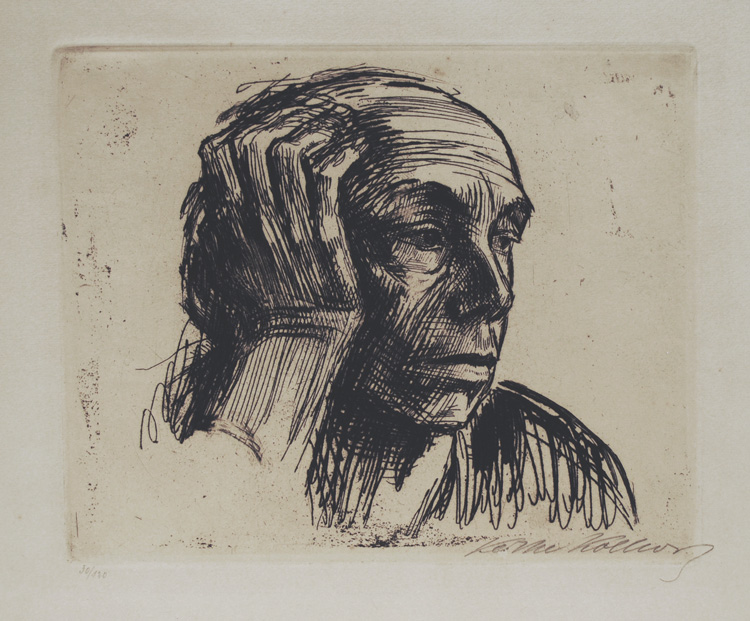
THINK THINK THINK Katie Kollwitz: http://www.spaightwoodgalleries.com/Media/Kollwitz/KK_SelfP_VonK171_signed.jpg

HERE IS THE FOLDER FOR YOUR SELF ASSESSMENT

Step back – one sticky note – Strongest element of the work in front of you. One area that you would like to have handled differently? This is your ticket out.


Studio Art 360: LAst day in CLAY

1.2P: Shape an artistic investigation of an aspect of present-day life using a contemporary practice of art or design.

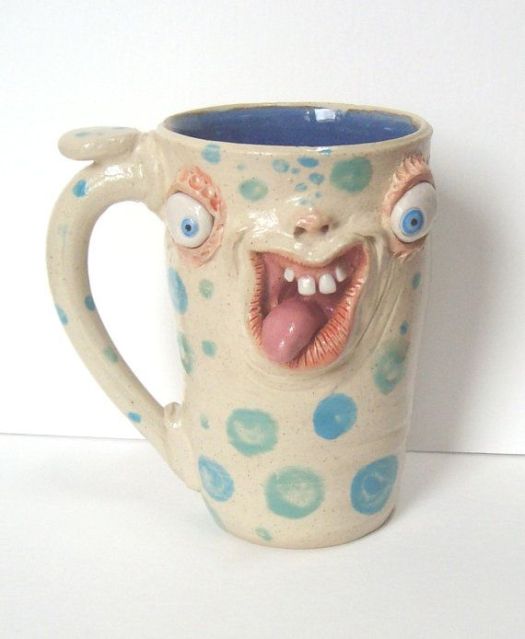
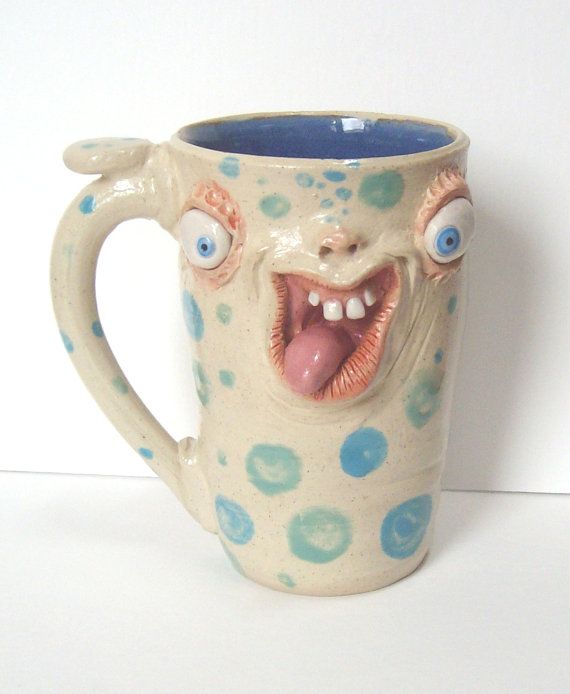
What challenges did you have in getting started last week on with the clay? REQUIREMENTS FOR THIS ARTWORK: Subtractive, Additive, and Manipulation to the clay. These techniques are REQUIRED in the FINAL Mug with a face. We are DONE with this TODAY.

1396818054-0
READY TO WORK! HAve a day of finishing it up! http://uploads.neatorama.com/images/posts/923/70/70923/1396818054-0.jpg CLAY MUGS

What was the largest success you have in today’s work? Take a look at the rest of the classes work BEFORE we clean up. PAUSE 10 minutes before the end of class.


AP Studio Art: Concentrate Folks

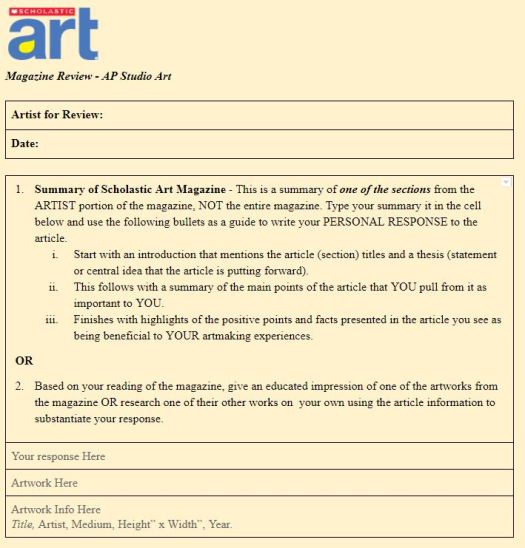
SCHOLASTIC ARTS ASSIGNMENT – You need to be in Google Classroom and you need the Alice Neel Magazine. Go to your GOOGLE CLASSROOM and use code: a8l9npy to join AP Studio Art. In there you will find the necessary materials. This is DUE on Monday!

1.2Ad: Choose from a range of materials and methods of traditional and contemporary artistic practices, following or breaking established conventions, to plan the making of multiple works of art and design based on a theme, idea, or concept.

Beginning on the FIRST set of 3 works… What is the CENTRAL IDEA behind your concentration? Remember that you need to have a common thread / common theme / CENTRAL IDEA that ties your works together.

1386711762-cbd8b
Michael Berryhill: Artist to watch. http://www.blouinartinfo.com/sites/default/files/styles/1050w576h/public/1386711762-cbd8b.jpg

What did your conversation with your classmates help you do, help you explain / understand as you move your work forward?