Once again, but with a moving twist, I offer a brief glimpse of the works currently on display (and for sale) at Cafe LuLu in the Bay View neighborhood of Milwaukee, WI. When you happen to be in the neighborhood – please stop in and take a look. My family and I had a great lunch there and this is a short video of the works. Please, stop in and check out the works, have a GREAT MEAL, and contact me when you are interested in the works. Also… mark your calendars for September 27 when the ENTIRE BAY VIEW Neighborhood opens their artistic doors to celebrate the artwork, artists, art galleries, and art spaces that Bay View, Milwaukee has to offer. I will be at Café LuLu to talk and chat… I hope to see you, and all your friends, there!
34 works of art in 50 seconds… Thanks Southampton Art Fair and Blouin Art Info for the Inspiration
It seems like I have been on a two week sabbatical… it has been busy and I am glad to be back.
Thanks to the Inspiration of Blouin Art Info‘s Southampton Art Fair (the Third and LARGEST art fair in Southampton), and the 60 works in 60 seconds video produced to publicize the show (Link Here). I present to you 34 Works of Art in 50 seconds. The video of my works (with music presented by YouTube – Thanks) I offer a brief glimpse of the works currently on display (and for sale) at Cafe LuLu in the Bay View neighborhood of Milwaukee, WI. If you happen to be in the neighborhood – please stop in and take a look. If you are in Southampton, do the same for their show!
It’s Not Just Content Anymore…
In a great video by Dr. Tony Wagner (Twitter: @DrTonyWagner), he describes the Seven Skills that are essential to the graduates of today. The unfortunate thing is… most courses do not offer these skills because, so it seems, most classes are so content driven, there is no room for the other skills that need to be taught.
Thanks to Edudemic.Com’s Post “The 7 Skills Students Must Have For The Future”, the seven skills that ARE needed include:
- Critical thinking and problem-solving
- Collaboration across networks and leading by influence
- Agility and adaptability
- Initiative and entrepreneurialism
- Effective oral and written communication
- Accessing and analyzing information
- Curiosity and imagination
As I consider the Arts Curriculum that I teach, with Goals and Objectives based on the National Visual Arts Standards, the Seven Skills that are “Must Have’s” are touched on and dealt with on a regular basis. Maybe not each skill every day, but as I look at particular assignments / artworks, one may see the connections that are dealt with to emphasize the seven skills (and one may look at Marzano’s Instructional Strategies [my notes on the book: Classroom Instruction that Works] to see if and how they all tie together). I am in a fortunate position where the elements and principles of art are simply a foundation for the creation of artwork and tie together and build upon one another from the very first class to the highest level of an AP course. Line is Line is Line… Value is Value is Value… Balance is Balance is Balance… and the artists just get more adept at using them throughout the years.
Skills and tools like Critical Thinking: looking at the assignment, challenge at hand and coming up with multiple successful solutions to the same challenge; Collaboration: sharing ideas and critiques – both through writing and orally; Being Agile and Adaptable: enough to solve problems with resources at hand; Taking Initiative: to be self driven artists (some struggle with this – some are pro’s); Effective Oral and Written Communication: Critiquing, again the written and oral – both self, teacher based, and peer to peer – soon parent to child to teacher; Accessing and Analyzing Information: taking the historical and contemporary ideas and tying the artistic challenge into their own artwork. Making sure that the artwork they create speaks about their important place in history; and finally Curiosity and Imagination: Making successful and challenging art – Duh? These are ALL parts of each and every artwork (sans the Art Foundations on EACH of the projects – there are the elements and principles one has to get through… but give it time).
Above is Dr. Tony Wagner’s Video and Below is his Power Point Presentation… Definitely worth the look. Thank you Edutopia and Dr. Tony Wagner.
Making Plans to Create an “One Week Painting”

Once a year, I get the opportunity to create a temporary artwork at the Art*Bar in Milwaukee, WI. The Art*Bar is exactly what it sounds like, a Bar that has no wall advertising for the adult beverages that it serves, but rather walls full of real, live, legitimate Art (with a capital A). To see MORE of my art and the PURCHASE MORE of my art (nudge nudge…) please visit frankkorb.com and get in tough with me through my e-mail there.
After September 11, 2001 occurred, and the world was still reeling from the shock, “Don Krause, then 42, took the event as a personal wake-up call and sought out a place to cultivate his Riverwest dream, to create a unique tavern. “I never told anyone what I was working on and I didn’t know when it was going to open,” says Krause. “I had never done anything like it before.” All he knew was how to create a good atmosphere, developed from his eight years as an interior designer at Ethan Allen.” (Putz, http://urbanmilwaukee.com/2013/05/27/taverns-artbar-is-a-painters-paradise/). Thank heavens Krause had this vision and was able to follow through with it. (As a side note: Please visit the a fore mentioned article / link about the Art*Bar. It is amazing how SMALL the world is. Nastasia Putz was a one semester student of mine YEARS ago and has now made her marks in the world of journalism. It is funny how people circle in and out of one’s life. Thanks for the conversation Nastasia – great article!)
10 years fast forward (and 10 paintings of my own at the Art*Bar) we arrive at July 7, 2013. Ok, the math doesn’t work out quite right, but the Art*Bar has been around for 10 years now… Walking into the space, I arrive with a start and see that the traditional scaffolding that usually holds the artist for the evening above the 3′ x 5′ canvas above the door is missing. This happened to me last year also, but it was just that the scaffolding had been forgotten about. This year… the scaffolding is gone and the canvas is propped up on a table awaiting the new ideas of the arriving artist.

The idea behind the “One Week Painting” that I have created and planned on creating is such an ingenious idea of temporary art, I have carried it into (or rather just outside of) my high school classroom. For one small amount of time (8 hours) a painting is created and then hangs for one week. After that week, another artist comes in and reworks, incorporates, or completely obliterates the previous weeks work and a NEW work is presented for the week. This happens for 51 weeks and then the final week a PARTY is held for the 51 artists who took part. Slide show of all the year’s paintings is projected, prints of the works are hanging on the large metal / magnet wall, and Don’s favorite 10 are printed / frames and hanging in the prominent place around the bar. I have had the fortune to be a “favorite” twice in my 9 previous year… maybe 3 times… I’ll have to check my CV.

Not entirely certain as to the direction I was planning on going, I prepared with some supplies of recycled drop papers, coffee filters, and my faith in the Bible pages I base most of my artworks over. I stepped into the establishment with supplies in hand, my trusty buckets and milk crates of paints, ready to attack, or at least gently work the painting from the previous week into my thoughts for the current week. The 6 hours I needed on July 7 were full of “What do I do NOW,” “How to solve that issue,” and “I think this is going to work, I have got it.” Here is the process of the 6 hours of making a “One Week Painting” at the Art*Bar.

The original painting I came upon.

My first thoughts and preliminary notions for the artwork.

The first grid has been laid in and the rest is still up in the air.

Continuing with the process…

The center column is laid in and as are the Bible pages.

The lower portion has been whitewashed – ready for paint!

Beginning with yellow and Gesso at the top.

Blues come into play next.

Red is next in the color choices… are you seeing a relationship in the use of colors?

Partway through the process…

Details and pure colors are being added.

GREAT Detail… Idea for future smaller work I think.

Detail.

Detail.

Another detail.

From the side… I love the new layout…

The entire area – great crowd!

The palette I put up last year is still getting used! I have made my mark!

The final art work “I Will Fill It With Splendid Gifts” July 7, 2013 – the Art*Bar.

Detail of NEW work over mine…

The lines have stayed in place… YEAH!

It was great to see the collaged materials still in place.

Great texture… great colors new artist!

Here it is… the new painting over my last week painting.
Technology in the Classroom
I apologize for missing the Thursday morning post. It is funny how the days are different when the daily planning for classes has been set a side and the larger picture of learning comes back into focus for me. I am not sure if anyone else in any other industry (if one can think of education as an industry) has experienced that… anyway.
~~~
As a BEFORE – I share today’s work in my studio with you. I THINK I have a show coming up in July… I’ll keep you posted, and it was good to get back to work.

~~~
Technology in the classroom was my big presentation at last weeks InterActiv Learning Conference 2013 in Whitewater, WI. My largest concern with the use of today’s technology is the misuse of it. Having had an opportunity to listen to a new Freshman in High School (not mine… well, my kid, but not my district) discuss the use (or in some conversations that stand out – misuse) of important resources such as YouTube and Google it struck me that the conversation of how we use technology in the classroom as a learning TOOL and not as “bells and whistles” to entertain or simply to “connect” with the kids was important.
Technology and Interaction in the Classroom (link to my Google Presentation is HERE) was the presentation I had at the conference and I really wish I had heard Michael Wesch’s 201o Presentation at the University of Denver prior to my presentation. The good news (maybe for me) is that I am working in the direction he speaks about in his lecture (link to his presentation is HERE). To keep this brief (and give you a chance to watch his presentation) I feel the most important part of his lecture was to emphasize that the INFORMATION out there is NOT SCARCE and the student of today has all the access to it, in their pocket! The important thing to keep in mind, and this is a brain shift for all in education (kids, parents, teachers, administrators, school board members… everyone), is that the teachers need to help the kids learn HOW to use the technology to be self directed learners. The kids sure know how to entertain themselves with the internet… but strong learners of Web 2.0 tools they are not.
How can we, as teachers, use the tools that are out there to help the kids LEARN how to LEARN? How do we demonstrate the tricks of the trace, the skills that are essential in the process of learning so that the students we have the privileged to work with, can become more independent learners? One of the tricks of using the technology (information really) that is out there is to make sure we are teaching them how to CONNECT to it and not to simply learn it all for the test. This also ties into the thoughts of Noah Chomsky (HERE for a YouTube video Presented at the Learning Without Frontiers Conference – Jan 25th 2012- London) that the TEST is not a very good demonstration of the knowledge the kids have. Yes, maybe for the day and a few weeks later, but then – POOF – that is gone. How can we, as concerned educators and leaders, help the learners make sure that the information we provide them with connects to the world they are living in? The tools are there, and they will be using them for as long as they live. How can we connect the tools, the information that is available, and the techniques to gather, toss aside, sort, filter, and use that information is through demonstration by example, teaching and reteaching, and reviewing the importance of being aware of how the tools and information is to be used.
– Frank
InterActiv 2013 – Day 2 – Technology in the Classroom!
Technology and Communication in the 21st Century Classroom: SURVEY – HELP me (and your contemporaries) with your thoughts! Survey is HERE.
~~~
~~~
Please FOLLOW my GOALS PAGE by entering your e-mail address (see the right of the screen) to get daily updates, ideas, and inspirations. Share, Retweet, Facebook me… however you can share me…
~~~

~~~
Goals:
- Walk away with a new set of tools, skills, and connections to help your students (and yourself) become stronger and more self-aware / driven learners (and teachers).
- Share the ideas and skills about technology that you are great at and help others become more knowledgeable in technology.
~~~
My 3 sessions at the InterActiv 2013 Technology Conference are listed below. The links to the Google Presentations are below also. I am ALWAYS looking for your feedback.
- Tuesday: Session 3: Hyland 3101: 1:45pm – 3:45pm: Presentation: Build Your Own WordPress Blog
- Wednesday: Session 2: Hyland 2314: 10:00am – 11:00am: Presentation: Technology and Interaction in the 21st Century Classroom – SURVEY on Technology in the classroom is HERE.
- Wednesday: Session 4: Hyland 3101: 1:45pm – 2:45pm – Presentation: WordPress in My Classroom
What are your thoughts about my sessions? What are things you enjoyed or learned from? What would you have liked to have learned more about? While this survey is “mostly” about my sessions… I am happy to share your responses about anything that you feel needs addressing. Thanks. Survey is HERE.
~~~
Kids will say the Darndest Things…
Knowing that sketchbooks and goals will ALWAYS be part of the courses, what is one suggestion that you have to offer for future classes? What are some suggestions you may have to help the class become even stronger or more fulfilling than it already is? These require explanation please.
- “Make the goals so that everyone does them and doesn’t slack. It helps my brain learn from the beginning of class and I know it will help others.”
- “To take the goals and understand them not just write them down.”
- “The goals were kind of hard to understand when looking back at them. It’s easy to understand when you explain. but the way they are written down is tricky to look back at.”
June 3, 2013 – Monday of Exam Week!
If we write our dreams and goals down, we dramatically increase our odds of realization. If we share them with others, they become potent and alive.” ―Kristin Armstrong

~~~
10 Lessons the Arts Teach Children
- The arts teach children to make good judgments about qualitative relationships. Unlike much of the curriculum in which correct answers and rules prevail, in the arts, it is judgment rather than rules that prevail.
- The arts teach children that problems can have more than one solution and that questions can have more than one answer.
- The arts celebrate multiple perspectives. One of their large lessons is that there are many ways to see and interpret the world.
- The arts teach children that in complex forms of problem solving purposes are seldom fixed, but change with circumstance and opportunity. Learning in the arts requires the ability and a willingness to surrender to the unanticipated possibilities of the work as it unfolds.
- The arts make vivid the fact that neither words in their literal form nor numbers exhaust what we can know. The limits of our language do not define the limits of our cognition.
- The arts teach students that small differences can have large effects. The arts traffic in subtleties.
- The arts teach students to think through and within a material. All art forms employ some means through which images become real.
- The arts help children learn to say what cannot be said. When children are invited to disclose what a work of art helps them feel, they must reach into their poetic capacities to find the words that will do the job.
- The arts enable us to have experience we can have from no other source and through such experience to discover the range and variety of what we are capable of feeling.
- The arts’ position in the school curriculum symbolizes to the young what adults believe is important.
Eisner, E. (2002). The Arts and the Creation of Mind, In Chapter 4, What the Arts Teach and How It Shows. (pp. 70-92). Yale University Press. Available from NAEA Publications. NAEA grants reprint permission for this excerpt from Ten Lessons with proper acknowledgment of its source and NAEA.
~~~
Art Foundations: EXAM Review today. 4″ x 6″ Notecard. Textbook. Lecture. Pair / Share… what else do you need?
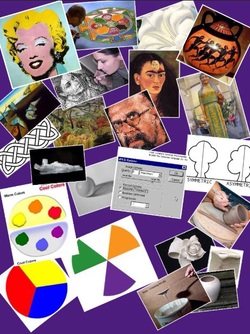
GOALS:
- Standard #1: Understanding and applying media, techniques, and processes.
- Standard #2: Using knowledge of principles and functions.
- Standard #3: Choosing and evaluating a range of subject matter, symbols, and ideas.
- Standard #4: Understanding the visual arts in relation to art history and cultures.
- Standard #5: Reflecting upon and assessing the characteristics and merits of the visual arts.
- Standard #6: Making connections between visual arts and other disciplines.
What do you remember and have down pat? What elements / principles / theories are you struggling with? What do you need to make SURE you have on the 4″ x 6″ note card (one side)?
~~~
Drawing: Computer time in the lab – let’s get the COLLABORATIVE work done – AFTER WE CLEAN and ORGANIZE our stuff.
GOAL:
- Communication and Collaboration – Students use digital media and environments to communicate and work collaboratively, including at a distance, to support individual learning and to the learning of others.
What do you think about your images? how has this been different than paper… other drawings… ideas in your understanding of art?
~~~
AP Studio Art: Computer Lab… Collaborative work. Clean Studio. Thanks.

GOALS:
- Communication and Collaboration – Students use digital media and environments to communicate and work collaboratively, including at a distance, to support individual learning and to the learning of others.
What has been the best / worst part of the year? How might you suggest changes take place for the following year? Bring these ideas to the exam day.
May 25, 2013 – Saturday – NVAS: Standard 6
Visual Art GOALS and OBJECTIVES
National Visual Arts Standards – Standard 6
Making Connections Between the Visual Arts and Other Disciplines

Frank Korb
~~~
Welcome to the last weekend of thinking about the 6 OVERARCHING GOALS that all students ought to work toward and focus on EVERY DAY during the year in all of their art classes. These Goals are unpacked from the National Standards for the Visual Arts so that they make more sense to the students and parents who are working with them through their art making and other art experiences. As I use goals in my classroom it OPENS THE FOLDER to learning.
The National Standards for the Visual Arts are now GOALS that are clear, measurable, observable, and understandable to the students, parents, and community. The use of goals is to keep the mind open to the idea of learning and focused on the act of learning, By combining both declarative (mind) and procedural (application) knowledge the intentional actions are focused on the combination of art theory and art making and art critiquing as well as the reflection on the close relationships.
This final objective, standard, is the one that I find easiest to see how it relates to the outside world but, when in the classroom, I find it hardest to put up as a daily goal for the kids to reflect upon. I am REALLY looking for your input and thoughts on this one so… if you have a career that you can help me relate the ideas to – please chime in.
~~~
Standard #6: Making connections between visual arts and other disciplines
As an art student you will demonstrate the ability to:
- 6.1 compare aspects of the visual arts with aspects of other disciplines
Where can we, the artists, relate to the outside the artist world? This is a question that kids (and parents alike) ask frequently. “You can draw, GREAT! But where is it going to get you in life?” I would guess, and an educated one at that, that there are no major corporations that do not invest a portion of their yearly budget to creativity. “How can we look at our product from a different point of view?” “What can we do to make the design of the (insert product here) so that it is flashier, sharper, more appealing, better overall to the consumer?” Technology, virtual reality, the machines we rely on day in and day out, the lifestyle we all lead, the fashion we wear, drive, live in and with, require the mind of a creative person. How can we advance with only the academics at the front of education? The answer is, has been (all the way back to the days of Socrates and more recently Leonardo da Vinci – of the 1400’s are more recent), and always will be… we can’t.
- 6.2 compare characteristics of the visual arts and other disciplines from history or movements
I find the characteristics of art movements easy to speak about, but as someone who is not a history buff or particularly well versed in world history, I struggle to find those connections between what the visual arts have done and what the world was going through. This is, however, a great place to make those connections. We recently wrapped up a Fauvist Project in my Drawing 1 class where we looked at the works of the French Fauvists (1905) and saw how they abandon the Romantic Tradition of the portrait and landscape on favor of the color explosion of the “Wild Beasts.” We also looked at the current culture most of the kids in class (all but one had taken some sore of goofy cell phone photograph of themselves sticking out their tongue or looking cross-eyed at the camera and they created soft pastel portraits based on art history and their own current cultures and social behaviors. This was a great way for them to relate to the arts of the past and to get a bit of knowledge about the history of the time… more about French social time of the era but… next time.
- 6.3 use the principles and techniques of art with those from other discipline
How can we use the ideas and practices that artists use and mix them with those from other disciplines? Math, Science, History, World Languages, Engineering, Design, Architecture, Dance, Theater… and the list goes on. One of the more important lessons I work to teach is that the visual arts the students learn in our classroom are NOT limited to the walls of that classroom. This seems silly, but when I often see collages and paintings done in classes outside of the arts, some of my very students forget the lessons in color theory, perspective, facial proportions, and even good composition and design and fall back to the days of the elementary artist. If it were intentionally, I could appreciate the effort to forget all the training that was done to make them stronger and more successful artists. That said, not a one of them has the deliberateness behind their marks as Pablo Picasso did as he said “When I was the age of these children, I could draw like Raphael: it took me many years to learn how to draw like these children.” Nope, they just made poor and rushed attempts. For a student to know that they can and should use all of the lessons about the elements and principles of design and art and put them to use in the academics and the rest of their life – truly lifelong learners they will be.
~~~
Lastly, once you open the door to learning you also need to close it. During the last couple of minutes of my classes, we take time to reflect, to GENERALIZE the relationship to the goals and the day’s work / lessons onto what the students know or think they know about the world / practice of the arts. This is the CLOSING THE FOLDER that allows the brain to settle down and pack away the learning, the experiences, until the following day.
You can find these ideas (and more of my thoughts and other individuals thoughts) in my Visual Arts Handbook HERE.
Thanks –
Frank
May 24, 2013 – Friday – Happy Birthday Abby!
“A dream only becomes overrated when not pursued by the dreamer.” ― Courtney Hickman
~~~
Art Foundations: Collage and build the ABSTRACT IMAGE based on your personal life and feelings…

GOALS:
- 1.3 communicate your thoughts on social topics clearly
- 4.3 compare relationships in visual art in terms of 4.3.3 your culture as it relates to your own art.
What have you learned about the creation of ABSTRACT ART? What have you learned about the important things in your life THROUGH the creation of your ABSTRACT ART PROCESS?
~~~
DRAWING: 1) Perspective and 2) Critiques… 6th hour is going to have to hustle ONE DAY tocatch up. PHOTOGRAPHS will HAVE TO BE a part of the process. THESE Photos are going to be UPLOADED to the FINAL CRITIQUE for the FINAL EXAM… make sure you are documenting the process.

GOALS:
- 5.1 Identify the rationale behind making art.
- 1.4 Create, define, and solve visual challenges using 1.4.1 Analysis (how do you see the perspective in your drawing?)
Where did you struggle in remembering perspective? How can you use the skills of sighting in to refresh your memory and heighten your skills? THIS IS A FAST PROJECT that IS the basis of the FINAL EXAM. If you do not finish the drawing in the time allotted – you will have a hard time passing the final exam. HOW can you make this YOUR own special drawing? Your locker? Your favorite hallway / doorway / classroom?
~~~
AP Studio Art: CONGRATULATIONS! Let’s get out there and be proud of the 9 months of ART MAKING!
GOALS:
- 2.5 defend personal evaluations
- 3.3 describe the creation of images and ideas and explain why they are of value Work at the (AP) Art Exhibition.
What did you contribute to the cultural end of the school day? What questions came up? What controversy came up? Who do you impress and why? What were your thoughts as the day / hour went by? Good job folks… One more week of Art Making and then the end…
May 18, 2013 – Saturday – NVAS: Standard 5
*Note: This is a day early because I am curious as to the comparison of a late Friday post versus a Saturday post. Any feedback? Let me know!
~~~
Visual Art GOALS and OBJECTIVES
National Visual Arts Standards – Standard 5
Reflecting upon and assessing the characteristics and merits of the visual arts
Frank Korb
Click HERE for a look at the RUBRIC for EVALUATING WORK I have implemented in MOST of my art courses. This document follows the process of making art through a Formative and Summative, Self – Evaluation and COLLABORATIVE Critique.
~~~
Welcome to another weekend of thinking about the 6 OVERARCHING GOALS that all students ought to work toward and focus on EVERY DAY during the year in all of their art classes. These Goals are unpacked from the National Standards for the Visual Arts so that they make more sense to the students and parents who are working with them through their art making and other art experiences. As I use goals in my classroom it OPENS THE FOLDER to learning.
The National Standards for the Visual Arts are now GOALS that are clear, measurable, observable, and understandable to the students, parents, and community. The use of goals is to keep the mind open to the idea of learning and focused on the act of learning, By combining both declarative (mind) and procedural (application) knowledge the intentional actions are focused on the combination of art theory and art making and art critiquing as well as the reflection on the close relationships.
~~~
Standard #5: Reflecting upon and assessing the characteristics and merits of the visual arts
As an art student you will demonstrate the ability to:
- 5.1 identify the rationale behind making art
All too often the ideas behind the art is forgotten or never fully realized and the art is made because it was an assignment. Through this focus, the artists are asked to think about why they are making the art they are. Does it matter? The use of a reason in the process has helped the artists I have worked with stay focused on the work as well as taking pride in the work they are completing. It is more than just making art for art’s sake… it is for their sake and the sake of an artist’s job of communication.
- 5.2 stand behind your criticism of art
Critiquing is SO important in the process of the art making procedure. This objective forces the artist to think about the choices they have made as well as the responses they verbalize (both in speech and in writing) and to be able to back it up with fact and experience. The novice, the uneducated, can easily throw off a “this work is terrible” or the opposite “this work is great!” The educated, the thoughtful artist / critic will have the words, facts, and personal experience to back up their thoughts. If they are critiquing others’ work, the facts and experiences are helpful… so long as the other artist is open for critique.
- 5.3 describe meanings of artworks by analyzing
- 5.3.1 techniques
- 5.3.2 how they relate to history and culture
How is one using materials and techniques to make art? The Impressionists had a certain brush stroke that the German Expressionists didn’t have. A minimalist would approach a work with a very different intent and hand than a Romanticist or der Blaue Reiter. What is happening in the young artists society and culture that they can relate to the work they are creating? What are they able to pull from the annals of history that impacts their artwork? To look at and JUSTIFY the work, once again, gives the work a strngth and rationale that simply “completing an assignment” does not do.
- 5.4 reflect on interpretations as a means for understanding and evaluating art
When a group sits down and has a conversation about the work in front of them, there are bound to be a variety of thoughts that are far different from the original intent of the artist. Is this a bad thing? When a young group of artists is able to listen to the variety of interpretations their classmates have about their work, the knowledge that their message may or may not have been communicated well can help them in the next work… or come to a realization that they need to go back and rework something in the current work in front of them.
- 5.5 evaluate responses to works of art for communicating
- 5.5.1 rationale
- 5.5.2 ideas
- 5.5.3 opinions
What was the artist trying to say? What was the impetus behind the work? Where are they deriving their ideas and thoughts from? Society, spirituality, politics… what do they hope to impress upon the viewer? As a professional, an artist should be thoughtful regarding the ideas they are trying to put out in the world. All that said, what do they think about how others are thinking about the works they are creating? One needs to put all of this is mind as they design, draw up, plan, create, and move forward with their works.
~~~
Lastly, once you open the door to learning you also need to close it. During the last couple of minutes of my classes, we take time to reflect, to GENERALIZE the relationship to the goals and the day’s work / lessons onto what the students know or think they know about the world / practice of the arts.. This is the CLOSING THE FOLDER that allows the brain to settle down and pack away the learning, the experiences, until the following day.
You can find these (and more) in my Visual Arts Handbook HERE.
Thanks –
Frank
 Art With Korb