#3Days until #Thanksgiving. We are #WORKING on #ART!

printable-color-wheel-secondary-colors
I Love Color: https://images.mrprintables.com/learn/printable-color-wheel-secondary-colors.jpg

51: Learn the basic principles of color. There are three primary colors: red, blue, and yellow. They are the building blocks of all other colors. The secondary colors are violet (blue and red), green (blue and yellow), and orange (red and yellow). They are composed by the equal mixture of two primaries. All other colors are referred to as tertiary, because they are mixtures of a primary and a secondary color. Kit White 101 Things to Learn in Art School

STUDIO ART 360: color and Color Schemes

UW-M Field Trip: TOMORROW we will meet at DOOR #8 (Main Office) at 7:55 and go from there. We will NOT be dismissing you via the announcements – you’ll just have to  know to get up and leave class quietly and respectfully.

QUIZ – -What are the PRIMARY, SECONDARY, and TERTIARY colors? Sticky Note!

16a40-rothko1blueorange
Mark Rothko – Color Scheme of WHAT?

Review with neighbors the relationships of the colors on the color wheel? When you look in your closet… what COLORS do you think you have the most of hanging? Why do you think that you have more of that color than others?


PAINTING: Hallways and Abstraction

As an individual, what do you think you are going to struggle with the most in today’s (and tomorrow – and maybe Monday’s) Critique.

-Unearthed-BLANK-1310-1
Cookie’s and Critiques – MONDAY! http://unearthedcomics.com/wp-content/uploads/2013/12/Unearthed-CritiquingCookie-1311-1-web.jpg

What one thing did you add to the critique that nobody else did?


Drawing: Kandinsky- Computer Lab – Google SlideShow

What did you take away from the KANDINSKY / BAUHAUS / der Blau Reider project? How can you see using these skills, understanding, knowledge in the future of your artmaking career?

Expressionist Wassily Kandinsky Painting
Kandinsky painting hos works – in a TIE! https://s-media-cache-ak0.pinimg.com/originals/46/3e/aa/463eaa78c26e9402afe875bd79008723.jpg

What did writing about your image / ideas do to help you understand the ideas you were trying to communicate VISUALLY?  


AP STUDIO ART: Concentration

How have YOU begun to understand the importance of reflection and N: Class critique – REVIEW some of the things to talk about during the critique. Ask the kids to talk about what is helpful and appropriate.

-Unearthed-BLANK-1310-1
Cookie’s and Critiques – MONDAY! http://unearthedcomics.com/wp-content/uploads/2013/12/Unearthed-CritiquingCookie-1311-1-web.jpg

What is something that you took away from the critique today – whether it be about YOUR work or about another person’s work.

this_american_life

Listen to ONE OF THESE STORIES about ADVENTURE from ACT TWO! Tell a STORY and we will share it with Ira Glass: https://www.thisamericanlife.org/radio-archives/episode/448/adventure 

What is the CENTRAL IDEA behind your concentration? Remember that you need to have a common thread / common theme / CENTRAL IDEA that ties your works together.

ASSIGNMENT PART 2: 3 concentration works. DUE NOVEMBER 21.

#Friday in #Studio means #MAKE ART! But casually – #bluejeans and #TShirts

 Art has no boundaries except those imposed by the needs of the maker. Boundaries are a form of definition, nothing more. They are a way to create a hierarchy of concerns, interests and priorities. Boundaries change all the time. That is part of what art does. By defining an area of interest or by stating a new priority, art allows us to create new definitions of ourselves and the context in which we operate. To blur a boundary is to confuse the definition. To move a boundary is to make a new definition. Kit White 101 Things I Learned in Art School


1 – 7:25-8:01
2 – 8:06-8:44
3 – 8:49-9:25
4 – 9:30-10:06
Assembly – 10:11-11:10
Recessional/Students Greet Vet’s in Halls to Commons – 11:10-11:20
5A Class – 11:20-11:44
5AB Class – 11:20-12:13
5BC Class – 11:49-12:42
5C Class – 12:18-12:42
A lunch – 11:20-11:44
B lunch – 11:49-12:13
C lunch – 12:18 – 12:42
6 – 12:47-1:24
7 – 1:29-2:05
8 – 2:10-2:46


Studio Art 360: CLAY and Cups and Figures and Animals

What portions of your sculpture do you see as ADDITIVE, SUBTRACTIVE, and MANIPULATIVE? Describe in DETAIL the areas – use imagery as descriptors.

abe-anjin-1938-present
Abe Anjin http://www.top10listland.com/wp-content/uploads/Abe-Anjin-1938-present.jpg

What was the biggest challenge you had with using clay and creating a three dimensional artwork – PAUSE 10 minutes before the end of class.


PAINTING: Hallways and Abstraction

A REAL day of painting – What are you looking to accomplish today? Look at your painting FIRST… them answer the question? REFLECTION!

Looking at your painting today… what DID you accomplish? What are you pleased with and what are you NOT happy with? Successes and Failures – TALK TO YOUR NEIGHBOR about this please.


Drawing: Kandinsky and YOU!

capture
https://www.ushmm.org/research/research-in-collections/collections-highlights/julien-bryan/nazi-germany-1937/1937-munich-exhibition-of-degenerate-art

What is one major idea about the similarities and differences in your ideas and Kandinsky’s u learned through the WRITING ASSIGNMENT for today?

kandinskycolorfullife
Early Kandinsky: http://dossierjournal.com/blog/wp-content/uploads/2009/09/kandinskycolorfullife.jpg

How does your art compare with the work of “professionals” and how can you work to create a better understanding of your approach / intent / ideas?)    


AP Studio Art: Concentration – CRIT DAY!

What was helpful about 1) seeing your work from a distance and 2) hearing what others thought about the work you created? – 2 minute thoughts aout what you are doing… You HAVE TO MAKE ART to MAKE ART!

hamburger-critique
CRIT Sandwich: http://2.bp.blogspot.com/-lUHLfa7kEPY/TzHdc2miDGI/AAAAAAAAAuQ/4dc8ZuH8VNk/s320/hamburger-critique.jpg

What is something that you took away from the 2 minute critique today – whether it be about YOUR work or about another person’s work.


Beginning on the FIRST set of 3 works… What is the CENTRAL IDEA behind your concentration? Remember that you need to have a common thread / common theme / CENTRAL IDEA that ties your works together. Work on THIS with me – let’s explore our ideas!

ASSIGNMENT PART 2: 3 concentration works. DUE NOVEMBER 21.

#Friday and you leave at #Noon! WooHoo for You! End of #1stQuarter in the #ArtStudio

#28: An idea is only as good as its execution. It is important that you master your medium. Poorly made work will either ruin a good idea or make the lamentable execution itself the subject. Overly finessed technique can mask a lack of content or can smother an image. At the same time, roughness and imprecision has its place in rendering. One can only gauge the need to throw technique away if one has first achieved the mastery of it. Kit White 101 Things I Learned in Art School

Studio Art 360: CLAY and Cups and Figures and Animals

What challenges did you have in getting started last week on Friday with the clay? REQUIREMENTS FOR THIS ARTWORK: Subtractive, Additive, and Manipulation to the clay. These techniques are REQUIRED in the FINAL Sculpture.

606-5488c4ba1837b
ROAR! Is the a salamander or a dinosaur? http://www.boredpal.com/post_images/2014/December/606-5488c4ba1837b.jpg

What was the largest success you have in today’s work? Take a look at the rest of the classes work BEFORE we clean up. PAUSE 10 minutes before the end of class.

PAINTING: Hallways and Abstraction

Does the use of LINE become a DOMINANT element in your artwork or are you seeing other elements as coming to the forefront of the composition? Explain your thoughts about the DOMINANT ideas.

compositionwithgrayandlightbrownbypietmondrian
Piet Mondrian – What are YOU doing with the colors and the space? http://emptyeasel.com/wp-content/uploads/2007/04/compositionwithgrayandlightbrownbypietmondrian.jpg

What color scheme have you begun to think about? Why? how does it DESCRIBE YOUR feelings toward the SIMPLIFICATION of the SPACE / SURROUNDINGS / COLOR?

Drawing: Kandinsky and YOU!

 MID CRIT TODAY – Put your work out and let’s reflect on what you have done and where are you going (before you begin today)!

544
Composition of Kandinsky: http://www.wassilykandinsky.net/images/works/544.jpg

Biggest struggle / success for today? Write it out and the WHY! 

AP Studio Art: Concentration – AAARGHHH!

What are you planning on doing TODAY to set yourself up for a productive WEEKEND? What is your body of work centered on? Drawing? 2D Design? How do you see this in your first three artworks?

van-gogh-painting
What did VanGogh do in his paintings the MODIFIED and ADVANCED the work? http://www.clevelandseniors.com/images/funny/art-thief/van-gogh-painting.jpg

What did you accomplish today? What do you need to do tomorrow? How can you develop your OWN voice? What does the BREADTH work do to help you find that VOICE in your concentration? EXIT TICKET – Sticky Note – What is the Central Idea behind your concentration of work. 5 hours of AP Studio Art this week in class – are you putting in 5 hours outside of class? REALLY WORKING? No? You need to be.

Body of Work: Henri Matisse: http://www.metmuseum.org/toah/hd/mati/hd_mati.htm

HERE is the link to the RUBRIC. – Still Being Built… Ready for Monday (I HOPE)

Beginning on the FIRST set of 3 works… What is the CENTRAL IDEA behind your concentration? Remember that you need to have a common thread / common theme / CENTRAL IDEA that ties your works together. Work on THIS with me – let’s explore our ideas!

ASSIGNMENT PART 1: 3 concentration works. DUE NOVEMBER 7.

Assignment Part 2: 50 Images – All On You Own. Due on NOVEMBER 6, 2016 at 11:59PM. You need to use the school based Google Drive: LINK HERE

#Wednesday is here – #LateWork is #DUE at 3:00!

#28: An idea is only as good as its execution. It is important that you master your medium. Poorly made work will either ruin a good idea or make the lamentable execution itself the subject. Overly finessed technique can mask a lack of content or can smother an image. At the same time, roughness and imprecision has its place in rendering. One can only gauge the need to throw technique away if one has first achieved the mastery of it. Kit White 101 Things I Learned in Art School

IF YOU ARE MIISSING WORK! This is a NOT SO GENTLE REMINDER to GET YOUR WORK COMPLETED TODAY for a GRADE IN THE FIRST QUARTER! If it is not IN BY 3:00 TODAY – it is a ZERO in the GRADE BOOK!

Studio Art 360: CLAY and Cups and Figures and Animals

What are three textures / techniques  you are going to have to interpret into your sculpture from your research?

Bende Robert: Animal sculpture: https://i0.wp.com/images.artparks.co.uk/sculpture/big_img/sculpture_artwork_bende_robert_untitled__4886_1.jpg
Bende Robert: Animal sculpture: http://images.artparks.co.uk/sculpture/big_img/sculpture_artwork_bende_robert_untitled__4886_1.jpg

What techniques are REALLY important to be using to make sure any ADDITIVE clay really HOLD TIGHT to the clay you are adding it to?  BEnde Robert

PAINTING: Hallways and Abstraction

What are the largest and most DOMINANT LINES you see in your drawing of the hallways? These are the lines that we are going to be looking at as the FOCAL POINT / DOMINANT LINES to build our next work off of.

Mondrian and the TREE! https://i0.wp.com/emptyeasel.com/wp-content/uploads/2007/04/treesbypietmondrian.gif
Mondrian and the TREE! http://emptyeasel.com/wp-content/uploads/2007/04/treesbypietmondrian.gif

How easy or difficult was it for you to begin simplifying the space and shapes of your drawings? What challenges do see as you continue? Know that the use of color in the work will be used to create a MOOD / EMOTIONAL response to the space that you are representing with your abstraction.

Drawing: Kandinsky and YOU!

Reflect on YESTERDAY before you begin today! What are your OVERALL IDEAS that you hope to communicate?

We have seen this one before... What are your goals? What are your thoughts? https://i0.wp.com/www.wassily-kandinsky.org/images/gallery/Yellow-Red-Blue.jpg
We have seen this one before… What are your goals? What are your thoughts? http://www.wassily-kandinsky.org/images/gallery/Yellow-Red-Blue.jpg

Biggest struggle / success for today? Write it out and the WHY! 

AP Studio Art: Concentration – AAARGHHH!

HUSE CHANGE OF PLANS… Ok, the ideas of the 200 images is a good idea. It really is. That said… we are going to chill out a bit on this… and when I say we… I mean me. 50 images. That’s it. A lot of you may already have had made a lot of images, and that is good. Some of you haven’t. Let’s start with 50 and see where we need to go from here.

What are your FEARS as you begin to come to the end of the first three works? What are your FEARS about the AP Process?

https://i0.wp.com/www.artnet.com/artwork_images_484_822284_robert-arneson.jpg
http://www.artnet.com/artwork_images_484_822284_robert-arneson.jpg

Ask 2 probing questions about the work of one of your classmates.

Robert Arneson: http://www.artnet.com/artists/robert-arneson/

Body of Work: Henri Matisse: http://www.metmuseum.org/toah/hd/mati/hd_mati.htm

HERE is the link to the RUBRIC.

Beginning on the FIRST set of 3 works… What is the CENTRAL IDEA behind your concentration? Remember that you need to have a common thread / common theme / CENTRAL IDEA that ties your works together. Work on THIS with me – let’s explore our ideas!

ASSIGNMENT PART 1: 3 concentration works. DUE NOVEMBER 7.

Assignment Part 2: 200 Images – All On You Own. Due on NOVEMBER 6, 2016 at 11:59PM. You need to use the school based Google Drive: LINK HERE

#Artmaking in the #ArtStudio – Coming up on the End of the Quarter – #WHAT?

Art is the product of process. “Whether conceptual, experimental, emotional, or formal, the process you develop yields the image you produce. The materials you choose, the methods of production, and the sources of the images should all reflect the interests that command your attention. The process does not stop with each work completed. It is ongoing. The cumulative result of that process is a body of work.”– Kit White 101 Things I Learned in Art School


We are coming upon the end of the quarter and grades will be finalized soon. Take a moment and look back on your rubrics, sketchbook assignments and thoughts about the artworks to see if there are things you’d like to revisit and demonstrate a greater MASTERY LEVEL. Please list and explain 3 aspects of your works that you would like to redo or fix to demonstrate that learning.


Studio Art 360: Still Life Drawing

Look back at your THUMBNAIL drawings… Which type of composition do you feel you are going to use? What are TWO things that have changed about your composition from the THUMBNAIL STAGE.

composition-threeplanes
A still life is chall;enging – check out the VALUES and FORMS! http://1.bp.blogspot.com/_PrG50iuNFK0/SxS501MvyiI/AAAAAAAAAL4/jF5L2eilTSU/s1600/Composition-+three+planes.jpg

Looking at the THUMBNAIL again and the DRAWING – What positive changes or negative changes have come from the process of drawing?

Painting: Watercolor PAINT!

Looking over the work you have, what surprises do you see from where you started? Stronger than you expected? Weaker? EXPLAIN! I will be asking you about Georgia O’Keefe’s work on Friday – anything stand out today? Keep an eye on her work as the week progresses.

okeeffe_eveningstarno-v1917
O’Keefe – Let’s look at her work ove rthe week. http://www.artexpertswebsite.com/pages/artists/artists_l-z/okeefe/O’Keeffe_EveningStarNo.V1917.jpg

What ELEMENT of art do you find being the strongest one that you are using? Color? Line? Shape? Form? Space? 

Drawing: Crit and Kandinsky

Looking at the still life in front of you, what is the one aspect of it that you are most pleased with? Why are you so pleased with how you handled the materials and composition?

cal_tp_crit_360
What can you say about your work? http://www.artic.edu/sites/default/files/styles/slideshow_scale/public/cal_TP_crit_360.png?itok=AhqbYJZS

What was it that you took away from today’s critique? How did you contribute to the success of the conversation?

AP Studio Art: Crit and Concentration

Time to CRITIQUE your “Work of Art” images. How are using the ideas of the rubric to push yourself – develop your ideas – Improve your work.

work-of-art-winner-abdi-farah-installs-his-brooklyn-museum-show
Abdi and his WORKS – What’s the Critique? http://www.allartnews.com/wp-content/uploads/2010/08/Work-of-Art-winner-Abdi-Farah-installs-his-Brooklyn-Museum-show.jpg

As you look back on the development of your composition, what are especially satisfied about? What are 3 things that you feel are successful compositionally? What did you add to the critique? 

#Sketchbook #Tuesday and #DRAW!

#2 Learn to draw. Drawing is more than a tool for rendering and capturing likenesses. It is a language, with its own syntax, grammar, and urgency. Learning to draw is about learning to see. In this way, it is a metaphor for all art activity. Whatever its form, drawing transforms perception and thought into image and teaches us how to think with our eyes. Kit White 101 Things I Learned in Art School

nahm-2016-31day-challenge-graphic

http://www.americansforthearts.org/events/national-arts-and-humanities-month 

Join us in the Cafeteria this week for a little bit of COLLABORATIVE work on a BIG ART PROJECT!

Studio Art 360: Drawing

What do you feel is the value of practicing in a sketchbook? How can you see this as being a place that others (engineers, designers, architects, artists) might need as a valuable tool?

$$$-ERNST A503 300dpi/A3-0
mAX eRNST – cOLLAGE AND frottage AT THE GUGGENHEIM http://study.com/cimages/multimages/16/max_ernsts_the_wood.jpg

frottage


Ok – What kind of FUN did you have in getting back to CRAYONS, Scissors, and Glue? 


Painting: Personal Reflection and Meaning – and PAINT!

ASSIGNMENT – Due at the END of the watercolor painting assignment October 21, 2016: Artists research on ONE of the following artists for imagery, technique, approach: Winslow Homer, Charles Demuth, Thomas Eakins, Edward Hopper, Dong Kingman, Reginald Marsh, Charles Sheeler, J.M.W. Turner, Thomas Moran, Georgia O’Keefe, James Whistler, or Andrew Wyeth.

How are you relating the ideas of making art to making art about yourself? Do you find this to be easy or difficult – WHY?

watercolor-techniques-from-julie-balzer
Julie Balzer and HER techniques: http://marciglenn.files.wordpress.com/2013/06/watercolor-techniques-from-julie-balzer.jpg

As you are working, what are you seeing as an area that you might need to really focus on as you continue.


Drawing: Pencils and Paper and NESTS!

Biggest things you need to work on before tomorrow’s mid crit?

birds-nest-artwork-526x420
NEST in the PAPER! What are you FOCUSING ON? http://www.viewalongtheway.com/wp-content/uploads/2012/05/birds-nest-artwork-526×420.jpg

What strengths are you needing to continue to work on? Is it a technique? Is it a studio habit? 


AP Studio Art: NATURE!

What have you been doing to try and create a work of art inspired by the outside? Where do you see this drawing / artwork going? How are you using the materials from outside to make GREAT ART?

2f98a170074f3e2a60d93038c289dbed1
Let’s visit the website for a few minutes… http://skyspace.rice.edu/ AND http://skyspace.rice.edu/site_media/media/cache/2f/98/2f98a170074f3e2a60d93038c289dbed.png

What have you accomplished in this day of work? What do you need to get accomplished for FRIDAY when your CURRENT BREADTH work is due online? James Turrell: Sky Space: 

#Drawing Week #Monday in the #Studio

#2 Learn to draw. Drawing is more than a tool for rendering and capturing likenesses. It is a language, with its own syntax, grammar, and urgency. Learning to draw is about learning to see. In this way, it is a metaphor for all art activity. Whatever its form, drawing transforms perception and thought into image and teaches us how to think with our eyes. Kit White 101 Things I Learned in Art School

nahm-2016-31day-challenge-graphic

http://www.americansforthearts.org/events/national-arts-and-humanities-month 

Join us in the Cafeteria this week for a little bit of COLLABORATIVE work on a BIG ART PROJECT!

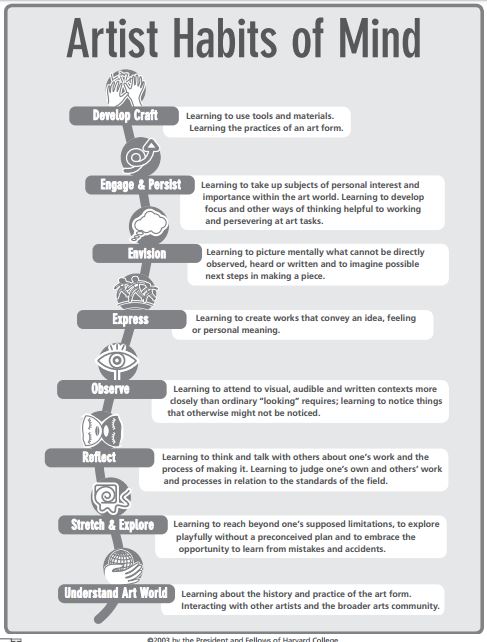
AS WE BEGIN THE WEEK: Look back to page 12 in our folder and rewrite your statement about the Artists Habits of Mind. That is it. I want you to be thinking about the techniques that we, as artists, need to be aware of and focus on as we move forward in our studio practices.

Studio Art 360: Drawing

What was the biggest challenge you found as you began to draw with PENCIL and VALUE last week?

1956-2
Giorgio Morandi – Still Life: http://ahuskofmeaning.com/wp-content/uploads/2012/05/1956-2.jpg

What are 2 difficulties that you had in beginning your drawing today? Remember – DRAWING IS A CHALLENGE – let it be!

Painting: Personal Reflection and Meaning – and PAINT!

ASSIGNMENT – Due at the END of the watercolor painting assignment October 21, 2016: Artists research on ONE of the following artists for imagery, technique, approach: Winslow Homer, Charles Demuth, Thomas Eakins, Edward Hopper, Dong Kingman, Reginald Marsh, Charles Sheeler, J.M.W. Turner, Thomas Moran, Georgia O’Keefe, James Whistler, or Andrew Wyeth.

Looking at the work you have in front you, what are the aspects that you feel TRULY speak about you – socially, culturally, or historically.

watercolor-sample-sheet
My Watercolor Style Sheet – Have you seen the demo videos? Look to the Right and in the VIDEOS of this website!

What was the most challenging part of the first bit of the painting? Watercolor Techniques:


Drawing: Pencils and Paper and NESTS!

Look at your series – What are your thoughts about your techniques / compositions

found-bird-nest
Love the BIRD’S NESTS! http://unschoolrules.com/wp-content/uploads/2012/03/found-bird-nest.jpg

What are you happiest with in regard to your drawings? What are the lessons learned as you create a series of works versus one at a time? 


AP Studio Art: NATURE!

What have you been doing to try and create a work of art inspired by the outside? Where do you see this drawing / artwork going? How are you using the materials from outside to make GREAT ART?

2f98a170074f3e2a60d93038c289dbed1
Let’s visit the website for a few minutes… http://skyspace.rice.edu/ AND http://skyspace.rice.edu/site_media/media/cache/2f/98/2f98a170074f3e2a60d93038c289dbed.png

What have you accomplished in this day of work? What do you need to get accomplished for FRIDAY when your CURRENT BREADTH work is due online? James Turrell: Sky Space: 


#LatePost on #Wednesday

SO SORRY about the lateness of today’s post – Painting a bathroom last night and the evening got away from me. Ok, What’s Next?

#17 Drawing is About Mark Making

“Every mark has a distinct character and quality.Every mark is a signature. Variations in pressure and weight is the visual equivalent of intonation. Marks, or lines, of consistent weight or thickness surrounding a figure or object will flatten the image. Tapering or breaking a line in a curve can connote a highlight or make the curve flow. Also, a tentative line will read as such. Give every mark or line authority and make sure it serves a purpose. Try to use only the marks you need.” 101 Things Learned in Art School, Kit White, 2011, MIT Press

Welcome to National Arts and Humanities Month! Today – VISUAL ARTS!

nahm-2016-31day-challenge-graphic

http://www.americansforthearts.org/events/national-arts-and-humanities-month 

While it is UNCERTAIN where we are exactly in the process of making art at this point, please take a sticky note (or two or three) and place it next to your work – hopefully we are in an unfinished state. Take time and WALK AROUND the studio and comment on your classmates work – complete sentences – and give them the feedback that you would like to receive as a learning artist. Stick these stickers in your folder RIGHT THERE.

Studio Art 360: TECHNOLOGY!

last day on the computer. How do you envision this tool, use of the tools, to be something that could be used as a tool in a future career?

image-from-sculpture-project
Cassidy Baranek and Emma Nisbet “Tempore Lingo” 2016

Looking back on the past 3 weeks of construction, collaboration, and creativity, what is one soft skill and one hard skill (AHOM, NVAS) that you feel you have developed? Explain.


Painting: WATERCOLORS!

What challenges did you have with the watercolors last week when it came to Techniques painting for you?

rowell-002-cover2-lg
Jean Lacy: Collage and CityScape – Social Commentary. https://southernspaces.org/sites/default/files/images/2015/rowell-002-cover2-lg.jpg

ASSIGNMENT: Artists research on ONE of the following artists for imagery, technique, approach: Winslow Homer, Charles Demuth, Thomas Eakins, Edward Hopper, Dong Kingman, Reginald Marsh, Charles Sheeler, J.M.W. Turner, Thomas Moran, Georgia O’Keefe, James Whistler, or Andrew Wyeth

Develop / collect images, consider the ideas about yourself and surroundings. This is going to be a SELF-PORTRAIT of sorts – no that it is going to look like you but rather… the objects and images, surroundings, ideas will be about you.

What are 5 images you gathered today that say something about you?  Jean Lacy – Social Commentary Collage:

Jean Lacy: Images and Tyler Museum of Art Bio

Drawing: NESTS!

3rd day with the ideas of developing compositions – What skills are you looking to develop?

8c933c98529e7fdc5399a3370640ed44
Beautiful use of the NEST idea. What does the idea of NEST mean to you? https://s-media-cache-ak0.pinimg.com/564x/8c/93/3c/8c933c98529e7fdc5399a3370640ed44.jpg

What feedback would you offer and like to get about your work? Elena Ray: 


AP Studio Art: NATURE!

What have you been doing to try and create a work of art inspired by the outside? Where do you see this drawing / artwork going? How are you using the materials from outside to make GREAT ART?

2f98a170074f3e2a60d93038c289dbed
James Turrell: SkySpace: http://skyspace.rice.edu/site_media/media/cache/2f/98/2f98a170074f3e2a60d93038c289dbed.png

What have you accomplished in this day of work? What do you need to get accomplished for FRIDAY when your CURRENT BREADTH work is due online? James Turrell: Sky Space:  WEBSITE: http://skyspace.rice.edu/


#Monday – #Art for EVERYBODY!

#17 Drawing is About Mark Making

“Every mark has a distinct character and quality.Every mark is a signature. Variations in pressure and weight is the visual equivalent of intonation. Marks, or lines, of consistent weight or thickness surrounding a figure or object will flatten the image. Tapering or breaking a line in a curve can connote a highlight or make the curve flow. Also, a tentative line will read as such. Give every mark or line authority and make sure it serves a purpose. Try to use only the marks you need.” 101 Things Learned in Art School, Kit White, 2011, MIT Press

Welcome to National Arts and Humanities Month! Today – VISUAL ARTS!

nahm-2016-31day-challenge-graphic

http://www.americansforthearts.org/events/national-arts-and-humanities-month 

Page 41 – Let’s start here. If you were to receive feedback from your peers about your work, what are 3 things you would benefit from in your studiomates comments about your work. Think about what we went over on page 41 for some inspirational thoughts or ideas to help you come up with what works for you.

Studio Art 360: TECHNOLOGY!

How do you see this site specific sculpture as working with the environment that we looked at from around the building? What are the strengths of the work and what is a weakness?

poam_sculpture_park
What’s your image look like in the sculpture park? http://st-ives.net/selected-art/denarend/pix/poam_sculpture_park.jpg

What is the coolest computer drawing, photography thing you have done with your technology.


Painting: WATERCOLORS!

What techniques do  you remember from your earlier classes about WATERCOLOR PAINTS?

Norham Castle, on the River Tweed circa 1822-3 by Joseph Mallord William Turner 1775-1851
JMW Turner and WATERCOLORS: http://www.tate.org.uk/art/images/work/D/D18/D18148_9.jpg

What difficulties do you see with your painting AT THIS MOMENT?

J.M.W. Turner BIO: http://www.biography.com/people/jmw-turner-40806 


Drawing: NESTS!

What do you see creating a series of drawings can do for a artist that a single drawing would not allow the artist to do?

v.Gogh, Vogelnester - v.Gogh / Bird's nests / 1885 - V.Gogh / Nids d'oiseaux 1885
Van Gogh and the Bird’s Nest! What can you DO?

As you look at your THUMBNAILS and the numerous drawings you have begun, what are the strengths that you are seeing as you move forward? 


AP Studio Art: NATURE!

workofart_edit
Work of Art: ARTtestants! http://images.onset.freedom.com/ocregister/blogs/pedrowatcher.ocregister.com/workofart_edit.jpg

As you look back on the body of works you have created so far, what are TWO things that you are seeing as falling short of AP Level work?

ag_02735
Andy Goldsworthy http://www.goldsworthy.cc.gla.ac.uk/images/l/ag_02735.jpg

What were the biggest impressions you had from going outside for ideas? What were the most difficult things you felt as you presented your work? Conversation between classmates about the 2 questions for your exam. How does this work relate to your concentration? BRING A WARM COAT TOMORROW. 

Andy Goldsworthy Digital Catalogue: http://www.goldsworthy.cc.gla.ac.uk/

#Most #SpiritedTeachers & #Homecoming #Friday in the #ArtStudio

“Art Can Be Anything.” It is not defined by medium or the means of its production, but by a collective sense that it belongs to a category of experiences we have come to know as “art”.”

“101 Things Learned in Art School”, Kit White, 2011, MIT Press

As we wrap up the week – describe how you see this course or the lessons learned in the course as being able to be related to your life outside of this studio space. Consider not the assignments or techniques associated with the assignments, but how you can use those ideas elsewhere in your life.

Studio Art 360: TECHNOLOGY!

last day on the computer. How do you envision this tool, use of the tools, to be something that could be used as a tool in a future career?

ioana_ostrich-1
Installation Art – YOUR work online! http://ioanacolor.com/ART-ostrich/ioana_ostrich-1.jpg

looking back on the past 3 weeks of construction, collaboration, and creativity, what is one soft skill and one hard skill (AHOM, NVAS) that you feel you have developed? Explain.


Painting: WATERCOLORS this week!

Are there aspects of painting that you are hoping to develop? What do you really hope to learn / experience in the making of the watercolors?

Norham Castle, on the River Tweed circa 1822-3 by Joseph Mallord William Turner 1775-1851
JMW Turner and WATERCOLORS: http://www.tate.org.uk/art/images/work/D/D18/D18148_9.jpg

What two things did you struggle with today in your painting (or paintings)? AT THIS MOMENT?

J.M.W. Turner BIO: http://www.biography.com/people/jmw-turner-40806

Turner Norham Castle on the River Tweed Above 


Drawing: Van Gogh’s Bird Nests – in PENCIL

What do you see creating a series of drawings can do for a artist that a single drawing would not allow the artist to do?

v.Gogh, Vogelnester - v.Gogh / Bird's nests / 1885 - V.Gogh / Nids d'oiseaux 1885
Van Gogh and the Bird’s Nest! What can you DO?

As you look at your THUMBNAILS and the numerous drawings you have begun, what are the strengths that you are seeing as you move forward?


AP Studio Art: Work of Art – NATURE

When you look to INSPIRATION… What is it that you draw your ideas from?

workofart_edit
Work of Art: CAST: http://images.onset.freedom.com/ocregister/blogs/pedrowatcher.ocregister.com/workofart_edit.jpg

Who do YOU think is on the OUTS? What might be worth your while as you visit the out doors next week?