Mr. Korb Goes to Washington. Seriously. This Tuesday.

 “I believe arts education in music, theater, dance, and the visual arts is one of the most creative ways we have to find the gold that is buried just beneath the surface. They (children) have an enthusiasm for life a spark of creativity, and vivid imaginations that need training – training that prepares them to become confident young men and women.”

– Richard W. Riley, Former US Secretary of Education

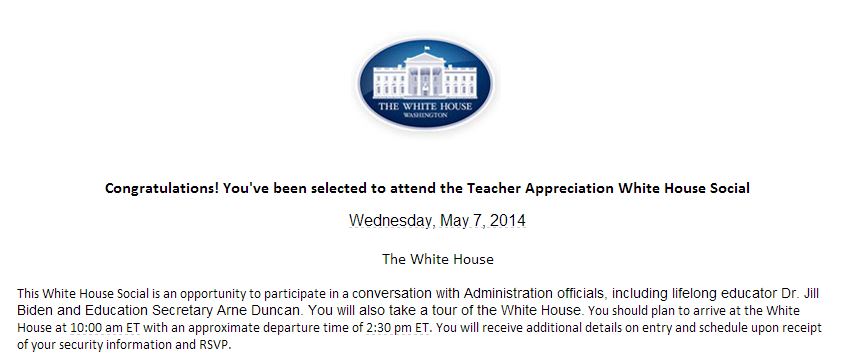
White House Invitation

I have never seen “Mr. Smith Goes to Washington” but perhaps this weekend it should be on my list of films tho watch. On Wednesday, May 6, I, along with 19 other teachers from around the country will be at the Teacher Appreciation Social in Washington D.C. at the White House. This is an opportunity to talk education with the his White House Social is an opportunity to participate in a conversation with Administration officials, including lifelong educator Dr. Jill Biden and Education Secretary Arne Duncan. We will also have the opportunity to get a tour of the White House.

Did I set some lofty Goals this year? You bet! Did I sit and reflectas tho my progress… you bet, ask my wife. Was this one of them? Not quite, but how can it get any better? Thanks to all the White House Executive staff who looked overt the applications and choose mine. I will do my school, fellow teachers, and administrators, and most importantly many students proud. I will follow up later this week with photographs… I hope.

Thank you to my loving wife Julie and daughter Abby for all their support this year and all my years.

Frank

“The future belongs to young people with an education and the imagination to create.”

–President Barack Obama

What Students Really Need to Hear

Chase Mielke's avatarAFFECTIVE LIVING

It’s 4 a.m.  I’ve struggled for the last hour to go to sleep.  But, I can’t.  Yet again, I am tossing and turning, unable to shut down my brain.  Why?  Because I am stressed about my students.  Really stressed.  I’m so stressed that I can only think to write down what I really want to say — the real truth I’ve been needing to say — and vow to myself that I will let my students hear what I really think tomorrow.

This is what students really need to hear:

First, you need to know right now that I care about you. In fact, I care about you more than you may care about yourself.  And I care not just about your grades or your test scores, but about you as a person. And, because I care, I need to be honest with you. Do I have permission to be…

View original post 765 more words

Use of GOALS in the Day to Day

Please, read through and give me your thoughts. Goals are a huge part of attaining any desired accomplishment – bug or small. Thank you for your time and thoughts!
Frank

The Art Student (and the lessons you can learn)

“I am interested in art as a means of living a life; not as a means of making a living.” ― Robert Henri

What a great day at the Milwaukee Art Museum. It has been FAR too long. Oh to get back into the looking at the visual arts (and a lot of it at that). I was very happy to have changed my approach and began with the European Art from the Baroque era and worked my way forward. Of course, I ended in the Bradley Collection with a look at the Alex Katz painting of “Sunny” but… it wouldn’t be a trip to MAM if I didn’t end there.

As an art teacher, I look to Robert Henri as one of THE art teachers to look up to. Color Theory, Art Theory, Aesthetics, History, Art Making… if one knows me, the ideas behind the art are as (if not more) important than the final product itself. Here you go… and if you are an art student, her you are…

10 Things the Arts Teach Students

1. The arts teach children to make good judgments about qualitative relationships.
Unlike much of the curriculum in which correct answers and rules prevail, in the arts, it
is judgment rather than rules that prevail.

2. The arts teach children that problems can have more than one solution
and that questions can have more than one answer.

3. The arts celebrate multiple perspectives.
One of their large lessons is that there are many ways to see and interpret the world.

4. The arts teach children that in complex forms of problem solving
purposes are seldom fixed, but change with circumstance and opportunity.
Learning in the arts requires the ability and a willingness to surrender to the unanticipated possibilities of the work as it unfolds.

5. The arts make vivid the fact that neither words in their literal form nor numbers exhaust what we can know. The limits of our language do not define the limits of our cognition.

6. The arts teach students that small differences can have large effects.
The arts traffic in subtleties.

7. The arts teach students to think through and within a material.
All art forms employ some means through which images become real.

8. The arts help children learn to say what cannot be said.
When children are invited to disclose what a work of art helps them feel, they must reach into their poetic capacities to find the words that will do the job.

9. The arts enable us to have experience we can have from no other source
and through such experience to discover the range and variety of what we are capable of feeling.

10. The arts’ position in the school curriculum symbolizes to the young
what adults believe is important.