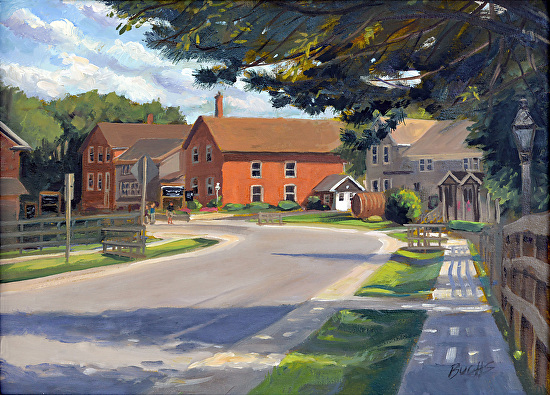
Plein Air Painting: Last day out there! What are you doing? How do you WRAP IT UP?
Matt working on a LONG VIEW of Wadewitz.
Mikayla enjoying the ease of watercolors in downtown Waterford.
Kelsey on the path to great paintings – well path to Rochester at least.
Sammy working at the local coffee shop – well, not making coffee – making great art.
Mary capturing the waterfront by the library in Waterford.
NVAS: 7.1P: 6.1P: Analyze and describe the impact that an exhibition or collection has on personal awareness of social, cultural, or political beliefs and understandings.
Question to begin with: Yesterday you thought about how your 4 weeks of painting have changed your views, maybe even enhanced your view of Waterford. As you continue through the art making experiences, I hope that the “artist’s eye” has really begun to open up in you. No question today… no deep reflection right now… just take an opportunity to consider that idea of “artist’s eye.” I think about it in how we, as artists, see the world through a different set of lenses than others. Please continue working through your painting today and look through those “artist’s eyes.” I lied… How are you seeing things differently today than you were 4 weeks ago.
Thank you for ALL your hard work over these past 4 weeks. Continue to be focused and WORK on your WORK. There is nothing better than working on work to get better at making work. You have all had great successes as well as aspects of the work that has been, well, not so successful – failure may be the better word.
NVAS: 7.1P: Hypothesize ways in which art influences perception and understanding of human experiences.
Question to begin with: How have you changed your views of Waterford and the surrounding areas over the past four weeks? Please explain your answer. How do you feel your VIEWERS will think about Waterford based on the images you have created? Why?
End of the Day (CLASS) Reflection (use Google Drive to answer this one): TONIGHT… Think about ALL that we have done these past four weeks. Stop and consider EVERYTHING that you have learned from these experiences. I am concerned about the experiences and opportunities you have had, taken, made, experienced… all of it. With a one page paper (Google Drive: Share it with fkorb@waterforduhs.k12.wi.us, 12 point font, Times New Roman, Double Spaced, Standard Margins) and write out three paragraphs. First paragraph – is about all that you were hoping to learn and experience in the course. Second paragraph is about WHAT you REALLY learned and experienced (allow yourself to use you past reflections and writing as well as examples of artwork from your body of work to better explain yourself). Final paragraph is a concluding statement – what you hope to continue doing, using, experimenting, exploring, etc… with your artwork. It doesn’t matter if you EVER paint en plein air again, this experience is going to put you over the top! Top of the paper – CENTERED and BOLD – type: Your First and Last name and then under it type Artist’s Statement. Like this:
NVAS: 7.1P: Hypothesize ways in which art influences perception and understanding of human experiences.
Question to begin with: What three things do you see about the beginning of you LAST painting as successful? WHY? What are two things you need to REALLY focus on today? WHY? What is ONE thing you hope to accomplish today while you are out and about painting? WHY? How will ANY of this drive you forward in the creation of your work?
End of the Day Reflection (use the back of this page for more reflection space): Analyze the ELEMENTS That you are setting up as being the emphasis of your painting. How would you use sentences to DESCRIBE how you are using those elements to create a successful composition? WHY does that work for you? SECONDLY – REFLECT on your thoughts from yesterday about WHY you took / WHAT you were hoping to learn from this course. Now… at this point in the course, what HAVE you learned / taken away / appreciated / other thoughts about the course and YOUR WORK – your learning. WEDNESDAY NIGHT’S HOMEWORK – Write up a ONE PAGE (double spaced, Times New Roman, 12 point). You can create it in GOOGLE DRIVE and SHARE it with me… or bring it printed. Google Drive is BEST though. I can make changes, edit, proof, format it… Let me know if you have questions.
Spotlight on Tony Robinson today! Look at hos brush strokes! Look at his use of COLOR! Look at the Shapes!
NVAS:2.1P: Engage in making a work of art or design without having a preconceived plan.
Question to begin with: Thinking on LAST WEEK’S ONE Acrylic Painting (now stop and really think about it) – SERIOUSLY – what are the biggest challenges you had with the ONE painting? Write out 3 things you were challenged with and then take the time to write out how you solved the issues. 3 things… 3 solutions… How will you use that as you move into the LAST FEW DAYS of painting?
End of the Day Reflection (use the back of this page for more reflection space): Describe what you have in your painting. Take the time to LIST everything that you have in today’s work. This is going to help you get some good reflection going here. SECONDLY – To begin with an artist statement: What are two things that you were / are hoping to take away / learn from these four weeks of class. This is in complete sentences and have an opening statement and supporting sentences to back it up. (Use the BACK of this page to write this out. This will be TRANSFERRED to digital / computer at the end of the week.)
What a GREAT 3 weeks we have had. One week to go – one more painting. While we were able to get a painting a day (for the most part done with watercolors, the acrylics seem to take a lot longer. I am VERY proud of the work of my students. The work they have been producing, the lessons they are learning, the techniques they are experimenting with. Successes and failures abound, but in the end, the experiences are why these five are taking the time out of their valuable (and fun filled) summer. Thanks all!
Mikayla enjoying the ease of watercolors in downtown Waterford.
Kelsey on the path to great paintings – well path to Rochester at least.
NVAS: 1.2P: Shape an artistic investigation of an aspect of present-day life using a contemporary practice of art or design.
Question to begin with: What did the painting of the complementary colors do for your painting? How does the underpainting help the composition (or is it hindering the painting)? What do you look forward to as you head out today? What does working in the town do DIFFERENTLY for you than painting out in the nature?
What are your TOP 3 learning experiences from this week? What are 2 things you would like to focus on next week – our last week together? What is ONE thing you would share with your classmates (current or future) about the process of painting?
NVAS: 6.1P: Analyze and describe the impact that an exhibition or collection has on personal awareness of social, cultural, or political beliefs and understandings.
Question to begin with: What is a strength of your first (and second?) acrylic painting? Let’s plan on accomplishing TWO paintings this week. Go into a bit of REFLECTION about the painting with acrylics. What are you enjoying – ONE THING about working with acrylics and then SENTENCES describing why.
How were you able to make successful use of the thickness of the acrylics versus the transparency of the watercolors? After a couple of days using the easels (for those who haven’t) how does it work DIFFERENTLY than painting in your lap – on a board?
NVAS: 1.1P: Use multiple approaches to begin creative endeavors.
Question to begin with: What are three aspects of Plein Air Painting you feel are enjoyable? What are two challenges that you face with painting outdoors? What is one thing that you will remember about the class when school starts up again?
How was using acrylics hugely different than using watercolors – now that you have had a chance to actually go out and paint? What was it like painting out in plain view of others? Did anyone talk to you about your images? The class? What are your public speaking skills like? Why did it seem so different than being out in nature?
NVAS: 1.2P: Shape an artistic investigation of an aspect of present-day life using a contemporary practice of art or design.
Question to begin with: What are three aspects of Plein Air Painting you feel are enjoyable? What are two challenges that you face with painting outdoors? What is one thing that you will remember about the class when school starts up again?
What challenges (3) do you think that acrylics will pose DIFFERENTLY than watercolors did? What 2 benefits do you think acrylics will offer you over watercolors?
Aspects of Creative Thinking are not usually Taught
You are creative. The artist is not a special person, each one of us is a special kind of artist. Every one of us is born a creative, spontaneous thinker. The only difference between people who are creative and people who are not is a simple belief. Creative people believe they are creative. People who believe they are not creative, are not. Once you have a particular identity and set of beliefs about yourself, you become interested in seeking out the skills needed to express your identity and beliefs. This is why people who believe they are creative become creative. If you believe you are not creative, then there is no need to learn how to become creative and you don’t. The reality is that believing you are not creative excuses you from trying or attempting anything new. When someone tells you that they are not creative, you are talking to someone who has no interest and will make no effort to be a creative thinker.
Creative thinking is work. You must have passion and the determination to immerse yourself in the process of creating new and different ideas. Then you must have patience to persevere against all adversity. All creative geniuses work passionately hard and produce incredible numbers of ideas, most of which are bad. In fact, more bad poems were written by the major poets than by minor poets. Thomas Edison created 3000 different ideas for lighting systems before he evaluated them for practicality and profitability. Wolfgang Amadeus Mozart produced more than six hundred pieces of music, including forty-one symphonies and some forty-odd operas and masses, during his short creative life. Rembrandt produced around 650 paintings and 2,000 drawings and Picasso executed more than 20,000 works. Shakespeare wrote 154 sonnets. Some were masterpieces, while others were no better than his contemporaries could have written, and some were simply bad.
You must go through the motions of being creative. When you are producing ideas, you are replenishing neurotransmitters linked to genes that are being turned on and off in response to what your brain is doing, which in turn is responding to challenges. When you go through the motions of trying to come up with new ideas, you are energizing your brain by increasing the number of contacts between neurons. The more times you try to get ideas, the more active your brain becomes and the more creative you become. If you want to become an artist and all you did was paint a picture every day, you will become an artist. You may not become another Vincent Van Gogh, but you will become more of an artist than someone who has never tried.
Your brain is not a computer. Your brain is a dynamic system that evolves its patterns of activity rather than computes them like a computer. It thrives on the creative energy of feedback from experiences real or fictional. You can synthesize experience; literally create it in your own imagination. The human brain cannot tell the difference between an “actual” experience and an experience imagined vividly and in detail. This discovery is what enabled Albert Einstein to create his thought experiments with imaginary scenarios that led to his revolutionary ideas about space and time. One day, for example, he imagined falling in love. Then he imagined meeting the woman he fell in love with two weeks after he fell in love. This led to his theory of acausality. The same process of synthesizing experience allowed Walt Disney to bring his fantasies to life.
There is no one right answer. Reality is ambiguous. Aristotle said it is either A or not-A. It cannot be both. The sky is either blue or not blue. This is black and white thinking as the sky is a billion different shades of blue. A beam of light is either a wave or not a wave (A or not-A). Physicists discovered that light can be either a wave or particle depending on the viewpoint of the observer. The only certainty in life is uncertainty. When trying to get ideas, do not censor or evaluate them as they occur. Nothing kills creativity faster than self-censorship of ideas while generating them. Think of all your ideas as possibilities and generate as many as you can before you decide which ones to select. The world is not black or white. It is grey.
Never stop with your first good idea. Always strive to find a better one and continue until you have one that is still better. In 1862, Phillip Reis demonstrated his invention which could transmit music over the wires. He was days away from improving it into a telephone that could transmit speech. Every communication expert in Germany dissuaded him from making improvements, as they said the telegraph is good enough. No one would buy or use a telephone. Ten years later, Alexander Graham Bell patented the telephone. Spencer Silver developed a new adhesive for 3M that stuck to objects but could easily be lifted off. It was first marketed as a bulletin board adhesive so the boards could be moved easily from place to place. There was no market for it. Silver didn’t discard it. One day Arthur Fry, another 3M employee, was singing in the church’s choir when his page marker fell out of his hymnal. Fry coated his page markers with Silver’s adhesive and discovered the markers stayed in place, yet lifted off without damaging the page. Hence the Post-it Notes were born. Thomas Edison was always trying to spring board from one idea to another in his work. He spring boarded his work from the telephone (sounds transmitted) to the phonograph (sounds recorded) and, finally, to motion pictures (images recorded).
Expect the experts to be negative. The more expert and specialized a person becomes, the more their mindset becomes narrowed and the more fixated they become on confirming what they believe to be absolute. Consequently, when confronted with new and different ideas, their focus will be on conformity. Does it conform with what I know is right? If not, experts will spend all their time showing and explaining why it can’t be done and why it can’t work. They will not look for ways to make it work or get it done because this might demonstrate that what they regarded as absolute is not absolute at all. This is why when Fred Smith created Federal Express, every delivery expert in the U.S. predicted its certain doom. After all, they said, if this delivery concept was doable, the Post Office or UPS would have done it long ago.
Trust your instincts. Don’t allow yourself to get discouraged. Albert Einstein was expelled from school because his attitude had a negative effect on serious students; he failed his university entrance exam and had to attend a trade school for one year before finally being admitted; and was the only one in his graduating class who did not get a teaching position because no professor would recommend him. One professor said Einstein was “the laziest dog” the university ever had. Beethoven’s parents were told he was too stupid to be a music composer. Charles Darwin’s colleagues called him a fool and what he was doing “fool’s experiments” when he worked on his theory of biological evolution. Walt Disney was fired from his first job on a newspaper because “he lacked imagination.” Thomas Edison had only two years of formal schooling, was totally deaf in one ear and was hard of hearing in the other, was fired from his first job as a newsboy and later fired from his job as a telegrapher; and still he became the most famous inventor in the history of the U.S.
There is no such thing as failure. Whenever you try to do something and do not succeed, you do not fail. You have learned something that does not work. Always ask “What have I learned about what doesn’t work?”, “Can this explain something that I didn’t set out to explain?”, and “What have I discovered that I didn’t set out to discover?” Whenever someone tells you that they have never made a mistake, you are talking to someone who has never tried anything new.
You do not see things as they are; you see them as you are. Interpret your own experiences. All experiences are neutral. They have no meaning. You give them meaning by the way you choose to interpret them. If you are a priest, you see evidence of God everywhere. If you are an atheist, you see the absence of God everywhere. IBM observed that no one in the world had a personal computer. IBM interpreted this to mean there was no market. College dropouts, Bill Gates and Steve Jobs, looked at the same absence of personal computers and saw a massive opportunity. Once Thomas Edison was approached by an assistant while working on the filament for the light bulb. The assistant asked Edison why he didn’t give up. “After all,” he said, “you have failed 5000 times.” Edison looked at him and told him that he didn’t understand what the assistant meant by failure, because, Edison said, “I have discovered 5000 things that don’t work.” You construct your own reality by how you choose to interpret your experiences.
Always approach a problem on its own terms. Do not trust your first perspective of a problem as it will be too biased toward your usual way of thinking. Always look at your problem from multiple perspectives. Always remember that genius is finding a perspective no one else has taken. Look for different ways to look at the problem. Write the problem statement several times using different words. Take another role, for example, how would someone else see it, how would Jay Leno, Pablo Picasso, George Patton see it? Draw a picture of the problem, make a model, or mold a sculpture. Take a walk and look for things that metaphorically represent the problem and force connections between those things and the problem (How is a broken store window like my communications problem with my students?) Ask your friends and strangers how they see the problem. Ask a child. How would a ten year old solve it? Ask a grandparent. Imagine you are the problem. When you change the way you look at things, the things you look at change.
Learn to think unconventionally. Creative geniuses do not think analytically and logically. Conventional, logical, analytical thinkers are exclusive thinkers which means they exclude all information that is not related to the problem. They look for ways to eliminate possibilities. Creative geniuses are inclusive thinkers which mean they look for ways to include everything, including things that are dissimilar and totally unrelated. Generating associations and connections between unrelated or dissimilar subjects is how they provoke different thinking patterns in their brain. These new patterns lead to new connections which give them a different way to focus on the information and different ways to interpret what they are focusing on. This is how original and truly novel ideas are created. Albert Einstein once famously remarked “Imagination is more important than knowledge. For knowledge is limited to all we now know and understand, while imagination embraces the entire world, and all there ever will be to know and understand.”
And, finally, Creativity is paradoxical. To create, a person must have knowledge but forget the knowledge, must see unexpected connections in things but not have a mental disorder, must work hard but spend time doing nothing as information incubates, must create many ideas yet most of them are useless, must look at the same thing as everyone else, yet see something different, must desire success but embrace failure, must be persistent but not stubborn, and must listen to experts but know how to disregard them.- See more at: http://www.creativitypost.com/create/twelve_things_you_were_not_taught_in_school_about_creative_thinking#sthash.ldO1JQvB.dpuf



 Art With Korb